Muslim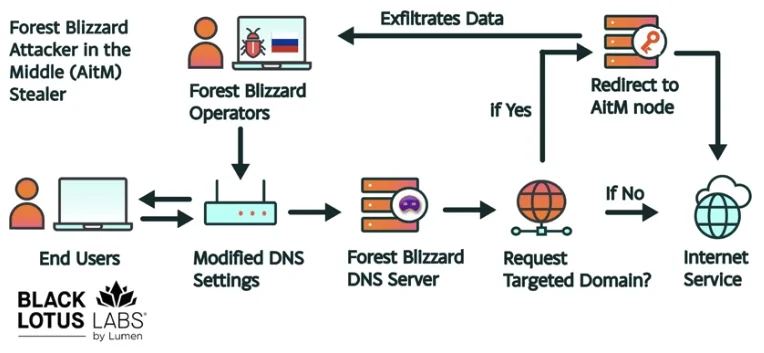
In a chilling demonstration of "low-tech" espionage, Russian state-sponsored hackers have successfully compromised over 18,000 networks globally, siphoning sensitive authentication tokens from Microsoft Office users without ever deploying a single line of malicious code. The campaign, which represents a masterclass in exploiting the overlooked vulnerabilities of aging infrastructure, has been attributed to the notorious threat actor known as "Forest Blizzard"—a group historically tied to the GRU, Russia’s military intelligence agency.
By pivoting away from complex malware and toward the exploitation of legacy hardware, the hackers have exposed a critical blind spot in modern cybersecurity: the invisible, unpatched, and often forgotten Small Office/Home Office (SOHO) routers that serve as the front doors to thousands of government agencies, law enforcement departments, and private corporations.
The Anatomy of the Campaign: A Stealthy DNS Hijack
The campaign, analyzed extensively by researchers at Black Lotus Labs, a division of the internet backbone provider Lumen, relies on a deceptively simple technique: DNS hijacking. Rather than attempting to break through hardened enterprise firewalls or sophisticated endpoint detection systems, Forest Blizzard targeted the "weakest link" in the networking chain—outdated routers from manufacturers like Mikrotik and TP-Link.
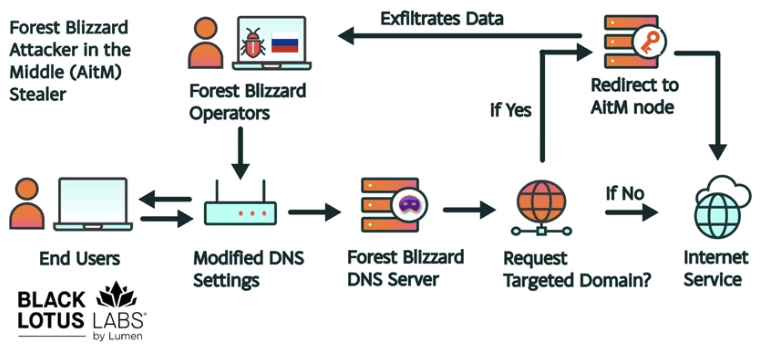
These devices, many of which are end-of-life (EOL) and no longer receive security updates, often contain known, unpatched vulnerabilities. Using these flaws, the attackers gained administrative access to the routers. Once inside, they did not install persistent malware that could be flagged by antivirus software. Instead, they simply modified the router’s Domain Name System (DNS) configuration.
DNS acts as the phonebook of the internet, translating human-readable website names (like outlook.office.com) into machine-readable IP addresses. By forcing the routers to use attacker-controlled DNS servers, the GRU operatives could redirect traffic at will. When a user on an affected network attempted to access their Microsoft account, the router steered them toward a malicious infrastructure designed to perform an Adversary-in-the-Middle (AiTM) attack.
Because this interception occurred at the network level, the attackers were able to capture OAuth authentication tokens. Crucially, these tokens are typically issued only after a user has successfully navigated the login process, including multi-factor authentication (MFA). By stealing the token post-authentication, the hackers effectively bypassed the very security measures designed to keep them out, granting them unfettered access to sensitive email and cloud resources.
Chronology of a Shadow Operation
The evolution of this campaign highlights the adaptability of state-sponsored actors when faced with public scrutiny.
- August 2025: The U.K.’s National Cyber Security Centre (NCSC) issued an advisory warning of APT28’s (Forest Blizzard) use of router-based malware to conduct espionage. At this stage, the group’s operations were highly targeted and relied on complex software payloads.
- Post-August 2025: Immediately following the NCSC report, the group pivoted. Recognizing that their malware-heavy approach was being detected, they shifted to the "graybeard" method of DNS hijacking. The operation transitioned from surgical strikes to a mass-harvesting model.
- December 2025: The espionage dragnet reached its peak intensity, with over 18,000 routers—including those belonging to foreign ministries and third-party service providers—ensnared in the infrastructure.
- April 2026: Microsoft officially acknowledged the scale of the compromise, identifying over 200 organizations and 5,000 consumer devices caught in the web, prompting a global security alert.
Supporting Data: The "SOHO" Security Crisis
The data provided by Black Lotus Labs paints a grim picture of the current state of edge-device security. According to Black Lotus Security Engineer Ryan English, the lack of "sexiness" in the attack is precisely what made it so effective.
"Everyone is looking for some sophisticated malware to drop something on your mobile devices," English noted. "These guys didn’t use malware. They did this in an old-school, graybeard way that isn’t really sexy but it gets the job done."
The impact of this campaign is reflected in the profile of the victims. The hackers were not interested in casual internet browsing; they prioritized government ministries, law enforcement agencies, and entities managing sensitive communication channels. By targeting SOHO devices, they were able to bypass the "perimeter defense" mindset that dominates most organizations. While an organization might spend millions on enterprise-grade security for their data centers, the remote employee working from home on a five-year-old, unpatched router remains an open door to the corporate network.
Official Responses and the Regulatory Fallout
The severity of the Forest Blizzard campaign has forced a massive shift in how regulators view consumer-grade hardware. On March 23, 2026, the U.S. Federal Communications Commission (FCC) issued a landmark ruling: the commission announced it would no longer certify consumer-grade internet routers manufactured outside of the United States.
This policy represents a dramatic escalation in the "technological decoupling" between the U.S. and foreign hardware manufacturers. The FCC justified the move by stating that foreign-made, poorly secured routers represent an "untenable national security threat." The commission warned that these devices could be leveraged to "immediately and severely disrupt U.S. critical infrastructure."
Industry experts have expressed skepticism regarding the feasibility of this policy. With the vast majority of global router manufacturing centralized in Asia, the U.S. market faces a potential supply chain crisis. Under the new rules, manufacturers may seek "conditional approval" through the Department of Defense or the Department of Homeland Security, but the path to compliance remains unclear for most consumer electronics firms.
Microsoft, for its part, has intensified its push for "Zero Trust" architectures. In their technical blog, the software giant emphasized that because AiTM attacks can intercept TLS-encrypted traffic by subverting the underlying DNS, organizations must move away from relying on network-level trust.
Strategic Implications: A New Era of Espionage
The Forest Blizzard campaign serves as a stark reminder that the "Internet of Things" (IoT) is effectively the "Internet of Vulnerabilities." As attackers refine their ability to manipulate the fundamental protocols of the internet—like DNS—the focus of cybersecurity must shift from protecting the device to protecting the identity and the data flow.
1. The Death of the Perimeter
The reliance on SOHO hardware for remote work has permanently eroded the concept of a secure office perimeter. When a home router is compromised, the corporate VPN or cloud-based authentication system is only as secure as the ISP-provided or store-bought router in the employee’s living room.
2. The Return of Legacy Exploits
State actors are increasingly looking backward. By utilizing known vulnerabilities in older hardware, they avoid the "cat-and-mouse" game of signature-based malware detection. These "living-off-the-land" techniques—where attackers use legitimate system functions (like DNS settings) for malicious purposes—are notoriously difficult to detect.
3. Regulatory Hardening
The FCC’s recent move suggests that the era of "unregulated connectivity" is ending. National security is now being directly tied to the hardware supply chain, with governments moving to mandate that critical communication infrastructure be vetted for backdoors and inherent design flaws.
4. The Challenge for Enterprise IT
Organizations must now grapple with the reality that they are responsible for the security posture of their employees’ home environments. This may lead to the adoption of "Corporate-Managed Edge" devices, where companies mandate that remote employees use hardware provided and strictly patched by the organization, effectively reclaiming the perimeter.
As we move deeper into 2026, the Forest Blizzard operation stands as a testament to the persistent threat posed by Russian military intelligence. Their ability to turn thousands of household routers into a massive, global spying apparatus highlights a vulnerability that is not just technological, but structural. Until the global community addresses the lifecycle of end-of-life hardware and the inherent insecurity of basic networking protocols, the "graybeard" methods of yesterday will continue to pose the most significant threats of tomorrow.


 Sagoh
Sagoh
 Nana Wu