Ali Ikhwan
The landscape of cybercrime is defined by a relentless cat-and-mouse game between security researchers and threat actors. Few entities demonstrate this persistence as clearly as the operators behind Tycoon2FA. Despite significant international disruption efforts in early 2026, the Phishing-as-a-Service (PhaaS) platform has not only recovered but has aggressively evolved. New research from eSentire reveals that the kit has integrated sophisticated OAuth 2.0 device-code phishing tactics, weaponizing legitimate infrastructure to bypass traditional security perimeters and hijack Microsoft 365 accounts with alarming efficiency.
The Evolution of Tycoon2FA: A Brief Chronology
The journey of Tycoon2FA is a testament to the "resilience of evil" in the digital age. For months, the platform served as a cornerstone for attackers targeting corporate credentials, utilizing a sophisticated relay system to circumvent multi-factor authentication (MFA).
The March 2026 Takedown
In March 2026, a coordinated effort by international law enforcement agencies, led by Europol, successfully disrupted the Tycoon2FA platform. The operation was hailed as a significant victory, aimed at dismantling the infrastructure that powered a wide array of phishing campaigns. However, the victory proved to be temporary.
The Rapid Rebound
By April 2026, analysts at Abnormal Security observed that the infrastructure had been entirely rebuilt. The operators proved highly agile, not only restoring previous functionality but immediately implementing new layers of obfuscation designed to thwart future disruption attempts. The rapid return to pre-takedown activity levels underscores the decentralized and modular nature of modern PhaaS platforms, which are often immune to single-point-of-failure takedowns.
The Adoption of OAuth Device-Code Flows
In late April and early May 2026, the threat actors behind Tycoon2FA shifted their strategy. Recognizing that traditional credential harvesting was facing increased friction from MFA-hardened environments, they pivoted to "device-code phishing." This technique, which has seen a 37-fold increase in usage this year according to Push Security, represents a significant escalation in threat sophistication.
Anatomy of the Attack: Weaponizing Trustifi and OAuth
The current iteration of the Tycoon2FA kit is a masterclass in obfuscation. The attack chain is meticulously designed to appear legitimate to both the user and the automated security filters that guard corporate environments.
The Delivery Chain
The attack begins with a lure email, typically themed as an urgent invoice. Embedded within this email is a link to a legitimate Trustifi click-tracking URL. Trustifi, a reputable email security platform, is being abused by the attackers as a "proxy" to lend legitimacy to their malicious links. Because the traffic originates from a trusted security provider, it often sails through email gateways that might otherwise flag suspicious URLs.

From the Trustifi landing page, the traffic is routed through a complex delivery chain involving Cloudflare Workers and several layers of obfuscated JavaScript. This four-layer in-browser process is designed to filter out security researchers and automated analysis tools.
The OAuth Device-Code Trap
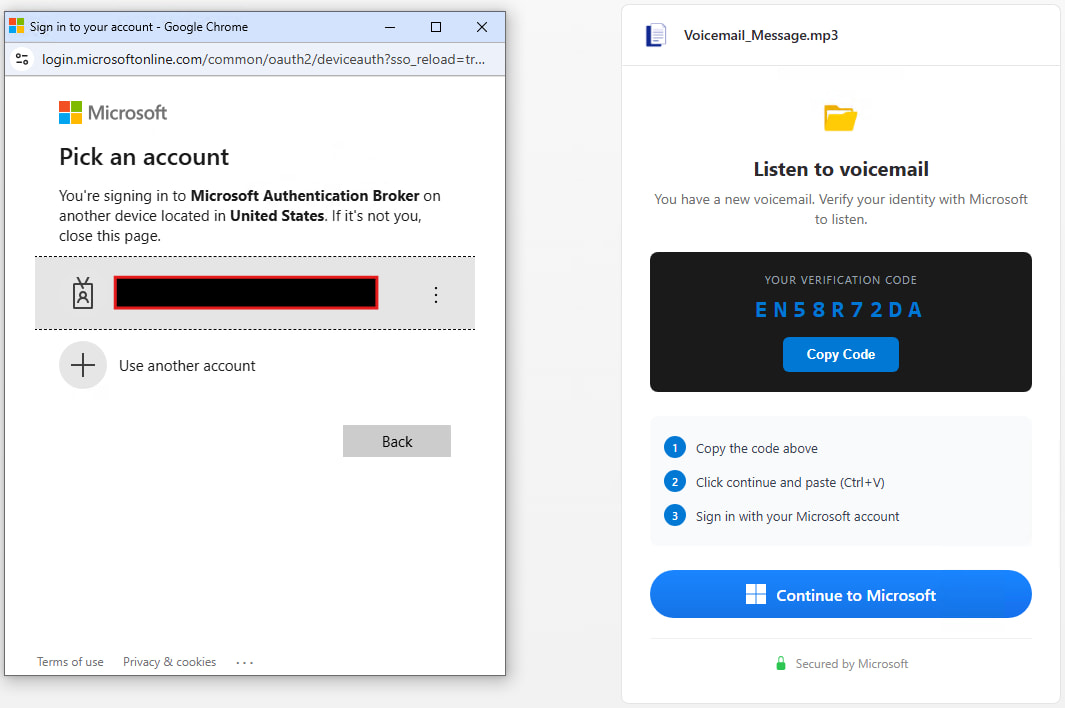
Once the victim reaches the final, malicious page—often a convincing spoof of a Microsoft CAPTCHA or login portal—the real deception begins. The phishing kit retrieves a legitimate Microsoft OAuth device code from the attacker’s backend. The user is then instructed to navigate to microsoft.com/devicelogin and enter the code.
By entering the code, the user is unknowingly authorizing a device controlled by the attacker. Because the user is completing the process on the official Microsoft domain, their browser and security software perceive the interaction as entirely benign. Once the victim completes their standard MFA process, Microsoft issues OAuth access and refresh tokens directly to the attacker’s device.
Persistent, Unrestricted Access
With these tokens in hand, the attacker no longer needs the user’s password or their MFA device. They have gained "persistent access" to the victim’s Microsoft 365 environment. This allows them to siphon emails, browse cloud file storage, monitor calendars, and potentially launch secondary attacks—such as Business Email Compromise (BEC)—from within the compromised account.
Supporting Data: Why Device-Code Phishing is Surging
The shift to device-code phishing is not an isolated trend; it is a global phenomenon. Proofpoint and Push Security have both documented a staggering rise in this specific tactic.
Security Bypass Mechanics
Traditional MFA is designed to stop unauthorized logins. However, device-code phishing exploits the "Authorization Grant" flow intended for headless devices (like smart TVs or printers). Because the user is the one performing the authentication on a legitimate portal, the platform treats the request as a valid authorization of a new device. It is a psychological exploit that bypasses the intent of MFA while satisfying its technical requirements.
Infrastructure Resilience
The Tycoon2FA kit includes a robust "anti-analysis" engine. eSentire researchers noted that the kit maintains a blocklist of over 230 vendor names, including security firms, cloud providers, and AI crawlers. If the kit detects a request coming from an environment that looks like a sandbox or an automated scanner (using tools like Selenium, Playwright, or Burp Suite), it immediately redirects the traffic to a legitimate Microsoft page, effectively "hiding in plain sight."
Defensive Implications: How to Protect Your Organization
The sophistication of Tycoon2FA presents a significant challenge for Security Operations Centers (SOCs). Standard perimeter defenses are largely ineffective against a threat that leverages legitimate Microsoft services to establish its foothold.
Strategic Recommendations
eSentire and other cybersecurity experts recommend a multi-layered defensive strategy:
- Restrict OAuth Flows: Disable the OAuth device-code flow for users who do not explicitly require it. This is the single most effective way to neutralize this specific attack vector.
- Strict Consent Policies: Enforce policies that require administrative approval for third-party applications requesting access to user data.
- Continuous Access Evaluation (CAE): Implement CAE to ensure that token validity is constantly checked against security policies, allowing for the revocation of access in near real-time if suspicious activity is detected.
- Device Compliance: Enforce strict device access policies. If a device is not managed or does not meet compliance standards, it should be denied access to sensitive resources.
Monitoring and Detection
Defenders should shift their focus toward behavioral indicators:
- Entra Log Analysis: Monitor for
deviceCodeauthentication events that correlate with unusual user agents, particularly those associated with Node.js or suspicious browser configurations. - MFA Logs: Look for discrepancies between the device attempting the login and the device where the MFA challenge was solved.
- IOCs: Security teams should proactively ingest the Indicators of Compromise (IoCs) provided by researchers like eSentire into their SIEM/XDR platforms.
The "Validation Gap": A Broader Warning
The resurgence of Tycoon2FA serves as a stark reminder of the "validation gap." As highlighted by recent industry reports, many organizations rely on automated penetration testing tools that only verify if an attacker can move through a network. However, these tools often fail to answer whether existing security controls—such as MFA policies, conditional access, and detection rules—actually hold up against real-world, human-operated phishing campaigns.
In the case of Tycoon2FA, the "network" wasn’t the target; the trust relationship between the user and their identity provider was. Organizations must move beyond static testing and embrace "threat-informed defense," where security controls are continuously validated against the latest tactics, techniques, and procedures (TTPs) used by groups like the operators of Tycoon2FA.
Conclusion
The evolution of Tycoon2FA confirms that even the most successful law enforcement operations can only provide temporary respite. As long as there is profit to be made from hijacked Microsoft 365 accounts, threat actors will continue to refine their craft, moving toward increasingly clever methods of social engineering and technical obfuscation.
For the modern enterprise, security is no longer just about keeping attackers out; it is about assuming they will get in and ensuring they have no path to escalate their privileges or exfiltrate data. By understanding the mechanics of the Tycoon2FA device-code phishing attack, organizations can better configure their environments to resist the next wave of identity-focused threats. The "Tycoon" may have been disrupted, but the platform’s return is a clear signal that the era of identity-based phishing is only just beginning.


 Sagoh
Sagoh
 Nana Wu