Rifan Muazin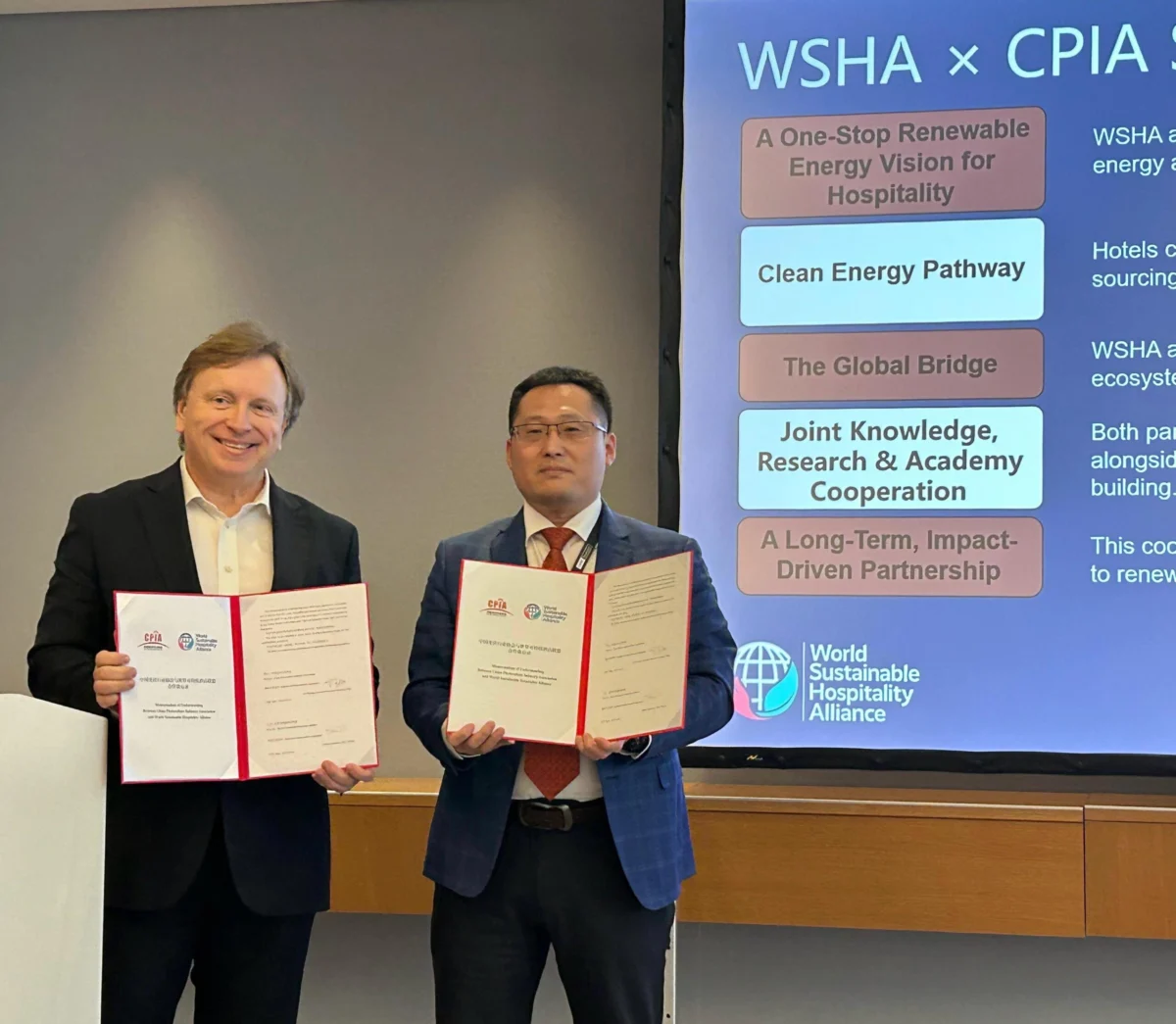
DÜSSELDORF, Germany — In a move set to redefine the environmental footprint of the global travel and tourism industry, the World Sustainable Hospitality Alliance (the Alliance) and the China Photovoltaic Industry Association (CPIA) have officially announced a strategic partnership. This collaboration, unveiled during the high-profile China–EU Solar & Energy Storage Industries Dialogue 2025 in Düsseldorf, marks a decisive shift in how the hospitality sector approaches its transition toward a low-carbon, net-positive future.
By aligning the hospitality industry’s immense energy consumption with the cutting-edge technological and manufacturing prowess of the Chinese solar sector, the two organizations aim to bridge the gap between clean-energy production and sustainable commercial consumption.
1. Main Facts: Bridging Hospitality and Innovation
The partnership represents a systemic approach to decarbonization. The hospitality industry, often characterized by its high energy demands for heating, cooling, and 24/7 operations, is under increasing pressure to meet global ESG (Environmental, Social, and Governance) targets. Simultaneously, the solar industry faces the challenge of scaling deployment in complex commercial environments.
This collaboration is designed to:
- Accelerate Renewable Adoption: Provide hotel groups with actionable, integrated pathways to transition from fossil-fuel-dependent energy to solar and storage solutions.
- Leverage Cross-Border Expertise: Facilitate the transfer of technology and expertise between China’s solar manufacturing ecosystem and global hotel operators.
- Standardize Energy Procurement: Establish frameworks for long-term Renewable Power Purchase Agreements (PPAs) that ensure stable, cost-effective, and low-carbon electricity for hotel portfolios worldwide.
- Capacity Building: Utilize the World Academy for Sustainable Hospitality to educate hotel stakeholders on the complexities of energy transition, from onsite solar installation to complex grid-storage integration.
2. Chronology of the Initiative
The road to this partnership was paved by a growing recognition that fragmented efforts are insufficient to meet the urgency of the climate crisis.
- Pre-2024 (The Assessment Phase): The Alliance conducted extensive audits of member hotel groups, identifying energy costs and carbon intensity as the primary barriers to Net Positive Hospitality.
- Early 2025 (Strategic Alignment): Discussions intensified between the leadership of the Alliance and the CPIA, recognizing that the CPIA’s leadership in photovoltaic (PV) technology could directly address the scalability issues faced by the hotel industry.
- March 2025 (The Formalization): The partnership was formally ratified on the sidelines of the China–EU Solar & Energy Storage Industries Dialogue. This venue was selected intentionally, as it serves as a critical nexus for European and Chinese industrial cooperation.
- Future Milestones: The partnership will move into a research phase, with a series of white papers and implementation frameworks scheduled for release in late 2025 and 2026, aimed at providing concrete deployment roadmaps for hoteliers.
3. Supporting Data and Industry Context
The urgency of this partnership is underscored by the current state of the global energy landscape. According to recent industry reports, the commercial building sector—within which hospitality is a significant player—is responsible for nearly 40% of global energy-related carbon emissions.
The Solar Advantage
Solar PV technology has seen a drastic reduction in the Levelized Cost of Energy (LCOE). In many regions, solar energy is now the cheapest form of electricity in history. For the hospitality sector, this creates a compelling economic argument:
- Cost Stability: Long-term PPAs hedge against volatile fossil fuel markets.
- Brand Value: As traveler demographics shift toward Gen Z and Millennials, sustainability is no longer a "nice-to-have" but a core brand expectation.
- Regulatory Compliance: Governments globally are tightening building codes, mandating that commercial properties meet stringent energy-efficiency standards.
The CPIA brings to the table an unmatched supply chain capacity. China currently accounts for the vast majority of the world’s solar module production. By linking this supply directly to the global hospitality market, the partnership aims to reduce the "middle-man" friction that often prevents hotels from retrofitting their properties with modern energy infrastructure.
4. Official Responses: A Vision for Change
The announcement has been met with enthusiasm from industry leaders who view this as a model for future sector-to-sector cooperation.
Glenn Mandziuk, President and CEO of the World Sustainable Hospitality Alliance, commented:
"We are proud to announce a landmark partnership between the World Sustainable Hospitality Alliance and the China Photovoltaic Industry Association. This collaboration connects one of the world’s largest energy-consuming sectors with a leading global hub of solar innovation, turning the hospitality industry’s significant annual investment into a driver of renewable energy transition. Built on five pillars—from a one-stop clean-energy pathway to global project collaboration and shared expertise—this agreement establishes a long-term, impact-driven framework for decarbonizing our sector."
RU Jialin, Director of International Affairs of the China Photovoltaic Industry Association, stated:
"The CPIA is delighted to join hands with the World Sustainable Hospitality Alliance to advance the hotel sector’s transition to renewable electricity. With the rapid progress of solar and energy storage technologies, clean power is becoming more accessible, stable, and cost-effective for hotels worldwide. Through this partnership, we will promote practical clean-energy solutions and scalable project cooperation, helping hotels reduce energy costs while accelerating low-carbon transformation."
5. Implications for the Global Hospitality Sector
The long-term implications of this partnership are profound, shifting the industry from reactive sustainability to proactive energy management.
Impact on Operations
Hotels will no longer be mere "consumers" of energy. Instead, through the implementation of onsite solar arrays and battery storage systems, properties can transition into "prosumers"—entities that generate, store, and manage their own power. This reduces strain on local grids and provides resilience against power outages, a critical factor for hotels operating in remote or infrastructure-challenged regions.
Technology Transfer and Scalability
One of the most significant challenges for hotels is the diversity of their portfolios—ranging from urban high-rises to remote island resorts. The Alliance and CPIA partnership plans to tackle this by creating modular, scalable energy solutions. This includes developing "plug-and-play" solar designs that can be adapted for different architectural styles, as well as digital monitoring systems that provide real-time data on energy generation and consumption.
A Model for Cross-Border Cooperation
Beyond the environmental benefits, this partnership serves as a diplomatic success story. By fostering cooperation between a European-headquartered global alliance and a leading Chinese industry association, it demonstrates that climate action can transcend geopolitical boundaries. The focus remains entirely on the practical application of technology to meet global climate goals—a "pragmatic environmentalism" that others may look to emulate.
The Roadmap Ahead
The next 18 months will be critical. The collaboration intends to:
- Develop Strategic Insights: Publishing comprehensive research on the solar potential of the hospitality sector.
- Establish Implementation Frameworks: Providing step-by-step guides for hotel owners to evaluate their properties, procure equipment, and secure funding for solar upgrades.
- Build Global Capacity: Training the next generation of hospitality leaders through the World Academy for Sustainable Hospitality, ensuring that energy management becomes a core competency for hotel management teams.
In conclusion, the partnership between the World Sustainable Hospitality Alliance and the CPIA is more than a memorandum of understanding; it is a catalyst for an industrial revolution within hospitality. By aligning the sector with the most efficient energy technologies available today, the partnership ensures that the hotels of tomorrow will not only be places of rest and comfort but also vital participants in the global energy transition. As the industry looks toward a 2030 target for significant carbon reduction, this alliance stands as a beacon of progress, demonstrating that through collaboration, the path to Net Positive Hospitality is not only possible but increasingly profitable.


 Dwi Wanna
 Basiran