
 Lina Hope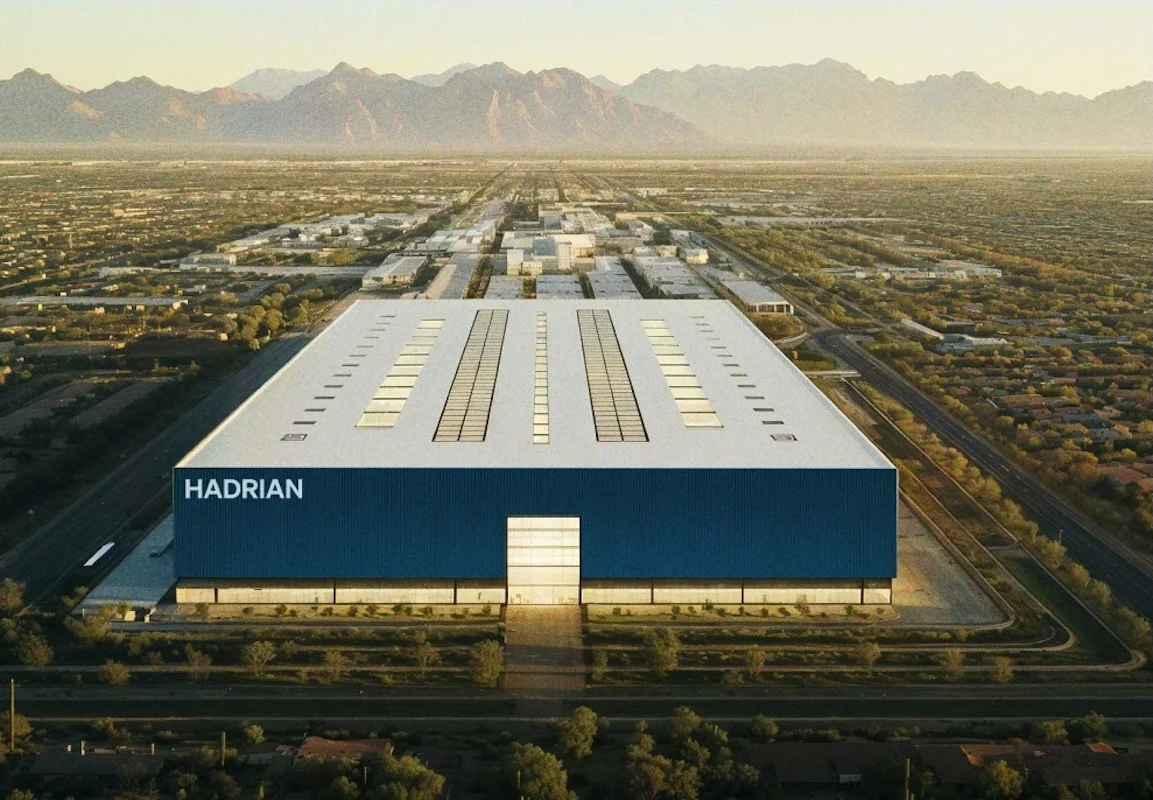
By Industry Desk
August 6, 2026
In a monumental shift for the U.S. defense manufacturing landscape, Hadrian—the high-growth startup focused on automating the production of critical defense components—announced on Thursday that it has successfully closed a $1.37 billion Series D funding round. This massive infusion of capital brings the company’s valuation to a staggering $7.87 billion, signaling a robust investor appetite for companies that prioritize the "hard tech" infrastructure necessary to sustain American industrial dominance.
The funding round, which features a "who’s who" of institutional and venture capital heavyweights, underscores the growing consensus that the modernization of the U.S. defense industrial base is no longer a peripheral concern but a national security imperative.
The Core Strategy: Why Hadrian Matters
Unlike many Silicon Valley ventures that focus on software-defined weaponry, autonomous drone swarms, or AI-driven battlefield analytics, Hadrian has carved out a distinct and vital niche: the factory floor.
The company is not designing the missiles or the submarines themselves; it is building the hyper-automated, AI-powered facilities that produce the essential parts these systems require. In an era where supply chain bottlenecks have plagued the Pentagon’s ability to meet production quotas for everything from naval vessels to aerospace components, Hadrian’s model of "industrial renewal" serves as a critical pressure valve.
By utilizing proprietary software to streamline the manufacturing process, Hadrian aims to slash the lead times that have historically slowed down defense contractors. Their facilities act as a force multiplier, ensuring that the legacy systems the military relies on—and the next generation of hardware currently in development—can be produced at the scale required for modern geopolitical competition.
Chronology: A Rapid Ascent
Hadrian’s trajectory over the past few years has been nothing short of meteoric. To understand the gravity of this $1.37 billion raise, one must look at the company’s recent history of aggressive expansion:
- Early Foundations: Hadrian emerged as a disruptor by applying software-first principles to CNC machining and metal fabrication, two sectors that have traditionally seen very little technological innovation over the last several decades.
- 2025 – The Series C Milestone: Roughly one year ago, the company announced a $260 million Series C round led by Founders Fund and Lux Capital. At the time, this was seen as a bold bet on the "re-industrialization" of America. The company used these funds to establish its presence in Arizona and scale its full-product manufacturing capabilities.
- March 2026 – The Alabama Expansion: Hadrian marked a significant shift in its business model by opening a major facility in Alabama. This site was specifically tasked with supporting the production of parts for the Columbia- and Virginia-class submarine programs. The project, valued at $2.4 billion, was structured as a public-private partnership, demonstrating that the federal government was ready to integrate Hadrian into its core supply chain.
- August 2026 – The Series D Breakthrough: With the closing of its $1.37 billion Series D, the company has now raised approximately $2 billion in total capital, according to estimates from PitchBook. This round serves as a "war chest," intended to build out an expansive network of highly automated factories across the United States.
Supporting Data: The Investor Syndicate
The composition of this funding round reflects a shift in how capital is being allocated toward national security. The list of investors is extensive and includes a mix of traditional venture capital, massive asset managers, and specialized defense-focused firms.
Lead Investors:
- WCM Investment Management
- Washington Harbour Partners
- Valor Equity Partners
- 137 Ventures
- Baillie Gifford
Participating Investors:
- 1789 Capital
- Morgan Stanley Wealth Management
- Funds managed by Apollo and T. Rowe Price
- CapitalG
- Andreessen Horowitz
- Founders Fund
- Lux Capital
- Altimeter
The participation of institutional giants like T. Rowe Price and Apollo suggests that Hadrian is moving past the "startup" phase and is being viewed as a foundational infrastructure play. For these investors, the value proposition is clear: as long as the U.S. requires a massive, reliable defense industrial base, the companies providing the components for that base are effectively "must-have" utilities.

Official Responses and Strategic Vision
While specific executive comments were not provided in the initial press release, the scope of the investment speaks for itself. Hadrian’s leadership has consistently framed their work as a mission-critical contribution to American industrial renewal.
By automating the manufacturing process, Hadrian is addressing the "missing middle" of the defense supply chain. Many prime defense contractors are currently struggling with aging equipment, a shrinking skilled labor pool, and outdated software systems. Hadrian’s facilities are designed to be "lights-out" or near-lights-out operations that can run 24/7, providing the precision and throughput that human-dependent factories struggle to maintain.
In the context of the current global climate—marked by increased tensions and the need for rapid military readiness—Hadrian’s ability to "turn on" manufacturing capacity is seen by analysts as a vital asset for the Department of Defense.
Implications: A New Era for U.S. Manufacturing
The success of Hadrian’s Series D round has profound implications for both the tech and defense sectors.
1. The "Hard Tech" Renaissance
For years, venture capital was synonymous with SaaS (Software as a Service) and consumer mobile apps. Hadrian’s valuation of nearly $8 billion proves that there is a massive market for companies that build things in the physical world. This is likely to trigger a surge of interest in "industrial tech" startups, as investors look for the next Hadrian in sectors like aerospace, maritime logistics, and advanced robotics.
2. Supply Chain Resilience
The U.S. military has been vocal about its need to diversify its supply chain and move away from over-reliance on single-source suppliers. By creating a scalable, automated factory model, Hadrian is helping to build a more resilient industrial base that can pivot quickly to meet changing procurement needs. If a specific component is needed for a submarine or an aircraft, Hadrian’s facilities can theoretically be programmed to pivot production lines with a speed that traditional manufacturing cannot match.
3. Public-Private Partnerships as the New Norm
The Alabama submarine facility deal is a template for the future. By aligning its business model with the long-term needs of the U.S. Navy and the Department of Defense, Hadrian has effectively de-risked its future revenue streams. We can expect to see more of these public-private partnerships as the government seeks to modernize its industrial footprint without necessarily having to manage the facilities itself.
4. The Labor Market Transformation
While Hadrian’s focus is on automation, the growth of these massive facilities creates a new kind of manufacturing job. The roles required to manage, monitor, and optimize these AI-driven systems are more technical than traditional assembly-line labor. This shift could lead to a resurgence of manufacturing-based economies in states like Arizona and Alabama, effectively blending high-tech talent with traditional industrial heartlands.
Conclusion
The $1.37 billion raise is more than just a successful funding event; it is a vote of confidence in the American defense industrial base. As the global geopolitical landscape becomes increasingly unpredictable, the ability to manufacture, repair, and scale hardware at speed is the ultimate competitive advantage.
Hadrian has positioned itself at the center of this paradigm shift. By focusing on the "boring" but essential task of manufacturing, the company has built a business that is as fundamental to the future of the American military as the sensors and software that sit inside the finished products. As the company prepares to break ground on its next set of facilities, all eyes will be on whether they can maintain this velocity while continuing to deliver the precision parts that the nation’s defense complex demands.
With $2 billion in total capital now behind them, Hadrian is no longer just a participant in the defense industry—they are becoming a pillar of it.


 Nana Muazin
 Neng Nana