Nana
Nana
Abbott Laboratories, a global leader in medical technology and diagnostics, is currently navigating the fallout of two distinct cybersecurity incidents. The breaches, which occurred in July 2026, involve unauthorized access to legacy internal systems within its Cancer Diagnostics business and a secondary alleged intrusion into the company’s LabCentral customer portal. While the company maintains that these events have not impacted core operations or patient safety, the involvement of notorious extortion groups and claims of massive data exfiltration have raised significant concerns regarding the security of supply chains in the medical technology sector.
Overview of the Security Events
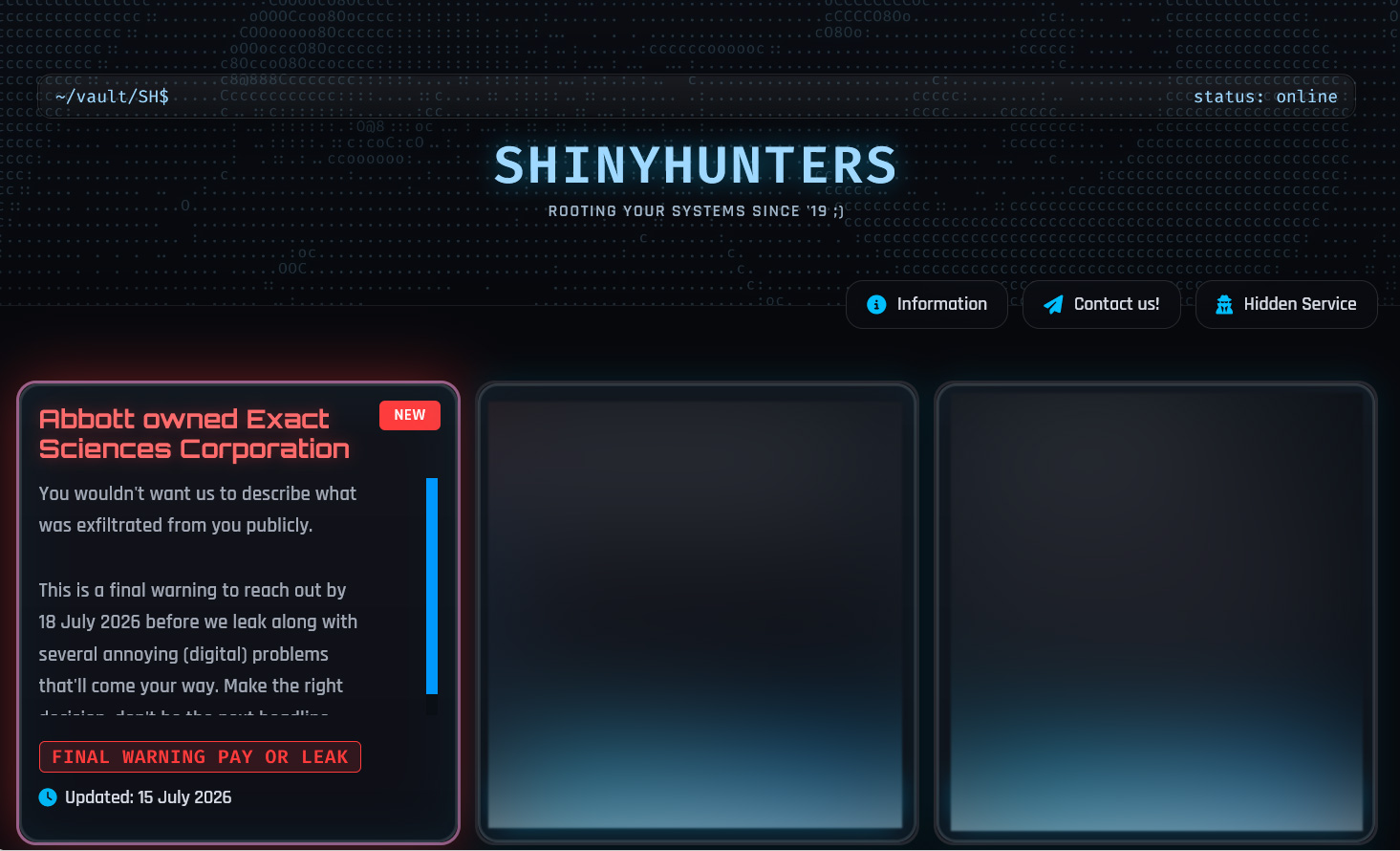
The first incident involves the well-documented extortion gang "ShinyHunters," which publicly targeted Abbott by listing the company on its data leak site. The group claimed that they successfully infiltrated legacy Exact Sciences systems—a business unit associated with Abbott—following a targeted social engineering campaign.
The second incident, involving a threat actor operating under the moniker "ShadowByt3$," centers on the LabCentral customer portal. This breach allegedly occurred via the exploitation of compromised customer credentials, leading to the unauthorized extraction of technical documentation and product specifications.
These events underscore a growing trend in the cybersecurity landscape: the systematic targeting of medtech firms by sophisticated threat actors who leverage social engineering and credential exploitation to bypass modern security measures, such as Single Sign-On (SSO) systems.
Chronology of the Breaches
The ShinyHunters Intrusion
The timeline of the ShinyHunters attack traces back to mid-June 2026. According to the threat actor, the infiltration was facilitated by a "vishing" (voice phishing) campaign directed at several Abbott employees. This social engineering tactic allowed the attackers to compromise a Microsoft Entra single sign-on (SSO) account, effectively granting them a foothold within internal networks.
- Mid-June 2026: Initial compromise via vishing and subsequent SSO account takeover.
- July 2026: ShinyHunters publicly lists Abbott on their extortion site, initially setting a deadline of July 18 for the company to negotiate a ransom payment.
- July 18, 2026: The threat actors extend the negotiation/publication deadline to July 21, 2026.
- Post-July 21, 2026: Ongoing monitoring of the leak site as investigators work to verify the scope of the exfiltrated data.
The ShadowByt3$ LabCentral Breach
The secondary intrusion appears to have been more focused on technical intellectual property rather than patient data.

- July 4, 2026: Threat actor ShadowByt3$ claims to have gained access to the LabCentral portal using compromised customer credentials.
- July 2026: The actors allegedly spent the following days methodically exfiltrating files by targeting specific API endpoints within the portal’s infrastructure.
- July 2026 (Late): Disclosure of the breach to media outlets, accompanied by screenshots intended to prove access to internal product manuals and regulatory documentation.
Analysis of Stolen Data Claims
The threat actors have made sweeping claims regarding the volume and nature of the data acquired during these breaches.
ShinyHunters’ Claims
ShinyHunters asserts that they have exfiltrated a massive cache of data, totaling over 30 million rows of customer personally identifiable information (PII). Their alleged haul includes:
- Sensitive PII: Names, email addresses, phone numbers, physical addresses, and dates of birth.
- Financial/Security Identifiers: Over one million Social Security numbers.
- Clinical Data: More than 22 million client notes, including transcripts of doctor-patient conversations.
- Operational Documentation: Over 20 million medical orders, along with proprietary customer agreements and Non-Disclosure Agreements (NDAs).
ShadowByt3$’s Claims
In contrast to the high-volume data theft claimed by ShinyHunters, ShadowByt3$ maintains that their objective was intellectual property. The group claims to have obtained:
- CE manufacturing certificates.
- Operational manuals and technical specifications.
- Regulatory documentation and product requirement archives.
- Assay files and calibrator value assignments.
It is important to note that, as of the time of this report, neither group has released the bulk of the allegedly stolen data publicly, and independent verification of these specific claims remains pending.
Official Responses and Corporate Stance
Abbott Laboratories has responded to both incidents with a strategy focused on containment, transparency, and public reassurance.
Statement on Cancer Diagnostics (ShinyHunters)
Abbott confirmed that they are investigating unauthorized access to a "limited number of internal systems" within the Cancer Diagnostics business. The company was quick to distinguish these systems from their primary infrastructure:
"This does not impact any business operations, product or product availability, manufacturing or lab operations, or our ability to serve patients. The legacy Exact Sciences systems are separate from Abbott’s [main] systems."
The company has engaged third-party cybersecurity experts to assist in the investigation and has notified relevant law enforcement agencies. Abbott maintains that it does not expect these incidents to have a material impact on its overall business or financial results.
Statement on LabCentral (ShadowByt3$)
Regarding the LabCentral portal, Abbott acknowledged the "potential" incident but explicitly disputed the threat actor’s characterization of the data. An Abbott spokesperson clarified the nature of the portal:
"LabCentral is an externally facing third-party hosted portal used by Abbott’s core laboratory diagnostics business. It houses publicly available technical product reference documents… and does not contain proprietary/sensitive customer or business information."
By framing the data as "publicly available," Abbott seeks to mitigate concerns regarding intellectual property theft, suggesting that the breach may be more performative than damaging.
Broader Implications for the Medtech Sector
The targeting of Abbott is far from an isolated event. Over the past several years, the medical technology industry has become a primary target for sophisticated extortion syndicates.

The Rise of SSO Exploitation
ShinyHunters, in particular, has mastered the art of targeting the "identity layer." By compromising Microsoft Entra, Okta, and Google SSO accounts, attackers gain the keys to the kingdom. Once inside, they can pivot to connected SaaS applications—Salesforce, Microsoft 365, Slack, and Zendesk—extracting data without ever needing to touch the traditional, hardened perimeter of a corporate network.
A Pattern of Targeting
The list of medical entities hit by similar campaigns is growing:
- Medtronic: Recently notified customers of a data breach linked to the same extortion group.
- iRhythm: Suffered a significant breach involving the theft of patient information.
- Stryker: Experienced a destructive data-wiping attack, highlighting that these groups are evolving beyond mere extortion into active disruption.
These trends suggest that medtech companies, which hold a unique combination of high-value clinical data and mission-critical intellectual property, must rethink their reliance on SSO-centric workflows. The "weak point" identified by ShadowByt3$ in the LabCentral portal serves as a reminder that even portals considered "public-facing" can serve as a conduit to deeper system enumeration if access controls are not rigorously managed.
Conclusion: The Path Forward
For Abbott Laboratories, the immediate challenge is to finalize the forensic analysis of both breaches and ensure that any compromised credentials are purged from their environment. The company’s focus on isolating the "legacy" nature of the breached systems is a strategic attempt to reassure shareholders and patients that the core of the business remains secure.
However, the industry at large faces a more systemic problem. As threat actors continue to weaponize social engineering and leverage the interconnectedness of cloud-based enterprise tools, the traditional concept of a "secure perimeter" is effectively obsolete. The future of security in the medical sector will rely on a Zero Trust architecture, where identity verification is continuous, and the assumption of compromise is the starting point for every operational process.
As the investigations continue, stakeholders and the public await further clarity on whether the claims made by ShinyHunters regarding the 30 million records of PII will manifest as a public dump, which would significantly escalate the severity of this cybersecurity event. For now, the events serve as a sobering case study in the vulnerability of global healthcare infrastructure in an era of advanced digital extortion.


 Sagoh
Sagoh
 Nana Wu