Rifan Muazin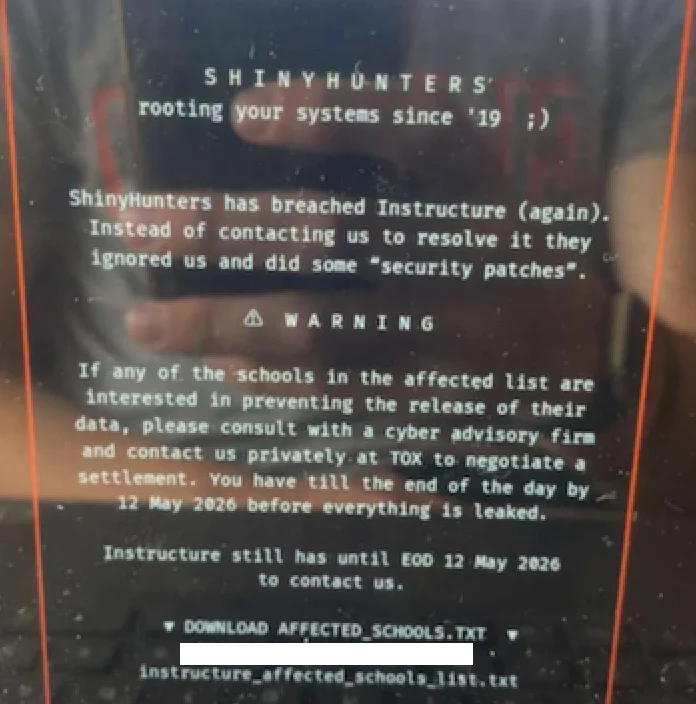
In a stark reminder of the fragility of the digital infrastructure underpinning modern education, the widely-used learning management system (LMS) Canvas, operated by the firm Instructure, has been thrust into the center of a high-stakes cyber-extortion crisis. The breach, orchestrated by the notorious cybercriminal collective known as ShinyHunters, has disrupted academic operations for thousands of school districts and universities across the United States, casting a shadow over end-of-semester assessments and final examinations.
The situation turned critical on May 7, 2026, when students and faculty attempting to log into their educational portals were greeted not by their course dashboards, but by a chilling ransom demand. The attackers claimed to possess the sensitive data of 275 million students and staff across approximately 9,000 educational institutions, threatening to release the information unless their demands were met.
The Anatomy of the Incident: A Chronology of Failure
The current crisis did not emerge in a vacuum; it is the culmination of an eight-month-long campaign of attrition against Instructure’s systems.
The Prelude: The September 2025 "Proof of Concept"
While the recent headlines focus on the May 2026 events, security experts point to a breach at the University of Pennsylvania in September 2025 as the true starting point. At the time, the incident was treated as a localized issue involving stolen donor records and internal memos. However, subsequent forensic analysis suggests that the attack utilized an access path mediated by Instructure. The company’s failure to fully address the vulnerability at that time essentially provided the blueprints for the current, larger-scale assault.
The May 2026 Escalation
- May 1, 2026: ShinyHunters successfully compromise the Instructure environment, demonstrating their control over the platform’s infrastructure.
- May 2, 2026: Instructure’s Chief Information Security Officer, Steve Proud, publicly declares that the incident has been "contained," assuring stakeholders that the platform is secure.
- May 6, 2026: Instructure acknowledges a data breach, admitting that while no financial or government identifiers were taken, names, email addresses, and student ID numbers were compromised. The company insists that operations have returned to normal.
- May 7, 2026: The situation deteriorates rapidly. Users globally report that the Canvas login page has been defaced with a ransom note. Instructure is forced to take the entire platform offline, masking the outage under the guise of "scheduled maintenance."
- May 8, 2026: Following intense public pressure, Instructure confirms that the breach originated from vulnerabilities within "Free-for-Teacher" accounts. The company announces the temporary suspension of these accounts to prevent further unauthorized access.
ShinyHunters: A Prolific Threat Actor
ShinyHunters has cemented its reputation as one of the most aggressive and fluid cybercriminal groups in the current threat landscape. Unlike state-sponsored actors who prioritize espionage, ShinyHunters is driven by pure, rapid-fire financial extortion.
Their methodology is remarkably consistent: they frequently employ "voice phishing" (vishing) and sophisticated social engineering tactics. By impersonating IT personnel or other trusted figures within an organization, they trick employees into surrendering credentials, often targeting Single Sign-On (SSO) systems like Okta. Once they have a foothold, they move laterally through an organization’s software-as-a-service (SaaS) stack, such as Salesforce or specialized educational platforms like Canvas.
The group’s recent track record is staggering. In April 2026, they targeted the home security giant ADT, exfiltrating the personal information of 5.5 million customers. This is in addition to high-profile attacks against Medtronic, Rockstar Games, McGraw Hill, 7-Eleven, and Carnival Cruise Lines.
Official Responses and the "Maintenance" Controversy
The communication strategy employed by Instructure during this incident has faced severe criticism from cybersecurity professionals. Dipan Mann, founder and CEO of the security firm Cloudskope, has been particularly vocal in his condemnation of the company’s transparency.
"Calling a defacement-driven outage ‘scheduled maintenance’ is not just a PR failure; it is a fundamental betrayal of user trust," Mann argued in a recent industry analysis. He posits that the May 7 re-compromise was a direct rebuttal to Instructure’s earlier claims of containment. "The May 1 incident was the production run. The May 7 re-compromise was ShinyHunters demonstrating publicly that the May 2 containment did not happen."
In its official update on May 8, Instructure attempted to clarify the scope of the breach, emphasizing that it was an exploitation of the "Free-for-Teacher" account architecture. They urged affected institutions not to rely on third-party lists circulating on social media, promising direct outreach to the relevant administrators. However, for many institutions, the damage to the academic calendar is already done, with the timing of the outage—during the peak of final exams—creating a logistical nightmare for administrators and students alike.
The Implications for the Education Sector
The breach of a platform as ubiquitous as Canvas highlights a systemic vulnerability in the digitalization of education. When thousands of institutions rely on a single vendor for their primary operational workflow, that vendor becomes a "single point of failure" for the entire sector.
1. The Ransom Dilemma
The extortion message left on the Canvas login page explicitly encouraged individual schools to negotiate their own ransom payments, regardless of whether Instructure itself decides to pay. This creates a fragmented and chaotic response. A source close to the investigation confirmed to KrebsOnSecurity that several universities have already initiated contact with the hackers, hoping to secure their data before it is leaked. This behavior threatens to normalize the payment of ransoms, fueling the cycle of extortion.
2. The Erosion of Data Privacy
The potential leak of billions of private messages between students and teachers is perhaps the most concerning aspect of this breach. Beyond simple identifiers, the repository of communication contains the intellectual property of classrooms, sensitive disciplinary records, and personal interactions that are protected under various privacy laws, such as FERPA in the United States.
3. The "Path of Least Resistance"
The concern among industry observers is that, much like the University of Pennsylvania incident, this will be treated as a series of isolated events rather than a systemic failure. Mann warns that if institutions choose to absorb the breach quietly rather than demanding institutional accountability from their vendors, these attacks will only increase in frequency and severity.
Conclusion: A Turning Point for Vendor Security
As the dust settles, the education sector faces a reckoning. The "Free-for-Teacher" model, while designed to foster accessibility and pedagogical innovation, has proven to be an Achilles’ heel for security.
For Instructure, the challenge is twofold: they must restore trust with their institutional clients while fundamentally re-engineering their security posture to prevent a repeat of the September-to-May cycle. For the broader educational community, the incident serves as a grim warning: reliance on cloud-based, third-party platforms requires a robust, proactive approach to third-party risk management.
In the words of Charles Carmakal, CTO at Mandiant Consulting, the "concurrent and discrete" nature of these campaigns suggests that we are in a new era of cyber-extortion. Educational institutions can no longer afford to view themselves as peripheral targets; in an age of data-driven learning, the classroom is now firmly in the crosshairs of global cybercrime.
As of the latest reports, Instructure remains under pressure to provide a full, transparent audit of the breach. Until that occurs, the specter of the stolen data—and the threat of its release—will continue to loom over the 275 million students and faculty caught in the middle.


 Sagoh
Sagoh
 Nana Wu