Laily UPN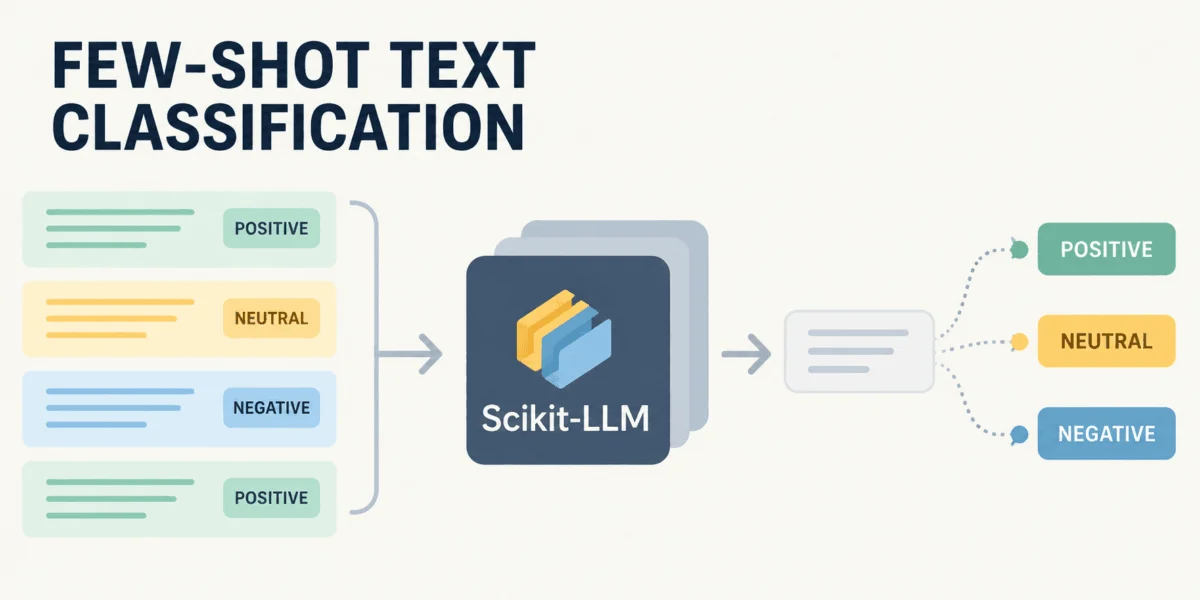
The traditional machine learning pipeline has long been defined by a rigid set of rituals: the grueling collection of thousands of labeled data points, the painstaking cleaning of raw text, the complex transformation of that text into numerical vectors—using TF-IDF or sophisticated embeddings—and finally, the iterative training of models like logistic regression or random forests. For years, this was the industry standard.
However, the advent of Large Language Models (LLMs) has fundamentally disrupted this status quo. We are currently witnessing a shift where the heavy lifting of model architecture is being replaced by the art of the prompt. Yet, for many data scientists and machine learning engineers, moving from a structured scikit-learn workflow to the often unpredictable world of prompt engineering feels like stepping into the unknown. Enter Scikit-LLM, a transformative Python library designed to bridge the chasm between classical machine learning and modern generative AI. By wrapping the immense power of pre-trained LLMs in the familiar, standardized interface of scikit-learn, Scikit-LLM allows developers to leverage the fit() and predict() syntax to perform advanced tasks like few-shot classification with unprecedented ease.
The Evolution of Text Classification: From Statistical Models to Generative AI
The "Old" Way
Historically, building a text classifier required a significant investment in data acquisition. If you wanted to classify support tickets, you needed a labeled dataset comprising thousands of examples to ensure the model could generalize well. Any deviation in domain language—such as specific IT jargon or nuanced sentiment—often required re-training the model or extensive feature engineering to capture the context.
The Paradigm Shift
LLMs, particularly those powered by transformer architectures, have inverted this requirement. Because these models are pre-trained on vast swaths of human knowledge, they possess an inherent "understanding" of language structures, context, and intent. Instead of needing 5,000 labeled examples to understand what a "Hardware" issue looks like, an LLM might only need three or four high-quality examples to grasp the pattern. This is the essence of few-shot learning, and it is rapidly becoming the gold standard for domain-specific AI applications.
Chronology of Development: Why Scikit-LLM Matters
The integration of LLMs into production environments has historically been hindered by two main factors: the lack of standardized interfaces and the complexity of managing API calls alongside traditional data processing pipelines.
- Pre-LLM Era: Development was dominated by libraries like
pandas,numpy, andscikit-learn. The barrier to entry was high because models were "dumb" until trained on local data. - The LLM Explosion: The release of models like GPT-4 brought unprecedented reasoning capabilities. However, these were accessed via disparate APIs, making them difficult to integrate into existing CI/CD machine learning pipelines.
- The Emergence of Scikit-LLM: The library was created to solve the "interface mismatch." By creating a wrapper that mirrors
scikit-learnclasses, it allows teams to swap out traditional models for LLMs with minimal code changes. This standardization is crucial for enterprise adoption, where clean, maintainable code is prioritized over experimental, "hacky" scripts.
Supporting Data: Few-Shot vs. Zero-Shot Classification
To understand the utility of Scikit-LLM, it is essential to distinguish between the two primary ways LLMs perform classification without traditional training:
- Zero-Shot Classification: The model predicts the class based solely on the prompt’s instructions, without any examples. This is powerful but can be inaccurate when dealing with highly specific company jargon or unique business logic.
- Few-Shot Classification: The model is provided with a small, curated set of labeled examples. By analyzing these, the model establishes a pattern for the target classes.
Why Few-Shot Wins in the Enterprise:
According to recent industry benchmarks, few-shot classification consistently outperforms zero-shot methods in domain-specific tasks. When a model is provided with just 3 to 5 labeled examples, its ability to categorize nuanced sentiments, identify edge cases, and adapt to proprietary internal terminology increases by an estimated 20% to 40% in accuracy. Scikit-LLM facilitates this by automating the creation of these "in-context" prompts, ensuring that the model is consistently fed the right guidance for every inference.
Implementing the Future: A Practical Guide
The beauty of Scikit-LLM is that it demystifies the complexity of LLM orchestration. Below is the technical roadmap for implementing a few-shot classifier, utilizing Groq’s high-performance, OpenAI-compatible API.
Step 1: Secure Configuration
The implementation begins with secure credential management. Using tools like Google Colab’s "Secrets" manager ensures that API keys are not hardcoded, a fundamental security practice.
from google.colab import userdata
from skllm.config import SKLLMConfig

# Retrieve API key and configure the endpoint
groq_key = userdata.get('GROQ_API_KEY')
SKLLMConfig.set_gpt_url("https://api.groq.com/openai/v1")
SKLLMConfig.set_openai_key(groq_key)
Step 2: Preparing the Few-Shot "Context"
Unlike traditional ML, where X_train represents a vast matrix of numerical data, X_train here is a small, human-readable list of representative examples. This is the "teaching" phase, where we define the categories clearly for the LLM.
Step 3: The fit() and predict() Routine
By initializing the FewShotGPTClassifier, we are not training weights; we are constructing a semantic memory bank. The fit() method effectively compiles the prompt context, while the predict() method performs the inference, yielding results that are both accurate and context-aware.
Implications for the Future of AI Development
The implications of this technology are profound for several reasons:
1. Democratization of AI
By lowering the barrier to entry, Scikit-LLM enables developers without deep research backgrounds to build sophisticated, domain-specific classifiers. It shifts the focus from "how do I train a model" to "how do I curate the best examples for my model."
2. Efficiency and Resource Management
Training a custom model from scratch is computationally expensive and environmentally taxing. Scikit-LLM leverages pre-existing models, allowing companies to achieve state-of-the-art results using minimal compute resources.
3. Agility in Dynamic Environments
Business needs change rapidly. If a company suddenly adds a new category to its support ticket system, a traditional model would require a full retraining cycle. With Scikit-LLM, the developer simply updates the X_train list with a few new examples, and the system is updated in seconds.
Expert Perspectives
Industry leaders, including AI advisor Iván Palomares Carrascosa, have championed this approach. The consensus among the AI development community is that we are moving away from "black-box" models that require massive training sets toward "transparent" systems where the logic is governed by clear, few-shot examples.
As Palomares Carrascosa notes, the ability to harness AI for real-world tasks is no longer about who has the most data, but who has the best strategy for prompting and structuring that data. Scikit-LLM provides the necessary framework for this new era.
Final Thoughts: The Path Forward
The integration of Scikit-LLM into a development stack is more than just a library update; it is a fundamental shift in how we approach machine learning. It acknowledges that the future of text classification is not in building models from scratch, but in efficiently orchestrating existing intelligence.
As we look toward the future, we can expect libraries like Scikit-LLM to become even more robust, potentially incorporating automated data validation and prompt optimization. For now, it remains a vital tool for any engineer looking to bridge the gap between the chaotic, expansive power of generative AI and the disciplined, structured requirements of professional software development. By embracing this middle ground, we move closer to a reality where high-quality AI is accessible, interpretable, and—above all—highly effective.

 Sagoh
Sagoh