Basiran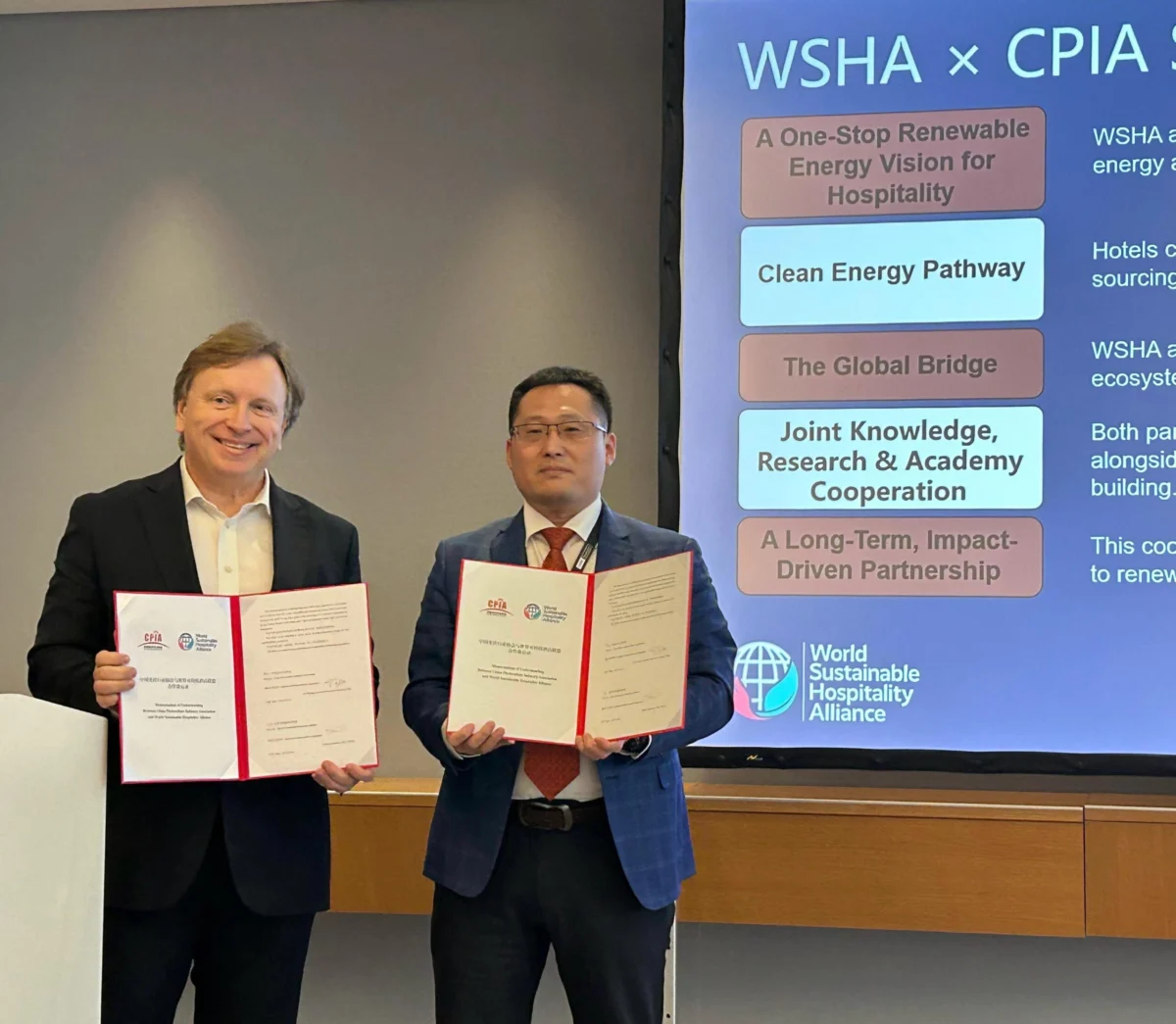
DÜSSELDORF, Germany — In a move that signals a seismic shift in how the global tourism sector approaches decarbonization, the World Sustainable Hospitality Alliance (the Alliance) and the China Photovoltaic Industry Association (CPIA) have formally announced a strategic partnership. Unveiled at the prestigious China–EU Solar & Energy Storage Industries Dialogue 2025, this collaboration aims to synchronize the hospitality industry’s immense energy demands with the rapid, scalable technological advancements of the global solar sector.
By uniting the world’s leading hospitality sustainability body with China’s powerhouse of solar innovation, the partnership seeks to move beyond abstract climate pledges and toward concrete, infrastructure-heavy deployment of renewable energy across international hotel portfolios.
The Strategic Imperative: Decarbonizing Global Hospitality
The hospitality industry is among the most energy-intensive sectors in the global economy. Hotels operate 24/7, requiring constant climate control, lighting, and guest services, resulting in a significant carbon footprint. As international regulations tighten and consumer demand for "green travel" grows, the sector faces an urgent mandate to transition away from fossil-fuel-dependent grids.
The partnership with the CPIA is designed to provide the necessary "bridge" to bridge this gap. By leveraging China’s dominance in the solar photovoltaic (PV) supply chain, the Alliance is positioning its members—which represent a significant portion of the world’s hotel room inventory—to access state-of-the-art energy storage solutions, high-efficiency solar panels, and expert procurement models that were previously difficult for hospitality groups to navigate on a global scale.
Chronology of the Collaboration: A Path to Partnership
The road to this partnership was paved by a shared recognition that technological supply and industrial demand were not effectively communicating.
- Q3 2024: Initial Engagements: Informal dialogues between the Alliance and CPIA representatives identified a "bottleneck" in renewable adoption: while hotel groups expressed a desire to install solar infrastructure, they lacked the technical framework to engage with global supply chains effectively.
- Late 2024: Feasibility Assessment: Technical teams from both organizations assessed the viability of integrating localized solar and storage systems into diverse hospitality environments, from urban high-rises to remote luxury resorts.
- January 2025: Formalization of Objectives: Both parties agreed to a memorandum of understanding (MoU) centered on five key pillars, designed to provide a "one-stop" pathway for sustainable energy adoption.
- December 2025: The Announcement: The partnership was officially unveiled at the China–EU Solar & Energy Storage Industries Dialogue 2025 in Düsseldorf, marking the beginning of a multi-year collaborative roadmap.
Supporting Data: Why Solar is the New Standard for Hotels
The economic argument for this partnership is rooted in the current energy landscape. According to recent industry data, the integration of onsite solar and storage capacity is no longer merely a "CSR initiative" but a core financial strategy.
Energy Cost Stability
As global energy markets fluctuate, hotels are increasingly vulnerable to price volatility. Onsite solar generation acts as a hedge against grid price spikes. By implementing Renewable Power Purchase Agreements (PPAs), hotels can lock in long-term energy pricing, significantly reducing the "operational expenditure" (OPEX) volatility that has plagued the industry post-pandemic.
Technological Advancements
The CPIA brings to the table access to the latest in photovoltaic efficiency. With the rapid evolution of solar cell technology—including bifacial panels and integrated building-photovoltaics (BIPV)—hotels can now generate electricity on façades, rooftops, and parking structures without compromising the aesthetic requirements of luxury hospitality.
Storage and Reliability
The integration of Battery Energy Storage Systems (BESS) is a game-changer. Historically, solar was viewed as intermittent. Modern storage solutions allow hotels to capture peak-sunlight energy and redistribute it during the high-demand evening hours, ensuring that a hotel’s "Net Positive" ambition is matched by operational reliability.
Official Perspectives: A Synergy of Vision
The leadership teams of both organizations emphasize that this is a long-term, impact-driven framework rather than a temporary initiative.
Glenn Mandziuk, President and CEO of the World Sustainable Hospitality Alliance, highlighted the scale of the impact during the announcement:
"We are proud to announce a landmark partnership that connects one of the world’s largest energy-consuming sectors with a leading global hub of solar innovation. We are effectively turning the hospitality industry’s significant annual investment into a driver of the renewable energy transition. This isn’t just about solar panels; it’s about establishing a long-term, impact-driven framework for decarbonizing our entire sector."
RU Jialin, Director of International Affairs of the CPIA, echoed this sentiment, emphasizing the accessibility of the technology:
"With the rapid progress of solar and energy storage technologies, clean power is becoming more accessible, stable, and cost-effective for hotels worldwide. Through this partnership, we will promote practical clean-energy solutions, helping hotels reduce energy costs while accelerating their low-carbon transformation. We look forward to building a more sustainable future for global hospitality."
Implications: The Road to Net Positive Hospitality
The partnership will manifest through several tangible channels, designed to build capacity across the hospitality value chain.
1. The World Academy for Sustainable Hospitality
A critical component of this partnership is the inclusion of the World Academy for Sustainable Hospitality. This platform will serve as the educational arm of the collaboration, offering specialized training for hotel engineers, procurement officers, and sustainability managers on how to evaluate solar projects and manage long-term energy contracts.
2. Standardized Implementation Frameworks
Currently, many hotel chains struggle with fragmented approaches to sustainability. The Alliance and CPIA will co-develop standardized frameworks that allow for "plug-and-play" renewable energy integration. This reduces the time and complexity involved in retrofitting existing properties.
3. Cross-Border Knowledge Transfer
By linking China’s renewable energy ecosystem with the global hospitality market, the partnership facilitates a flow of technology transfer. This is particularly vital for developing markets where the hospitality sector is expanding rapidly and needs clean energy solutions that can scale alongside new construction.
4. Global Project Collaboration
The partners intend to launch pilot projects across different climate zones to showcase how solar and storage systems can be optimized for diverse environments. These "lighthouse projects" will serve as proof-of-concept for the broader industry, demonstrating that sustainable hospitality is both environmentally imperative and commercially viable.
Future Outlook: A Catalyst for Industry-Wide Change
The success of the Alliance-CPIA partnership will be measured by the rate of adoption of renewable energy across the member hotel groups. As the "Net Positive Hospitality" movement gains momentum, this collaboration provides the logistical and technical backbone required to achieve the goal of a carbon-neutral industry.
The partnership also sets a precedent for cross-industry collaboration. By aligning with a specific technological trade body like the CPIA, the hospitality industry is moving beyond generic sustainability goals and entering the realm of direct industrial integration.
As we look toward the remainder of the decade, the focus will shift from the initial agreement to the "on-the-ground" implementation. With both organizations committed to research, capacity building, and project deployment, the hospitality sector is better positioned than ever to transition from being a major energy consumer to a significant contributor to the global clean energy grid.
The message from Düsseldorf is clear: The future of global travel is being built on the rooftops of our hotels, powered by the sun, and supported by a strategic bridge between the hospitality industry and the global leaders of renewable innovation.


 Layla Zulfa
 Dwi Wanna