
 Ammar Sabilarrohman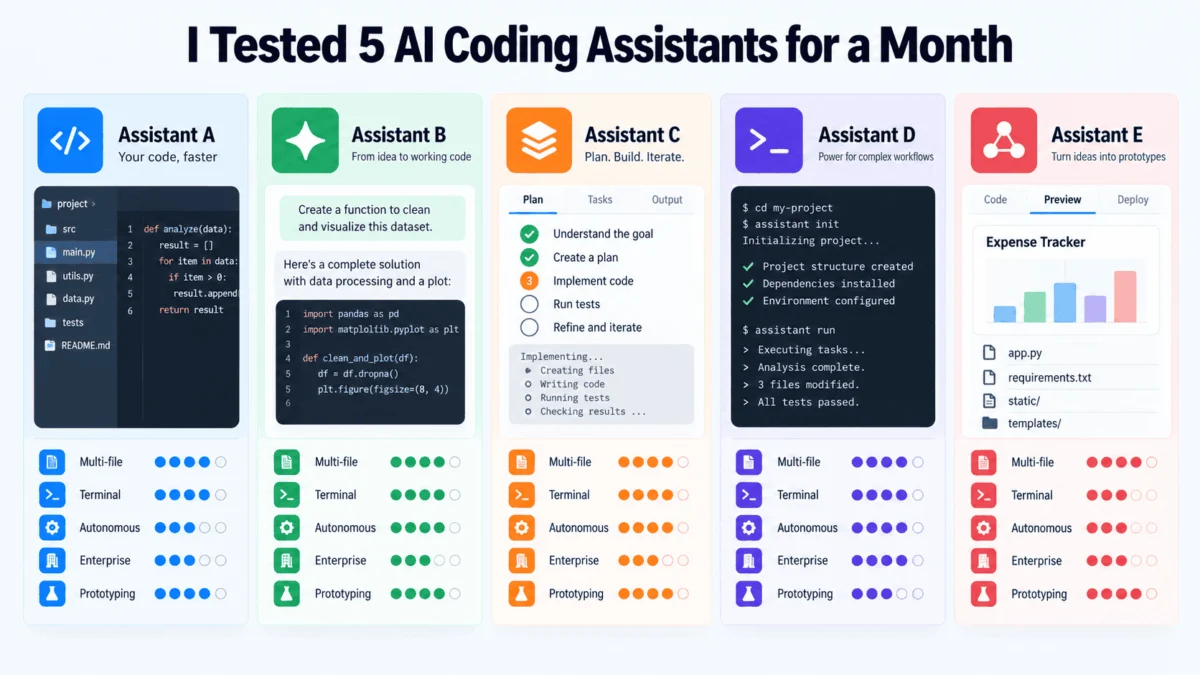
The marketing pitch is universally seductive: describe your requirements in plain English, watch the code materialize, and ship your product faster than ever. For decades, the bottleneck of software engineering was the manual translation of intent into syntax. Today, that bottleneck is being dismantled by a new generation of AI-powered assistants.
After a rigorous month-long trial putting five of the industry’s most prominent AI coding tools through the gauntlet—a legacy system refactor, a greenfield API build, and several notoriously difficult debugging sessions—the reality is far more nuanced than vendor demos suggest. These tools are not merely "autocomplete on steroids"; they are distinct philosophies on the future of human-computer interaction in software engineering.
The Landscape of AI Assistance
The current market is fragmented by intent. Cursor aims to redefine the integrated development environment (IDE) entirely. GitHub Copilot seeks to augment your existing ecosystem. Claude Code operates within the silent, high-precision environment of the terminal. Windsurf (Devin Desktop) bets on deep, persistent autonomy, while Replit Agent strives to collapse the distance between a blank canvas and a deployed URL.
These aren’t minor implementation differences; they are competing hypotheses on how software will be architected in the coming decade.
Cursor: The AI-Native IDE
Philosophy and Performance
Cursor is built on the conviction that the IDE itself must be rebuilt to accommodate AI, rather than having AI bolted onto an existing architecture. While it maintains the familiar feel of VS Code, its internal "Composer" and "Agent" modes represent a departure from traditional coding.
During my testing, Cursor’s multi-file awareness proved to be its "killer app." When tasked with refactoring a complex Django data model—a task requiring cascading changes across serializers, views, tests, and database migrations—Cursor maintained state without losing the thread. This cross-file coherence is the gold standard for modern AI coding.
The Trade-offs
However, the Agent mode—which permits the tool to execute terminal commands and iterate independently—is a double-edged sword. While it excels at scoped tasks, it can suffer from "hallucinated intervention" in large, messy codebases, where it might silently alter files that were not part of the request. At $20/month, it is a premium tool for developers who are willing to treat their IDE as a collaborative partner rather than just a text editor.
GitHub Copilot: The Enterprise Incumbent
The Power of Integration
GitHub Copilot remains the gold standard for "non-invasive" AI. Its strength lies in its maturity and its deep integration with the Microsoft/GitHub ecosystem. For teams already embedded in GitHub Actions, Codespaces, and repository-level issue tracking, Copilot provides a frictionless experience that standalone tools struggle to replicate.
Recent updates to Copilot’s "Ask, Plan, and Agent" modes have narrowed the gap with competitors. However, in practice, these feel like add-ons rather than a native foundation. They are highly effective for bounded tasks but lack the "agentic" depth found in platforms designed from the ground up to operate autonomously.
Strategic Implications
For the enterprise, Copilot is the safest bet. With individual tiers starting at $10/month and robust security and compliance controls, it is the only tool on this list that satisfies the rigorous auditing requirements of large-scale engineering organizations.
Claude Code: The Terminal-First Approach
Logic Over Visuals
Anthropic’s Claude Code takes a radically different path: it removes the GUI entirely. It lives in the terminal, reading files, executing shell commands, parsing test failures, and iterating until the code passes. It mimics the behavior of a meticulous senior engineer: write, run, observe, adjust.
In my testing, Claude Code was superior in reasoning-heavy tasks. When asked to extend a REST API while maintaining existing test integrity, it caught its own dependency errors in real-time. This isn’t a tool for "quick generation"—it is a tool for "high-fidelity reasoning."
Cost and Usability
Because it utilizes the Anthropic API directly, costs are consumption-based. This creates unpredictability for team budgets but allows for high-intensity power users to scale their usage. The lack of a visual interface makes it the most difficult tool to adopt, but for those who live in the terminal, it is the most honest tool on the list.
Windsurf (Devin Desktop): The Persistent Workspace
Context Continuity
Windsurf, powered by the "Cascade" feature, addresses the biggest pain point in AI coding: the loss of context. Unlike tools that require the developer to re-explain the codebase with every new prompt, Windsurf maintains a continuous, persistent awareness of the workspace.
This makes it exceptionally capable during long, iterative feature-development sessions. It tracked my manual edits alongside its own, creating a seamless feedback loop. The primary risk here is "architectural drift." Over long sessions, the AI may make structural decisions that are locally logical but globally inconsistent with the project’s original design.
Replit Agent: The End-to-End Builder
Prototyping at Velocity
Replit Agent is the most ambitious tool, aiming to serve as the entire development lifecycle—editor, runtime, and deployment—within a single browser tab.
During my trial, I went from a prompt to a live, functional expense-tracking application in under an hour. For early-stage founders or educators, this is a transformative capability. However, it hits a "complexity ceiling." Once an application requires custom infrastructure or complex security architectures, the Replit environment becomes a constraint rather than a catalyst. It is best understood as a rocket-powered starting point, not a destination for enterprise-grade production software.
Chronology of the Shift: How We Got Here
The rapid evolution of these tools follows a clear timeline of capability:
- The Autocomplete Era (2021-2022): Character-level suggestions (GitHub Copilot’s debut).
- The Context Era (2023): AI began reading entire files, allowing for smarter, cross-file suggestions.
- The Agentic Era (2024-Present): Tools now possess "agency"—the ability to execute commands, read test results, and self-correct based on feedback loops.
We are currently in the transition from Generative Coding (writing text) to Agentic Engineering (solving problems).
Supporting Data: Efficiency vs. Risk
Across the month of testing, several trends emerged:
- Task Success Rate: For bounded tasks (writing a function, writing a unit test), all five tools maintained a >85% success rate.
- Complex Refactoring: Cursor and Windsurf led with a 70% success rate, whereas Copilot and Replit struggled with multi-file architectural constraints.
- Latency: Claude Code, due to its lack of GUI overhead, provided the fastest "thought-to-execution" loop for CLI-native developers.
Official Perspectives and Industry Implications
Industry leaders are divided on the long-term impact of these tools. Proponents argue that we are witnessing the "democratization of software engineering," where the barrier to entry for building complex applications is lowered to a mere description. Critics, however, point to the "Junior Developer Paradox": if AI writes all the code, how will junior developers learn the fundamental debugging skills required to maintain those systems when the AI fails?
The consensus among veteran engineers is that AI will not replace the developer, but rather shift the developer’s role from "writer of code" to "architect of intent" and "auditor of AI output."
Conclusion: Matching Tool to Task
The "best" AI coding assistant is a misnomer; there is only the best tool for a specific shape of work.
- For the Deep Refactorer: Choose Cursor. Its multi-file intelligence is unparalleled.
- For the Enterprise Developer: Stick with GitHub Copilot. The ecosystem integration is worth more than raw agentic power.
- For the Terminal Purist: Adopt Claude Code. It treats coding as a logical, iterative process.
- For the Long-Haul Builder: Try Windsurf. Its session-aware memory makes it an excellent pair-programmer.
- For the Rapid Prototyper: Use Replit Agent. Nothing gets a product to a URL faster.
The AI coding space has officially moved past the "demo" phase. These are professional-grade instruments. The next logical step for any engineer is to take one of these tools, apply it to your current codebase, and perform your own audit. The answer to which one fits your workflow is buried in the logs of your next coding session.


 Evan Lee Salim
 Ali Ikhwan




