
 Ali Ikhwan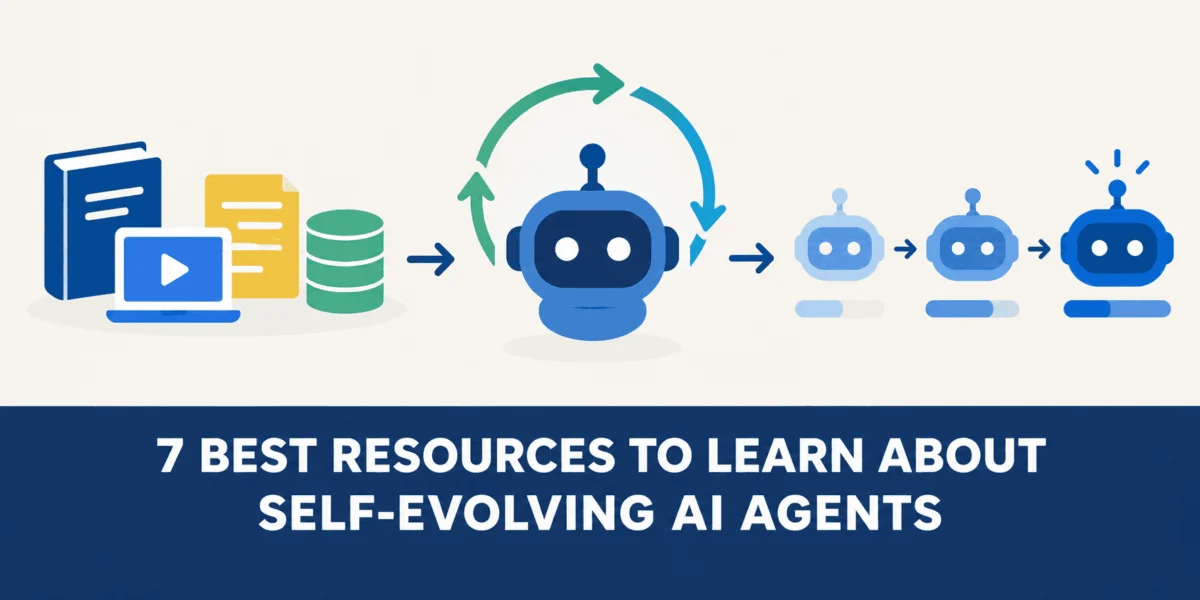
The landscape of artificial intelligence is undergoing a seismic shift. For the past several years, the paradigm of "Agentic AI" has been defined by static execution: a user provides an instruction, the agent calls a tool, and a result is returned. However, the most cutting-edge research has pivoted toward a far more ambitious objective: Self-Evolving AI Agents.
These systems are not merely reactive; they are recursive. By learning from previous failures, accumulating long-term memory, refining their own prompts, and modifying their reasoning pipelines, these agents represent the next evolution in machine intelligence. Rather than remaining stagnant post-deployment, they possess the latent potential to "grow" in capability. For researchers and engineers eager to navigate this rapidly developing field, we have curated the seven most vital resources to master the mechanics of self-improving systems.
The Core Concept: What is a Self-Evolving Agent?
At its most fundamental level, a self-evolving agent is an autonomous system characterized by a closed-loop feedback mechanism. Unlike standard Large Language Models (LLMs) that rely on fixed weights and hard-coded system instructions, these agents utilize an "optimizer" layer. This layer analyzes the agent’s interactions with its environment, identifies bottlenecks or errors, and implements changes—whether by updating a skill library, fine-tuning a prompt, or adjusting a retrieval strategy.
The shift toward self-evolution is driven by the necessity for robustness. In complex environments like software engineering or automated scientific research, human-in-the-loop intervention is a bottleneck. By enabling agents to manage their own improvement cycles, developers are attempting to build systems that can scale their intelligence horizontally and vertically without constant manual oversight.
Chronology of the Field: From Static Tools to Recursive Systems
The trajectory of AI agents has been non-linear, marked by specific milestones that brought us to the current era of self-improvement:
- The Primitive Phase (2022–2023): The rise of simple ReAct (Reasoning + Acting) patterns. Agents could use search engines and calculators but lacked internal mechanisms to learn from their mistakes.
- The Scaffolding Phase (2024): The introduction of frameworks like LangGraph and LlamaIndex. Developers began building "harnesses" that allowed for multi-step reasoning and state management, but the agents were still largely governed by static logic.
- The Self-Evolving Phase (2025–Present): The current frontier. Researchers are now publishing works that focus on "test-time compute" and recursive self-improvement (RSI). We are seeing systems capable of generating their own training data, evaluating their own performance through internal verifiers, and re-writing their core operational prompts.
Curated Roadmap: 7 Essential Resources
To navigate this complex field, we recommend a structured approach, moving from the foundational mechanics of standard agents to the advanced theory of recursive self-improvement.
1. The Foundation: Hugging Face Agents Course
Before attempting to build a system that modifies its own logic, one must master the standard agentic loop. The Hugging Face Agents Course is the gold standard for foundational knowledge. It covers the essential Think/Act/Observe loop, function-calling, and the integration of robust frameworks like smolagents, LangGraph, and LlamaIndex.
- Why it matters: It provides the "harness" knowledge required to understand how agents communicate with tools. Without a firm grasp of observability and evaluation, you cannot reliably measure if a self-evolving agent is actually improving or simply hallucinating changes.
2. The Academic Benchmark: Stanford CS329A
Stanford’s CS329A: Self-Improving AI Agents is perhaps the most intellectually rigorous entry point. Unlike training courses that focus on specific libraries, this syllabus is anchored in core research papers.
- Key Topics: Constitutional AI, verifiers, reinforcement learning, and multi-step reasoning.
- Implication: It moves the conversation away from "which library should I use" toward "what is the mathematical foundation of an agent’s internal improvement loop?"
3. Defining the Taxonomy: A Comprehensive Survey of Self-Evolving AI Agents
If you are confused by the terminology, this seminal survey is your guide. It provides a clean taxonomy of what actually constitutes "evolution." It categorizes the agent into four distinct components: the model, the memory, the tool-use strategy, and the organizational structure (in multi-agent setups).
- Takeaway: It frames evolution as a formal feedback loop connecting the system input to an optimizer, clarifying that "evolution" can apply to anything from a prompt string to the underlying model weights.
4. System-Level Insights: Self-Improvements in Modern Agentic Systems
While the previous survey provides the theory, this document focuses on the 2026 state of the industry. It makes a crucial distinction between improving the Foundation Model (the LLM) and the Scaffolding (the system surrounding the model).
- Why it’s vital: Distinguishing between these two is the difference between a research project and a product. Knowing when to simply update a prompt library versus when to trigger a model fine-tuning run is a critical engineering decision for any AI architect.
5. The Bibliography: Awesome Self-Improving Modern Agentic Systems
Research in this space moves at a blistering pace. The Awesome Self-Improving Agents repository acts as a living bibliography. It is categorized by what is being improved—be it memory, skill libraries, or model parameters—and provides links to the latest benchmarks and codebases.
- Strategic Use: Use this to scan for new papers. If you are researching "OpenSkill" or "Evolving Skill Systems," this is where you find the most recent implementations.
6. The Broader Landscape: Awesome RSI (Recursive Self-Improvement)
For those interested in the long-term safety and theoretical implications of AI, Awesome RSI is the definitive resource. It covers not just agents, but the broader concept of Recursive Self-Improvement, including embodied systems and automated AI research and development.
- Safety Perspective: This resource is essential for understanding the guardrails required when building agents that have the capability to modify their own code.
7. The Operational Toolkit: Awesome Harness Engineering
Finally, we turn to the "harness." An agent is only as good as the system that tests it. This list focuses on the engineering of the environment. It covers the tools, control loops, and, most importantly, the evaluation frameworks that allow an agent to know if its latest "self-improvement" was a success or a regression.
Implications of Self-Evolving Systems
The rise of self-evolving agents carries profound implications for the software industry.
1. The End of Static Software:
Traditional software is brittle. It performs the same logic every time. Self-evolving agents suggest a future where software "learns" the quirks of its environment. A data analysis agent could, for instance, learn to ignore specific types of noise in a database without a human engineer needing to patch the script.
2. The Evaluation Crisis:
If an agent changes its behavior over time, how do we perform quality assurance? The industry is currently shifting toward "continuous evaluation." We are seeing the rise of "agentic testing," where an agent is tasked with running its own unit tests and performance benchmarks before deploying a change to its own reasoning pipeline.
3. Economic Efficiency:
By automating the process of "prompt engineering" and "skill acquisition," companies can drastically reduce the human overhead required to maintain AI systems. An agent that can fix its own broken tool-calls is infinitely more valuable than one that requires a developer to debug every exception.
Official Perspective and Conclusion
Industry leaders, including those at major AI labs, have noted that the "Agentic Turn" is the final barrier to achieving truly autonomous systems. As research moves from static prompting to recursive improvement, the role of the AI engineer is shifting from "writer of prompts" to "architect of evolution."
The recommended learning path is deliberate: start with the Hugging Face Agents Course to build your operational foundation, move to Stanford CS329A for the theoretical framework, and then utilize the Awesome repositories to stay abreast of the latest research.
The field is moving fast, and there is no expectation to read every paper published on arXiv. Instead, adopt a "build-first" mentality. Pick a specific sub-problem—such as letting an agent optimize its own RAG pipeline or building a skill library for code generation—and iterate. In the world of self-evolving AI, the most important skill is not knowing the answer, but building the system that can find it for you.
About the Author:
Kanwal Mehreen is a machine learning engineer and technical writer dedicated to the intersection of AI and data science. A Google Generation Scholar and founder of FEMCodes, she continues to bridge the gap between academic research and practical, scalable AI implementation.


 Evan Lee Salim
 Ammar Sabilarrohman




