
 Sagoh
Sagoh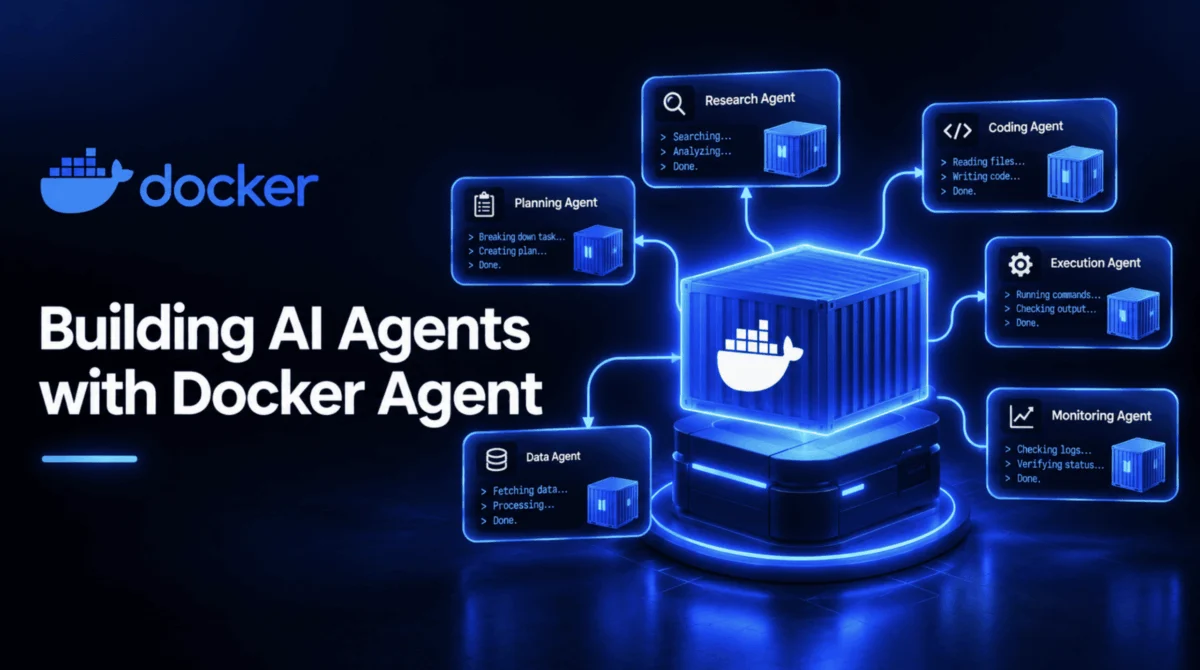
In the rapidly evolving landscape of artificial intelligence, a persistent challenge has been the "last mile" of deployment: moving an AI agent from a local Jupyter notebook or a chaotic development script into a production-ready, shareable, and version-controlled format. Docker, the company that revolutionized software development by standardizing how applications are packaged and shipped, is now applying that same philosophy to the world of LLMs and autonomous agents.
Enter Docker Agent: an open-source CLI plugin designed to treat AI agents not as ephemeral code snippets, but as immutable, distributable artifacts. By leveraging declarative YAML configurations and the familiar OCI (Open Container Initiative) registry ecosystem, Docker is providing a definitive answer to the question of how to standardize the lifecycle of agentic AI.
The Evolution of Agentic Infrastructure
Docker’s entry into the agentic space was not a sudden pivot, but the culmination of a multi-year strategy. While the developer community has spent the last two years experimenting with frameworks like LangChain or AutoGen, these solutions often suffered from "dependency hell" and environment drift.
A Chronology of Docker’s AI Journey
- Early 2025: Docker begins laying the groundwork for native AI integration, recognizing that the developer experience for AI was becoming increasingly fragmented.
- July 2025: A watershed moment occurs when Docker officially extends its Compose specification to support AI models and agents natively. This move allowed developers to define their AI infrastructure alongside their traditional web services.
- March 2026: The first tagged releases of the
docker-agentGo module appear onpkg.go.dev. The project gains immediate traction, signaling a shift toward a dedicated, specialized tool rather than a bolted-on feature. - Present Day: With over 3,300 GitHub stars and nearly 10,000 commits, Docker Agent has emerged as a robust, Apache 2.0-licensed standard for defining, running, and sharing AI agent teams.
Decoding the Docker Agent Philosophy
The core innovation of Docker Agent is the shift from imperative code to declarative configuration. In the traditional paradigm, developers write complex Python scripts to manage agent state, tool calls, and model switching. Docker Agent replaces this with a YAML or HCL configuration file.
Why Declarative Configuration Matters
By removing the "code" requirement for the definition of an agent, Docker has lowered the barrier to entry. A non-engineer can now define an agent’s persona, its model provider, and its toolset without writing a single line of logic.
Furthermore, the system is provider-agnostic. Whether a developer chooses to leverage the massive compute capabilities of OpenAI’s GPT series, the nuance of Anthropic’s Claude, or the privacy of a local model running via Docker Model Runner, the configuration remains consistent. This modularity allows teams to hot-swap models based on cost, latency, or performance requirements without rewriting the orchestration logic.
Architecting Multi-Agent Teams
Perhaps the most ambitious feature of Docker Agent is its native support for multi-agent orchestration. In modern AI workflows, a single, monolithic "God-model" is rarely as effective as a team of specialized agents.
The Coordination Pattern
Docker Agent facilitates a hierarchy where a "Root" agent acts as a coordinator. This coordinator can delegate tasks to sub-agents—such as a researcher, a coder, or a writer—each configured with its own specific environment, tools, and model.
For instance, a content research team can be structured as follows:
- The Coordinator: Manages the high-level workflow, ensuring the user’s prompt is broken down into actionable steps.
- The Researcher: Equipped with web-search tools (like the MCP-powered DuckDuckGo integration) and a local memory database, this agent gathers raw information.
- The Writer: Receives the structured findings from the researcher and transforms them into professional-grade copy.
This delegation is not just a structural convenience; it is a performance optimization. By assigning the "Researcher" role to a highly capable model and the "Writer" role to a more cost-effective model, developers can optimize their API spend while maintaining high output quality.
Leveraging the OCI Ecosystem
The most profound implication of Docker Agent is the ability to push and pull agents to OCI registries (such as Docker Hub, AWS ECR, or GitHub Packages).
Reproducibility via Digests
In the world of containers, a "tag" (like :latest) is often considered a liability in production because it can point to different versions over time. Docker Agent enforces the same best practices used in enterprise software:
- Tags for Development: Useful for rapid iteration and testing.
- Digests for Production: By pinning an agent to a
sha256digest, developers guarantee that the agent they tested in staging is identical to the one running in production. This eliminates the "it worked on my machine" problem that has plagued AI development since its inception.
Supporting Data: Security and Validation
A major concern in the agentic space is the risk of "runaway" agents. Docker Agent addresses this through strict schema validation. By using jsonschema to validate configurations, the system prevents misconfigured agents from even launching.
Moreover, the integration of the Model Context Protocol (MCP) allows agents to access external tools in a sandboxed manner. By running MCP servers inside isolated Docker containers, the agent can interact with filesystems or APIs without exposing the host machine to undue risk. For enterprise security teams, this provides an audit trail: you know exactly which tools an agent has access to and exactly what image version it is running.
Implications for the Industry
The shift toward "Containerized Intelligence" has significant implications for both software engineering and the AI industry at large.
1. The Standardization of AI Development
For years, the "AI Stack" has been a fragmented collection of Python libraries. Docker Agent suggests a future where the AI stack is just another part of the standard DevOps pipeline. This is a massive win for enterprise adoption, as it allows existing CI/CD tools to manage AI agents alongside microservices.
2. The Death of "Prompt Engineering" as a Silo
When an agent’s behavior is defined in a version-controlled YAML file rather than a hidden system prompt in a proprietary web UI, the "prompt" becomes a configuration parameter. This encourages better documentation and team collaboration, moving AI development away from "black box" magic toward transparent, reproducible engineering.
3. Edge AI and Local Model Deployment
With the maturity of Docker Model Runner, the ability to run agents locally—disconnected from the cloud—becomes a reality. For industries concerned with data sovereignty, such as finance or healthcare, the ability to define an agent team in YAML and deploy it entirely on-premises using the Docker engine is a game-changer.
Conclusion: A New Standard
Docker Agent is not just another tool in the crowded AI toolbox; it is an infrastructure layer. By applying the principles of containerization to AI agents, Docker has provided the industry with a roadmap for scaling, securing, and maintaining autonomous systems.
As organizations move from "AI experimentation" to "AI production," the ability to treat an agent as a stable, versionable, and portable asset will be the primary differentiator between successful deployments and failed projects. For those looking to build the next generation of intelligent software, the message is clear: stop writing scripts, start building images. The era of the standardized AI agent has officially arrived.
Shittu Olumide is a software engineer and technical writer passionate about leveraging cutting-edge technologies to craft compelling narratives, with a keen eye for detail and a knack for simplifying complex concepts.


 Evan Lee Salim
 Ammar Sabilarrohman




