
 Ali Ikhwan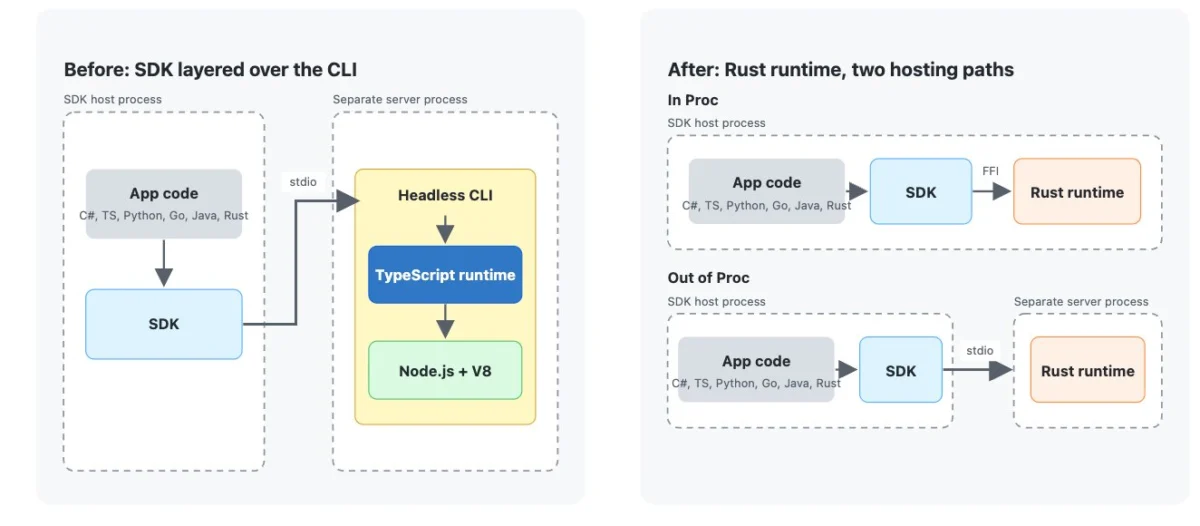
In a landmark feat of engineering that blurs the lines between legacy maintenance and cutting-edge automation, GitHub has successfully completed the migration of its Copilot runtime from TypeScript and Node.js to Rust. This massive undertaking—which involved the replacement of over 800,000 lines of production code—was not merely a refactoring exercise. It was a strategic transformation that leveraged AI-assisted development to achieve a performance leap that would have been considered unattainable by traditional manual standards.
The transition, which spanned approximately 14.5 weeks, resulted in a staggering reduction in latency. Client startup, session creation, and single-turn scenarios plummeted from 5.25 seconds to a mere 292 milliseconds. By moving away from a resource-heavy Node.js-based architecture to a native Rust implementation, GitHub has fundamentally altered how its AI-powered coding assistant interacts with host environments.
The Technical Imperative: Why Rust?
The previous architecture of GitHub Copilot was tethered to the Node.js runtime and the V8 engine. While effective for initial prototyping and cross-platform compatibility, this approach introduced significant overhead. Because the runtime operated across a process boundary, it necessitated constant communication between the host application and the Node.js instance. This architectural "tax" added roughly 100 MB of working set memory per client—a cost that scales poorly in resource-constrained development environments or IDEs already managing large codebases.
Rust, known for its memory safety, zero-cost abstractions, and lack of a garbage collector, offered a compelling alternative. By compiling the runtime into a native binary, GitHub can now embed the Copilot engine directly into host applications via a C ABI (Application Binary Interface). This shift eliminates the need for a separate Node.js process, drastically reducing the memory footprint while simultaneously unlocking near-instantaneous execution times.
The new Copilot SDK, which acts as the bridge for this transformation, now supports a diverse ecosystem of languages, including TypeScript, Python, Go, .NET, Java, and Rust, ensuring that the performance gains are accessible to developers regardless of their preferred integration stack.
A Chronology of Transformation: The Incremental Approach
Rather than opting for a "big bang" rewrite—a high-risk strategy that often leads to catastrophic regression—GitHub’s engineering team adopted an incremental replacement strategy. This methodology allowed the team to deliver 135 releases over the course of the 14.5-week migration, comprising 35 stable versions and 100 pre-release versions.
Phase 1: The Compatibility Bridge
The foundation of this migration was the establishment of a robust interoperability layer. Utilizing Node.js’s N-API, the team created a bridge that allowed TypeScript components to communicate seamlessly with new Rust modules. This was critical: it allowed the team to replace individual components of the Copilot runtime one by one, while the remaining legacy TypeScript code continued to function without interruption.
Phase 2: Concurrent Validation
Throughout the 128 pull requests that defined the migration, existing end-to-end (E2E) tests were continuously run against the evolving codebase. This ensured that the business logic remained consistent, even as the underlying execution engine underwent a total transformation. By the time the migration reached its final stages, the compatibility layer had ballooned to 2,019 internal N API exports and 3,356 TypeScript call sites—a testament to the complexity of the legacy surface area.
Phase 3: The Final Cutover
By August 21, the migration reached its zenith. The runtime had been completely purged of its Node.js dependencies, replaced by 832,378 lines of production Rust code, supported by an additional 468,689 lines of Rust unit tests. The temporary N-API compatibility layer was decommissioned, leaving behind a lean, native-compiled engine.
Supporting Data: AI as the Architect
Perhaps the most provocative aspect of this migration is the role played by AI agents. GitHub did not manually port these 800,000 lines of code; instead, they employed AI agents to handle the bulk of the implementation. However, the process was far from "set it and forget it."
Human engineering judgment remained the critical filter throughout the process. The team identified and resolved regressions that the AI agents could not perceive—specifically those involving complex state management, lifetime handling in Rust, library semantics, and nuanced performance optimizations that were lost during the initial AI-generated drafts.
The rigor of the validation process is highlighted by the data:
- Total Pull Requests: 128
- Cargo Check Runs: 4,478
- Success Rate of Automated Checks: 87.1%
- Production Rust Codebase: 832,378 lines
These figures reveal that while AI provided the velocity, human oversight provided the stability. The high frequency of cargo check runs demonstrates a culture of "test-early, test-often," where automated linting and compilation served as the first line of defense against the pitfalls of automated refactoring.
Industry and Community Responses
The developer community’s reaction to GitHub’s announcement has been a mix of admiration and cautionary skepticism. While the performance metrics are indisputably impressive, industry experts have pointed to the inherent risks of relying on AI to perform large-scale architectural migrations.
Francesco Pira, an XR Tech Lead at Leonardo, noted that the success of the project was not merely due to the AI, but rather the "small reviewable changes, compatibility layers, and human engineering judgment." This sentiment underscores that even with the most powerful AI, architectural integrity relies on the discipline of the human engineers managing the transition.
Côme Redon, a Senior Solution Engineer at Microsoft, highlighted the "challenge of identifying undocumented behavioral contracts in legacy systems." This is a significant point: legacy code often contains "hidden" logic—side effects that are not documented but are relied upon by other systems. An AI might replicate the primary function of a module while missing these subtle dependencies, which is why the compatibility-layer-first approach was so vital to GitHub’s success.
/filters:no_upscale()/news/2026/10/github-copilot-rust-migration/en/resources/1githubrust-1790473005883.jpeg)
On platforms like Reddit, discussions have focused on the "black box" nature of AI-assisted migrations. User PLBjt poignantly remarked: "The interesting part here is less that Copilot wrote Rust and more whether the migration kept the runtime’s behavior stable at the boundaries." This captures the primary fear of enterprise-scale refactoring: that you might optimize for speed at the cost of hidden, long-term stability issues that only emerge in production.
Implications for the Future of Software Engineering
GitHub’s successful migration serves as a proof-of-concept for the future of enterprise software maintenance. We are moving toward a paradigm where the "maintenance" of a legacy codebase will increasingly be delegated to AI agents, guided by human architects.
1. The Death of the "Big Bang" Rewrite
GitHub has demonstrated that incremental, AI-assisted migration is the superior path to modernization. By using compatibility layers, organizations can mitigate the risks of full-system rewrites, allowing for continuous integration and deployment while the "plumbing" of the application is replaced.
2. The Rise of Polyglot Runtime Orchestration
The new Copilot architecture, which allows for both embedded C-ABI integration and out-of-process operation, highlights a growing trend in software design: flexibility in how runtimes are consumed. As applications become more complex, the ability to switch between native performance and isolated process boundaries will become a standard requirement for high-performance software.
3. The Human-in-the-Loop Requirement
The lesson from GitHub is that AI is a force multiplier, not a replacement for domain expertise. The 4,478 cargo check runs and the meticulous human review of AI-generated code prove that "AI-assisted" really means "AI-drafted, human-validated." For the foreseeable future, the architect’s role is shifting from writing code to verifying the output of intelligent agents and ensuring that behavioral contracts remain intact.
Conclusion
GitHub’s migration of the Copilot runtime is a watershed moment in the history of developer tooling. By successfully replacing 800,000 lines of code with a Rust-based, high-performance runtime in less than four months, GitHub has provided a blueprint for how large-scale technical debt can be addressed in the era of Generative AI.
The project proves that when performance, maintainability, and security are treated as non-negotiable requirements, the combination of Rust’s safety and AI’s velocity is a formidable pairing. As other organizations look to modernize their own legacy systems, they will likely look to the Copilot migration not just for the technical achievement, but for the methodology of incremental, high-trust, AI-augmented engineering.


 Lina Irawan
 Sagoh
Sagoh





