
 Nana Muazin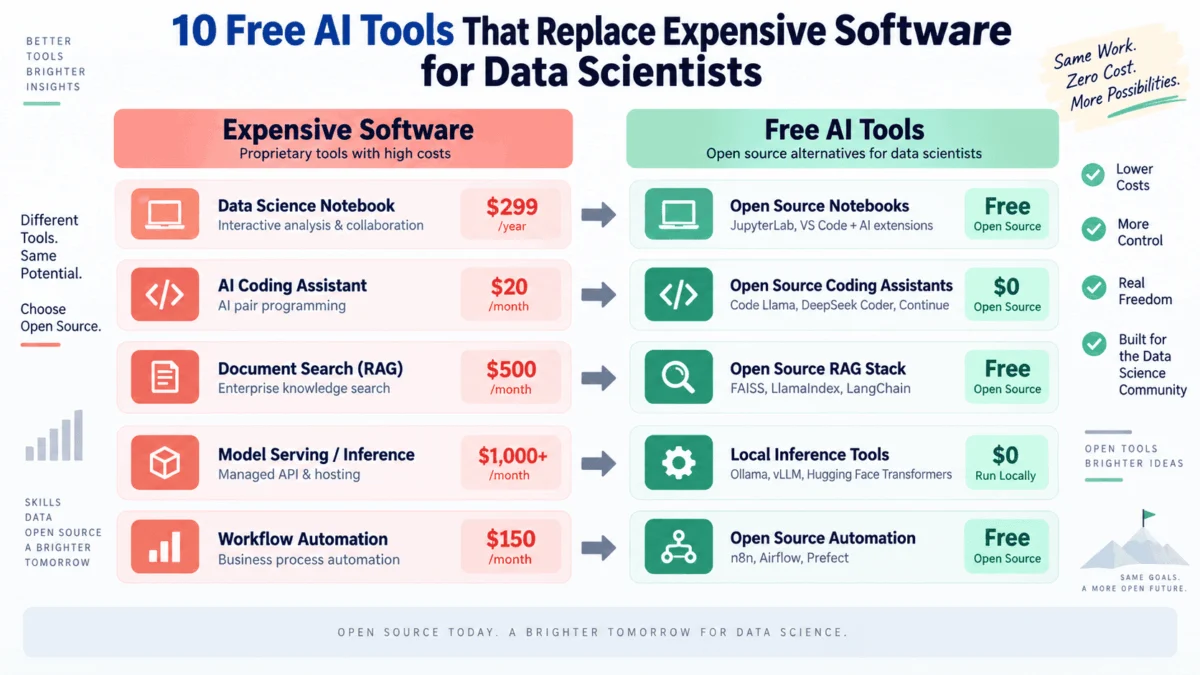
For the better part of a decade, the "data science stack" has been synonymous with a heavy tax on innovation. Enterprises have been funneled into a rigid ecosystem where a single seat at a platform like DataRobot could cost upwards of $50,000 annually, and per-token fees for Large Language Model (LLM) APIs—like those from OpenAI or Anthropic—created a "billing ceiling" that simply didn’t exist. For data-intensive teams, scaling operations meant scaling costs linearly, often forcing leaders to choose between analytical depth and budget survival.
However, a tectonic shift is underway. The quality and maturity of open-source alternatives have reached an inflection point. The gap between proprietary enterprise tools and their free, community-driven counterparts has not only narrowed—it has, in many professional workflows, effectively closed. Today, tools that once required complex cloud infrastructure and massive commercial licensing fees can be run locally, offering state-of-the-art performance that often exceeds their paid equivalents.
The Financial and Strategic Imperative
The cost of inaction is no longer just about software licensing; it is about data sovereignty. When companies route sensitive datasets, proprietary algorithms, and confidential documents through third-party APIs, they invite significant compliance and security risks. The transition to a local, open-source stack is as much about regaining control over intellectual property as it is about cutting the "AI tax."
This article explores ten pivotal open-source tools that are redefining the data science workflow, offering a blueprint for teams looking to reclaim their autonomy and their budgets.
1. Local Inference: Ollama + Open WebUI
The Replacement For: OpenAI and Anthropic APIs.
The Economic Impact: Eliminates variable per-token costs that can scale into the thousands of dollars monthly for high-volume data extraction or summarization pipelines.
Ollama has become the industry standard for running open-weight models—such as Llama 3.3, DeepSeek-R1, and Mistral—directly on local hardware. By decoupling inference from the cloud, teams remove rate limits and ensure that data never leaves their local environment. When paired with Open WebUI, users gain a sophisticated, browser-based interface that rivals the UX of ChatGPT. This setup allows non-technical stakeholders to leverage powerful models without the risk of data leakage, making it an ideal solution for secure, continuous document processing.
2. Secure Coding Assistants: Tabby
The Replacement For: GitHub Copilot Business and Tabnine.
The Economic Impact: Saves $19 to $59 per user, per month, while providing superior context-awareness.
Data sovereignty is the primary driver for adopting Tabby. While commercial tools send your codebase to remote servers for completion, Tabby is a self-hosted assistant that runs entirely within your private infrastructure. Beyond privacy, Tabby offers repository-level context indexing, allowing the model to be "aware" of internal libraries and specific coding conventions that commercial tools often ignore. For teams working in regulated environments, this is the only way to utilize AI-assisted coding without violating compliance mandates.
3. AutoML Democratization: AutoGluon
The Replacement For: DataRobot and H2O Driverless AI.
The Economic Impact: Replaces enterprise licenses that can reach $250,000 annually with a high-performance, open-source framework.
Developed by AWS and now a cornerstone of the open-source community, AutoGluon automates the entire machine learning lifecycle. It handles complex tasks like feature engineering, hyperparameter tuning, and ensemble stacking with remarkable efficacy. By running within a standard Python environment, AutoGluon eliminates the need for expensive cloud platforms, allowing data scientists to iterate continuously without the fear of hitting usage caps or billing hurdles.
4. Natural Language Analytics: PandasAI
The Replacement For: ThoughtSpot and Alteryx.
The Economic Impact: Eliminates per-user license fees (often thousands per year) for non-technical data exploration.
PandasAI introduces a natural language query layer to standard Pandas DataFrames. It allows users to query data using plain English, which the tool translates into Python or Matplotlib operations. This is a game-changer for Exploratory Data Analysis (EDA), enabling non-technical stakeholders to interrogate data independently. Because PandasAI can run locally, it serves as a powerful, private bridge between raw data and actionable insights.
5. Knowledge Management: AnythingLLM
The Replacement For: Enterprise RAG (Retrieval-Augmented Generation) platforms.
The Economic Impact: Avoids high monthly subscription fees for internal knowledge-base tools.
AnythingLLM is a full-stack RAG application that turns static files—PDFs, codebases, and websites—into a queryable, AI-driven knowledge base. Its "point-and-query" architecture allows for rapid setup without complex cloud infrastructure. By providing source citations for every answer, it offers the transparency needed for high-stakes enterprise decision-making while keeping the entire knowledge base air-gapped from external services.
6. Automated Data Labeling: Autodistill
The Replacement For: Scale AI and Labelbox.
The Economic Impact: Dramatically reduces the labor-intensive costs of manual annotation, which can run into the tens of thousands for large projects.
Autodistill utilizes foundation models like Grounding DINO and the Segment Anything Model (SAM) to auto-label computer vision datasets. By using "distillation," teams can train smaller, highly efficient models based on these labels. This process essentially automates the most expensive part of computer vision—human annotation—and reserves human review only for edge cases, drastically accelerating the time-to-market for CV pipelines.
7. Interactive Visualization: PyGWalker
The Replacement For: Tableau and Power BI Premium.
The Economic Impact: Eliminates high per-user monthly costs for visualization tools.
PyGWalker transforms a Jupyter notebook into an interactive visual exploration environment. By mimicking the shelf-based interface of Tableau, it allows data scientists to perform drag-and-drop analysis without ever leaving their coding environment. This eliminates the "export-to-BI-tool" friction, ensuring that visualizations are inherently reproducible and tethered directly to the underlying data source.
8. Experiment Tracking: MLflow
The Replacement For: Weights & Biases (Enterprise).
The Economic Impact: Removes per-seat pricing and provides a unified standard for experiment tracking.
MLflow has solidified its position as the open-source standard for experiment tracking and model registry management. Its recent expansion into LLM observability—tracking prompts, responses, and token usage—makes it a comprehensive tool for both traditional machine learning and modern generative AI projects. Because it is self-hosted, it ensures that sensitive experimental metadata remains entirely under the organization’s control.
9. Local Data Warehousing: DuckDB
The Replacement For: Snowflake and BigQuery.
The Economic Impact: Saves thousands in monthly compute and storage costs for analytical workloads.
DuckDB is an in-process analytical database that allows for high-performance SQL queries on local files (Parquet, CSV, etc.) without needing a cloud server. For datasets under 100GB, DuckDB often outperforms managed cloud warehouses. By removing the need for data movement and cloud compute charges, it allows for faster, cheaper, and more private analytical workflows.
10. LLM Observability: Langfuse
The Replacement For: LangSmith.
The Economic Impact: Eliminates per-trace pricing for LLM debugging and evaluation.
Langfuse provides critical visibility into LLM pipelines, capturing traces, latency, and cost in real-time. By deploying it via Docker on private infrastructure, teams can monitor their applications without committing to expensive, proprietary observability platforms. It is the missing link for teams that need to debug inconsistent AI outputs while maintaining strict data governance.
Implications and Implementation Strategy
The primary barrier to adopting this open-source stack is not technical capability, but rather the initial investment in configuration. While proprietary platforms sell "convenience" in exchange for high subscription fees, open-source tools require a shift toward "engineering ownership."
For organizations looking to transition, the most effective strategy is a phased approach:
- Identify the "Pain Point": Start with the single highest line item in your current software budget.
- Pilot a Replacement: Spend a two-week sprint setting up an open-source equivalent.
- Verify Compliance: Ensure that the local deployment meets your internal security and data privacy standards.
- Scale: Once the workflow is stabilized, systematically replace the next tool in the chain.
The era of the "all-in-one" expensive enterprise suite is ending. In its place is a modular, high-performance, and deeply customizable stack that returns power to the developers and data scientists who build the future. By embracing these ten tools, organizations can stop paying for the privilege of working and start investing in the value of their insights.


 Evan Lee Salim
 Ammar Sabilarrohman




