
 Asep Darmawan
The global marathon circuit is currently experiencing a historic surge in popularity, evolving from niche athletic challenges into massive, multi-billion-dollar tourism engines. Following a landmark year for the sport—highlighted by record-shattering performances in London that pushed the boundaries of human potential—the spotlight is shifting to the United States. This October and November, Chicago and New York City stand at the epicenter of this movement, preparing to welcome tens of thousands of athletes and millions of spectators.
New data released by Amadeus Travel Intelligence confirms that these iconic races are not merely athletic spectacles; they are profound drivers of domestic and international travel demand. As air travel surges and hotel occupancy rates climb, the hospitality industry is witnessing a shift in traveler behavior that underscores the rising influence of "wellness tourism."
The Economic Pulse of the Marathon Season
The economic impact of the Chicago and New York marathons is measurable through the granular lens of travel intelligence. For hoteliers and city planners, these events represent a "perfect storm" of demand, where supply is finite and interest is global.
Chicago: High Occupancy and Premium Pricing
Chicago’s marathon weekend, which typically spans Friday through Sunday, has become a high-water mark for the city’s hospitality sector. According to Amadeus Demand360®, hotel occupancy for the marathon weekend currently sits at a robust 85.9%. Perhaps more importantly for the local economy, the Average Daily Rate (ADR) has surged to $364.00. Compared to the same period last year, on-the-books occupancy is up by 1.8%, while the ADR has seen a significant 10.2% increase, signaling that travelers are willing to pay a premium for proximity to the race course.
New York: Price Appreciation Amidst Changing Dynamics
While New York City presents a slightly different narrative, the economic indicators remain bullish. Occupancy is currently paced at 58.1%—a marginal dip of 0.7% compared to last year—but the city is compensating through pricing power. The ADR in New York has climbed 12.4% to reach $369.00. This indicates that while the volume of rooms booked may fluctuate slightly, the perceived value of being in the city for the marathon has never been higher, allowing hoteliers to optimize revenue management strategies effectively.
Chronology of a Global Movement
The rise of the "marathon tourist" did not happen overnight. It is the culmination of a decade-long shift in lifestyle trends where fitness has moved from a private hobby to a social currency.

- Q1-Q2 (The Training Phase): Travel demand begins to reflect race registration calendars, with long-haul flights from key international hubs showing early spikes as elite and amateur runners secure their travel logistics months in advance.
- The "London Effect" (April): The spring season brought unprecedented global attention to the sport. The first official sub-two-hour marathon efforts solidified the marathon as a premier global sporting event, acting as a catalyst for increased interest in fall marathons in the U.S.
- The Autumn Peak (October-November): The Chicago and New York races serve as the grand finale of the global marathon calendar. These dates have become "anchor events" for the hospitality industry, dictating hotel pricing, airline capacity adjustments, and city-wide event planning.
The Geography of Demand: Where are the Runners Coming From?
While domestic runners remain the bedrock of the events, the international footprint of these marathons is expanding rapidly. Data from Amadeus reveals that the "runners’ map" is becoming increasingly decentralized.
The New York International Surge
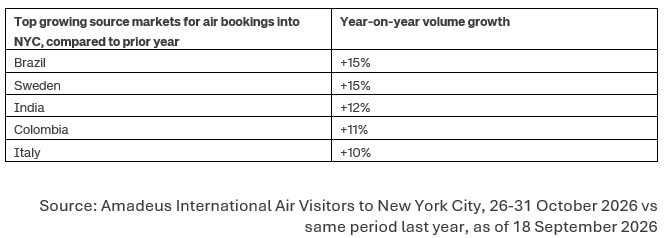
New York continues to solidify its reputation as a global destination. The city is seeing a dramatic influx of travelers from diverse markets. Italy has emerged as a powerhouse, with inbound arrivals from Rome up by 48% and Milan by 12%. Simultaneously, Brazil is proving to be a critical growth market, with arrivals from São Paulo rising by 34%. This diversification suggests that the marathon is a primary draw for travelers who might otherwise have visited New York during a different season, highlighting the efficacy of sports-based tourism marketing.
The India Connection: A Rising Source Market
Perhaps the most notable trend in the latest data is the sustained growth in arrivals from India. Both Chicago and New York are benefiting from this emerging market. For the Chicago marathon, arrivals from India have increased by 14% year-on-year, accounting for 3.8% of the city’s total international traffic. New York is seeing a similar trend with a 12% increase, led largely by a 30% surge in traffic from Delhi. This suggests that Indian runners are increasingly viewing U.S. marathons as bucket-list experiences.
The Sunbelt Powerhouse: Domestic Travel
Domestically, the "Sunbelt" region—particularly Texas—is fueling the demand. Texan cities are the primary origin points for the surge in domestic travel to both host cities. For the Chicago marathon, arrivals from Texas have increased by 24%, while for New York, the growth is an staggering 86%. Houston, in particular, has seen a 121% increase in travelers heading to New York for the race, suggesting that running clubs and large social groups in the South are organizing mass trips to these events.
Understanding the "Fly-In, Race, Fly-Out" Dynamic
A critical challenge and opportunity for the travel industry is the behavioral pattern of these visitors. Currently, the industry is dominated by a "fly-in, race, fly-out" model.
Short-term stays of one to five nights account for 88% of domestic air travel into Chicago and 87.4% into New York. This high frequency of short-stay travel places immense pressure on local infrastructure and presents a logistical challenge for hotels trying to maximize revenue beyond the race weekend. International travelers, by contrast, are more likely to stay for longer durations, with nearly half of all international arrivals staying beyond the five-night window.
However, a new segment is emerging: the large-group traveler. Domestic bookings for parties of six or more have seen explosive growth—up 106% for Chicago and 241% for New York. This shift represents a massive opportunity for hoteliers. By offering curated packages that bundle race registration support, recovery services (such as spa access or specialized nutrition), and extended stay discounts, hotels can encourage these large groups to stay longer, effectively converting a weekend race into a week-long vacation.
Industry Expert Perspectives
The data-driven nature of these events has changed the conversation for industry leaders. Jill Boegel, SVP of Commercial, Americas, Hospitality at Amadeus, emphasizes the shift in traveler priorities. "On-trip wellness and fitness is no longer an afterthought for travelers; it is now a driving force of travel itself," she notes. "Events such as marathons create short, precise windows of demand, making data-driven insight increasingly important for hoteliers and destinations to identify audiences, target demand effectively, and optimize operations."
For Boegel, the key lies in personalization. By leveraging data, hotels can move beyond simple room sales and start offering "wellness-minded" experiences that resonate with the specific needs of an athlete preparing for or recovering from a 26.2-mile run.
Chris Heywood, Senior Vice President at Brand USA, highlights the broader cultural implications. Reflecting on a year where international soccer tournaments brought the world to the U.S., he notes, "Sport can be fantastically unifying. It’s terrific to see events like the Abbott marathons continue to draw in runners and spectators from around the world. I hope to see this trend continue and deepen—perhaps with attendees taking extra days around the race weekend to see what these great cities and even destinations beyond have to offer."
Implications: The Future of Sports Tourism
The integration of marathon schedules into the broader travel economy offers a roadmap for how cities can manage demand spikes. As these events continue to scale, the industry must focus on three core areas:
- Sustainability and Infrastructure: With millions of spectators and thousands of runners, host cities must balance the influx of travel with urban sustainability goals.
- Targeted Personalization: Hotels that treat marathon runners not just as guests, but as athletes, will capture the highest loyalty. This includes everything from high-protein room service menus to late check-out options for post-race recovery.
- Extended-Stay Incentives: The data regarding large-party growth is a clear call to action. By incentivizing these groups to stay 48 hours longer, cities can significantly increase the total economic output of the event without needing to attract a higher volume of individual travelers.
As the Chicago and New York marathons approach, they stand as a testament to the power of human endurance—not just on the pavement, but in the global economy. The intersection of sports, data, and travel is creating a new, vibrant ecosystem, one where the finish line is just the beginning of the journey.


 Azzam Bilal Chamdy
 Ali Ikhwan




