
 Layla Zulfa
In the competitive world of hospitality, corporate travel remains the bedrock of revenue stability. While leisure guests fill rooms on weekends, corporate accounts provide the essential, high-volume midweek demand that keeps occupancy rates—and profits—consistent. However, the days of passive "reactive" selling are over. To thrive in the modern market, hotels must transition from viewing corporate business as a stack of RFP responses to managing it as a sophisticated, high-performance portfolio.
The Evolution of the Corporate Sales Strategy
A robust hotel corporate sales strategy is an organized, proactive plan designed to capture and grow bookings from business travelers. It transcends simple rate negotiation; it encompasses precise account targeting, strategic distribution visibility, and rigorous, long-term relationship management.
The industry’s most persistent failure is "reactive selling"—a cycle where hotels wait for Request for Proposal (RFP) season, blindly bid on every opportunity, and measure success by the sheer volume of loaded rates. This approach often leads to a system clogged with low-yield accounts that provide negligible revenue while incurring high administrative costs. In many cases, the technical labor of loading and auditing these unproductive rates exceeds the actual profit generated by the business. A winning strategy, by contrast, treats corporate accounts as a diversified portfolio, balancing large, medium, and small entities to ensure yield and volume are perfectly calibrated.
Why Corporate Business Is the New Revenue Frontier
Corporate travel is not merely "back to normal"; it is undergoing a fundamental transformation. According to the Global Business Travel Association (GBTA), global business travel spending is forecasted to reach a record-breaking $1.71 trillion by 2026. While the volume of trips is growing at a modest 1.3 percent, the total spend is rising by 7.2 percent.
This divergence is critical: fewer trips are occurring, but those that do are significantly more valuable. As Suzanne Neufang, CEO of the GBTA, noted, companies are becoming "increasingly more selective and productivity-focused." For hoteliers, this means that every corporate account is now under a microscope. Organizations are consolidating their travel programs, directing more volume to fewer preferred suppliers. Hotels that cannot demonstrate consistent service, clear value propositions, and reliable booking patterns are being pruned from these preferred lists. Consequently, securing a place in a corporate program is no longer just about the lowest rate; it is about proving one’s worth as an indispensable partner.

The Anatomy of an Account Portfolio
Building a successful portfolio requires a shift in mindset. Instead of chasing every RFP, hoteliers should perform a deep-dive audit of their local market.
Mapping the Local Demand Generators
The most effective prospecting begins within a 15-minute drive of the property. Hoteliers should identify the "engines" of their local economy—universities, hospitals, construction firms, manufacturing hubs, and corporate headquarters.
Consider the case of a boutique hotel located near a major shipping port. While a large international hotel chain might chase global Fortune 500 accounts, this independent property finds its highest value in marine engineering firms that send project teams to the port for weeks at a time. These are not one-off travelers; they are consistent, recurring demand generators. By focusing on firms with a legitimate, geographically specific reason to be near the hotel, sales managers ensure their portfolio is anchored in reality rather than aspiration.
The Power of Segmentation
A balanced portfolio typically follows a 3-tier structure:
- Anchor Accounts: Three to five major clients providing 300+ room nights annually. These are the foundation of your occupancy.
- Growth Accounts: Ten to fifteen mid-sized firms generating 100–300 room nights. These represent the primary focus for expansion.
- Tactical Accounts: A "tail" of smaller companies managed via flexible corporate rates rather than complex contracts, reducing administrative overhead.
The RFP Response: A Chronological Discipline
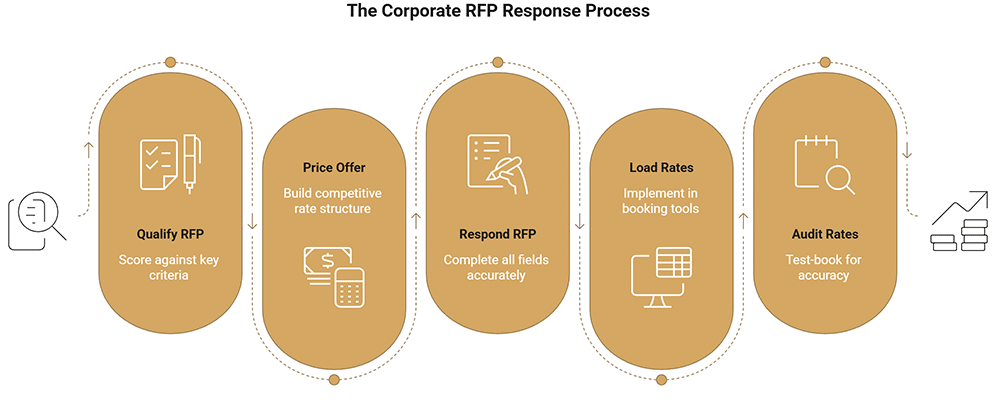
The RFP process is where strategy meets execution. It should be handled as a rigorous, time-bound project.

- Phase 1: Qualification (August–September): Before bidding, score the RFP against your internal needs. Does this client travel during your high-demand periods? Does their rate tolerance match your revenue goals? If the answer is no, declining the RFP is a strategic victory.
- Phase 2: Pricing and Terms (September–October): Structure your offer with care. Define your inclusions, blackout dates, and cancellation policies. This is the moment to protect your yield.
- Phase 3: Submission (October–November): Ensure every field is completed. Many procurement platforms use automated filters that reject incomplete bids before a human ever reviews them.
- Phase 4: Technical Loading (December): Once accepted, ensure rates are loaded into the Global Distribution System (GDS) and client booking tools with 100% accuracy.
- Phase 5: The Audit (January): During the first two weeks of the contract year, perform a "test booking." If the system does not display the rate or the inclusions as promised, fix it immediately.
- Phase 6: Quarterly Reviews: Never let an account run on autopilot. Review production data every quarter and communicate directly with the buyer if the actual volume falls short of projections.
Navigating Rate Structures: LRA vs. NLRA
One of the most common mistakes in corporate sales is the blanket application of Last Room Availability (LRA) rates. An LRA agreement guarantees that a client can book their negotiated rate as long as a single standard room remains in your inventory. While this is attractive to the client, it is dangerous for the hotel on high-demand dates when the market is willing to pay significantly higher rates.
Reserve LRA for your top-tier anchor accounts that provide reliable, year-round volume. For smaller or more unpredictable accounts, utilize Non-Last Room Availability (NLRA) or dynamic pricing—a fixed percentage discount off the Best Available Rate (BAR). This protects your yield during peak periods while still offering a competitive price to your corporate partners.
The Critical Role of GDS and TMCs
Managed travel is effectively governed by Travel Management Companies (TMCs) and online booking tools. These platforms pull their data from the GDS (Global Distribution System). If your hotel is not represented in the GDS, you are essentially invisible to half of the corporate travel market.
For independent properties, GDS connectivity is an investment that must be calculated against expected return. However, connectivity alone is insufficient. You must maintain "content hygiene"—ensuring that your property descriptions, room photos, and amenities are accurate. A common issue is the "breakfast inclusion" mismatch: if a corporate rate includes breakfast, but the GDS fails to display it, the traveler may perceive your rate as more expensive than it is, leading them to book a competitor.
Unlocking Hidden Revenue: Meetings and MICE
A fatal error in hotel sales is the siloed approach, where the "Corporate Sales" team and the "MICE" (Meetings, Incentives, Conferences, and Exhibitions) team never speak. An account that sends 50 individual travelers a year is likely also hosting quarterly training sessions, board meetings, or project kick-offs.
During every account review, the sales manager should explicitly ask: "Who handles the meeting and training logistics for your team?" By capturing these events, you transform a transient account into a multi-dimensional revenue stream. Small meetings are particularly lucrative; they often require short lead times and can fill midweek gaps that would otherwise remain empty.
The Future: Data-Driven Relationship Management
The role of the corporate sales manager at a mid-sized or independent property has shifted from "salesperson" to "portfolio analyst." You do not need a massive sales department to succeed; you need one dedicated individual who owns the process and has protected time for prospecting and analysis.
The KPIs for this role should be clear:
- Materialization Rate: Are clients actually booking the volume they promised?
- ADR Spread: How does the negotiated rate compare to the BAR?
- Midweek Occupancy Growth: Are you successfully stabilizing your Tuesday and Wednesday nights?
If these metrics are moving in the right direction, your strategy is sound. In the modern hospitality era, the hotels that win are those that stop guessing and start managing. By auditing your base, qualifying your prospects, and treating corporate buyers as true partners, you ensure that your property remains a cornerstone of the global business travel economy.


 Evan Lee Salim
 Iffa Jayyana