Rifan Muazin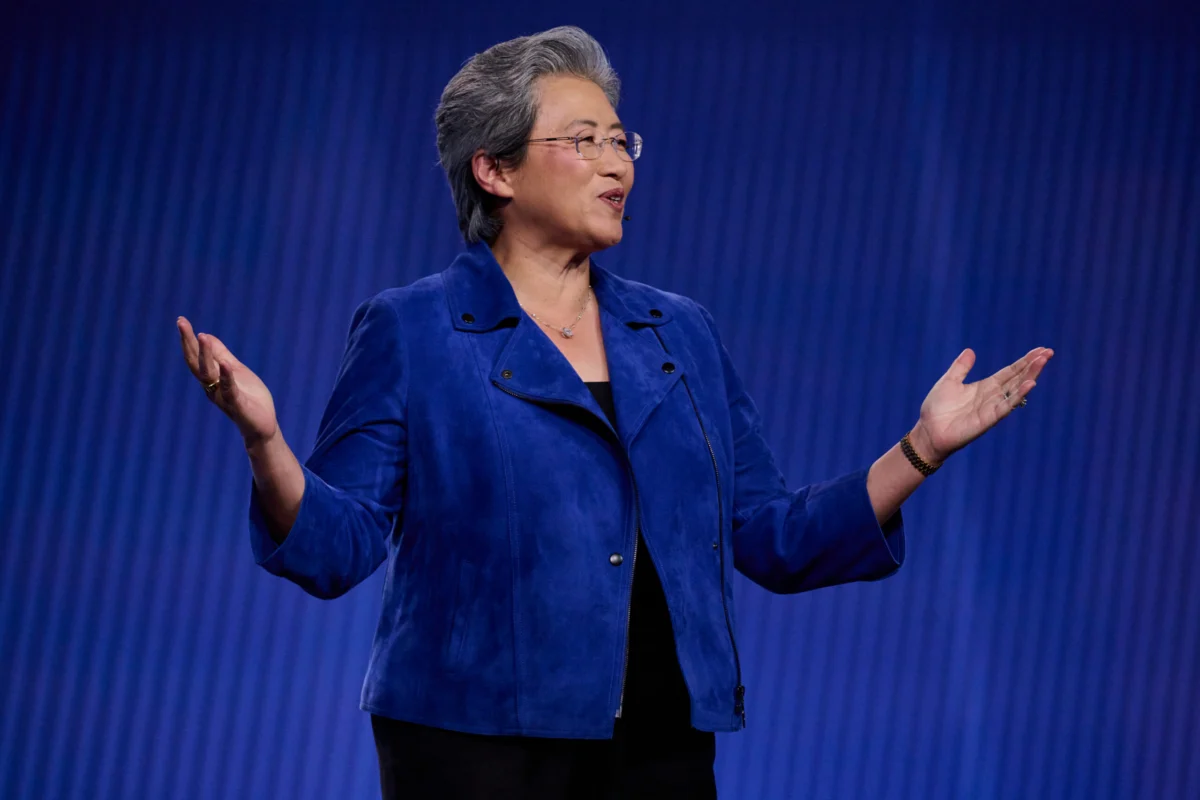
In a high-stakes showdown that marks a pivotal shift in the artificial intelligence hardware landscape, AMD has officially fired its latest volley at long-time industry hegemon Nvidia. During a sold-out "Advancing AI" conference in San Francisco this Thursday, AMD Chair and CEO Dr. Lisa Su unveiled the company’s new rack-scale system, Helios. Designed to be the backbone of the world’s most ambitious AI laboratories, Helios is not merely a product launch; it is a strategic maneuver intended to dismantle Nvidia’s near-monopoly on the data center infrastructure that powers the generative AI revolution.
The Architecture of Power: What is Helios?
At the core of the announcement is the Helios rack system. In the world of high-performance computing, a "rack" is a consolidated, high-density unit that houses dozens, sometimes hundreds, of processors, cooling systems, and networking components. These units are the engines of the modern internet, serving as the primary infrastructure where massive AI models are trained and executed.
Dr. Su described Helios as the "highest-performance AI rack" in the industry today, explicitly engineered to handle the "frontier models"—the most complex and resource-intensive AI systems currently under development. With the ability to be deployed at a gigawatt-scale, Helios represents a modular, brute-force approach to scaling compute. By integrating advanced GPU clusters with high-speed interconnects, AMD is positioning Helios as the premier destination for companies that are hitting the physical and power limitations of their current data centers.
Chronology of a Strategic Pivot
The path to Helios has been a calculated, multi-year progression for AMD, reflecting the company’s evolution from a consumer-focused chipmaker to a primary architect of the AI age.
- 2025 – The Reveal: AMD first teased the concept of its rack-scale system, signaling to investors and the broader tech industry that it intended to compete directly with Nvidia’s proprietary hardware stacks.
- January 2026 – Public Debut: Helios made its first tangible appearance at CES 2026. The physical presence of the unit—which weighs roughly as much as two compact cars—served as a visceral reminder of the immense hardware requirements needed to fuel modern LLMs (Large Language Models).
- July 2026 – Full Commercial Rollout: Following a series of tests and optimizations, the Advancing AI conference served as the formal "go-to-market" event, with Dr. Su announcing that shipments would commence later this year.
- The Future – 2027 and Beyond: The company also announced the upcoming Venice-X CPU, slated for a 2027 launch. Designed for high-performance computing, the Venice-X is expected to offer 96 cores and 1,152 MB of 3D V-Cache, ensuring that AMD’s CPU roadmap remains as competitive as its GPU offerings.
Supporting Data: AMD vs. Nvidia
The rivalry between AMD and Nvidia has never been more intense. Historically, Nvidia has held a commanding lead with its Vera Rubin and Grace Blackwell architectures. However, the market is beginning to show signs of fragmentation as hyperscalers—the massive cloud providers like Microsoft, Meta, and Google—look for alternatives to avoid vendor lock-in and high pricing.
According to industry reports and preliminary performance benchmarks, Helios is not just keeping pace with Nvidia’s current offerings; in several critical metrics, it is outpacing the Vera Rubin architecture. By focusing on "full-stack compute," AMD is attempting to provide a more flexible, programmable ecosystem. Dr. Su argued that because AI algorithms are still in their infancy and subject to rapid change, the programmability of the silicon is a significant competitive advantage. As workloads evolve, the ability to adapt hardware at the software level becomes more valuable than static, specialized performance.
The Industry Response: A Roster of Giants
The legitimacy of AMD’s challenge is underscored by its immediate adoption by the world’s leading AI firms. The "Helios" system has already secured a significant client base, including OpenAI, Meta, Oracle, Anthropic, and Microsoft.
The most notable endorsement came from Microsoft CEO Satya Nadella, who confirmed on Monday that Microsoft would be significantly expanding its Azure cloud infrastructure using the Helios platform. This is a massive win for AMD, as Azure is the primary hosting platform for OpenAI’s models.
Furthermore, the strategic partnership between AMD and Anthropic announced this Wednesday—which involves the deployment of up to two gigawatts of AMD Instinct MI450 series GPUs—demonstrates that major AI labs are actively diversifying their hardware supply chains. This shift is not just about price; it is about supply chain security and ensuring that the training of next-generation models is not throttled by the availability of a single supplier’s hardware.
Implications: The $1.4 Trillion Horizon
Perhaps the most significant takeaway from the event was Dr. Su’s economic forecast. She projected that by 2030, the global market for AI accelerators will reach approximately $1.4 trillion. To put that in perspective, the AI accelerator market is expected to grow to nearly the size of the entire current semiconductor market by the end of the decade.
The Era of Agentic AI
The primary driver for this growth, according to Su, is the transition from simple chatbot interfaces to "agentic AI." Unlike traditional AI, which provides a response to a single prompt, agentic AI acts as an autonomous worker.
"When you ask the agent to do something, it actually has dozens of steps," Su explained. "It has to reason, it has to call tools, it has to access data, and it has to keep doing it over and over until it solves the problem. You need lots of GPUs to do all that."
This "step change" in compute demand suggests that the current era of AI development is just the tip of the iceberg. As AI moves from generating text to executing complex, multi-stage workflows, the hardware demand will grow exponentially.
Why GPUs Will Rule
Despite the potential for specialized ASICs (Application-Specific Integrated Circuits) to gain market share, Su remains bullish on GPUs. She noted that because the underlying algorithms of AI are still evolving so rapidly, the flexibility inherent in GPU architectures remains the most efficient path forward. If the math behind AI were to change tomorrow, a programmable GPU can adapt; a rigid ASIC might become obsolete.
Conclusion: A New Competitive Reality
AMD’s aggressive push into the rack-scale market with Helios represents a fundamental shift in how the industry views infrastructure. By offering a high-performance, flexible, and scalable alternative to Nvidia, AMD is forcing a conversation about long-term sustainability and supply chain diversity in the AI sector.
As we look toward 2030, the battle for the $1.4 trillion accelerator market will be defined by who can provide the most power-efficient, performant, and reliable hardware for the age of agentic AI. With Helios, AMD has signaled that it is no longer content to play second fiddle. The race for the compute-hungry dragon of the AI industry is officially on, and the stakes have never been higher for both the companies building the chips and the world that relies on the intelligence they produce.


 Ammar Sabilarrohman
 Pevita Pearce