Lina Irawan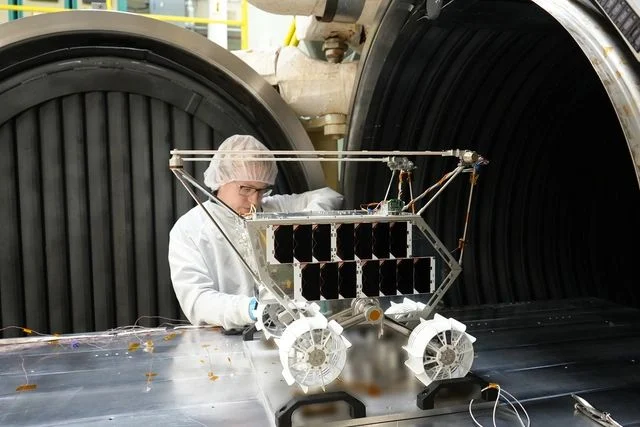
As the global race for lunar dominance intensifies, the primary battlefield is shifting from mere transportation to computational intelligence. Nvidia, the undisputed titan of the terrestrial artificial intelligence revolution, is setting its sights on a new, high-stakes environment: the Moon. Through a strategic collaboration with space-robotics startup Lunar Outpost, Nvidia is preparing to deploy its Jetson edge-computing platform to the lunar surface, marking what could be the first instance of a dedicated GPU processing data in the harsh, radiation-drenched environment of our nearest celestial neighbor.
The Mission: Bringing Physical AI to the Moon
The initiative centers on the integration of Nvidia’s Jetson chips into Lunar Outpost’s next-generation rovers. These chips, designed for power efficiency and high-performance local processing, are tasked with managing the rovers’ sophisticated lidar systems. By shifting from traditional, rigid computing architectures to a "Physical AI" approach, Lunar Outpost aims to grant its robots the ability to interpret, navigate, and react to the unpredictable lunar terrain in real-time.
For Lunar Outpost, the transition represents a paradigm shift. "We’re taking the Nvidia Jetson and comparing it to our flight compute platform that has a little bit more spaceflight heritage," explains Justin Cyrus, CEO of Lunar Outpost. "We’re seeing what the pros are, seeing what the cons are. And we’re really pushing towards trying to adopt these more capable GPU-powered systems in these extreme environments."
Chronology: A Roadmap to the Lunar Surface
The path to this lunar debut is part of a broader, aggressive timeline supported by NASA’s Commercial Lunar Payload Services (CLPS) program. This initiative mirrors the agency’s successful public-private partnership model with SpaceX, incentivizing private industry to lead the charge in lunar exploration.
- Late 2024: The upcoming mission, scheduled to launch on a SpaceX Falcon 9 rocket before the year’s end, will carry the Nvidia-equipped rover. This mission is designed to test the viability of advanced GPUs in the extreme lunar environment.
- The Reiner Gamma Mission: Following the initial deployment, a subsequent mission is slated to investigate the "Reiner Gamma" region, a mysterious magnetic anomaly on the Moon’s surface that has long baffled planetary scientists.
- The Pegasus Era (2026–2028): Looking further ahead, Lunar Outpost is developing "Pegasus," a larger, more robust rover platform designed specifically to support human astronauts. While the timeline is subject to the development cycles of heavy-lift launch vehicles like Blue Origin’s New Glenn, the overarching goal remains a sustained human presence on the Moon by 2028.
The Technical Hurdle: Surviving the Lunar Environment
Deploying silicon in space is a monumental challenge. While GPUs have been used in orbital satellites—which benefit from the Earth’s magnetic field and are relatively shielded—the lunar surface is a different beast entirely. It is a world of extreme temperature swings and direct exposure to cosmic radiation.
The Thermal and Radiation Challenge
The Moon possesses no atmosphere to moderate temperatures or deflect high-energy particles. During the lunar day, temperatures can soar to 127°C, while the lunar night drops to a brutal -173°C. For an electronic component, these fluctuations are catastrophic, leading to thermal expansion and contraction that can fracture delicate solder joints and degrade silicon pathways.
"Your system has to survive lunar night and has to do so on very low power," notes Cyrus. The Jetson platform, while compact and efficient, must be encased in specialized thermal-management systems to ensure that its high-density transistors do not suffer from the "dark-side" freeze or the "day-side" overheat.
The Role of Edge Computing
The necessity of the Jetson chip lies in "Physical AI." Older space-exploration models relied on "deterministic" computing—scripts that follow a rigid, pre-programmed set of instructions. If an unexpected obstacle appeared, the robot would often have to stop and wait for a command signal from Earth, which takes roughly 1.3 seconds to travel each way. By embedding GPUs, the rover can process sensor data locally, enabling it to avoid craters, identify mineral-rich soil, and adjust its trajectory in milliseconds.
Supporting Data: The Ecosystem of Lunar Tech
Nvidia’s push into space is not limited to surface rovers. The company has also announced a strategic partnership with Firefly Aerospace. Firefly, which earned its place in history as one of the first private companies to land a robotic payload on the Moon, is now integrating the Jetson platform into an orbiting lunar satellite.
This satellite will serve a dual purpose:
- Mapping and Imagery: Utilizing onboard GPUs to process high-resolution visual data in orbit, reducing the bandwidth required to send massive image files back to Earth.
- Infrastructure Monitoring: As the lunar surface becomes more populated with robots from various nations and companies, the orbiting GPU-powered satellite will serve as a traffic-control and monitoring hub, tracking the location and health of assets on the ground.
Official Responses and Strategic Implications
The implications of this move extend far beyond simple scientific discovery. NASA’s current strategy is focused on moving from temporary exploration to permanent habitation. To achieve this, the agency requires a "robotic workforce" capable of operating independently to build infrastructure, extract water, and prepare sites for human arrivals.
The Vision of Permanence
"What we at Lunar Outpost are currently working on is how do we go from exploration to permanence, how do we actually build that outpost on the moon?" Cyrus says. He believes the marriage of deterministic programming and physical AI is the "secret sauce" that will enable sustainability. If robots can perform the heavy lifting, resource extraction, and site maintenance without constant human oversight, the cost of a lunar base drops exponentially.
Challenges in Launch Infrastructure
Despite the technological optimism, the industry remains tethered to the availability of heavy-lift launch vehicles. The delay of Blue Origin’s New Glenn rocket—which was slated to carry the larger Pegasus rover—serves as a reminder that even the most advanced AI is useless if it cannot leave the ground. While Blue Origin has reported "good progress," the uncertainty surrounding launch windows highlights the bottleneck in the current "New Space" economy.
The Future: Toward Space Data Centers
The long-term trajectory for companies like Nvidia and Lunar Outpost points toward the creation of "space data centers." If a lunar base can support local compute power, the Moon could eventually serve as a processing hub for deep-space telemetry, astronomical observations, and even manufacturing operations.
By proving that Nvidia’s Jetson can survive the harsh reality of the Moon, these companies are effectively laying the digital foundation for a space-faring civilization. The transition from terrestrial AI to extraterrestrial physical AI is more than just a marketing milestone for Nvidia; it is a critical step in the evolution of humanity’s ability to survive and thrive off-planet.
As the industry waits for the next generation of rockets to reach the pad, the focus remains on the "edge"—the jagged, cratered, and unforgiving edge of the lunar frontier. If the Jetson can succeed there, the promise of a permanent, AI-supported human outpost on the Moon moves from the realm of science fiction into the practical reality of the late 2020s.
Disclaimer: This article contains references to commercial technology. Links provided in the original reporting may result in affiliate commissions, which support ongoing journalistic efforts at TechCrunch and other industry outlets. The author, Tim Fernholz, brings decades of expertise in the private space sector to this analysis.


 Ammar Sabilarrohman
 Pevita Pearce