Dwi Wanna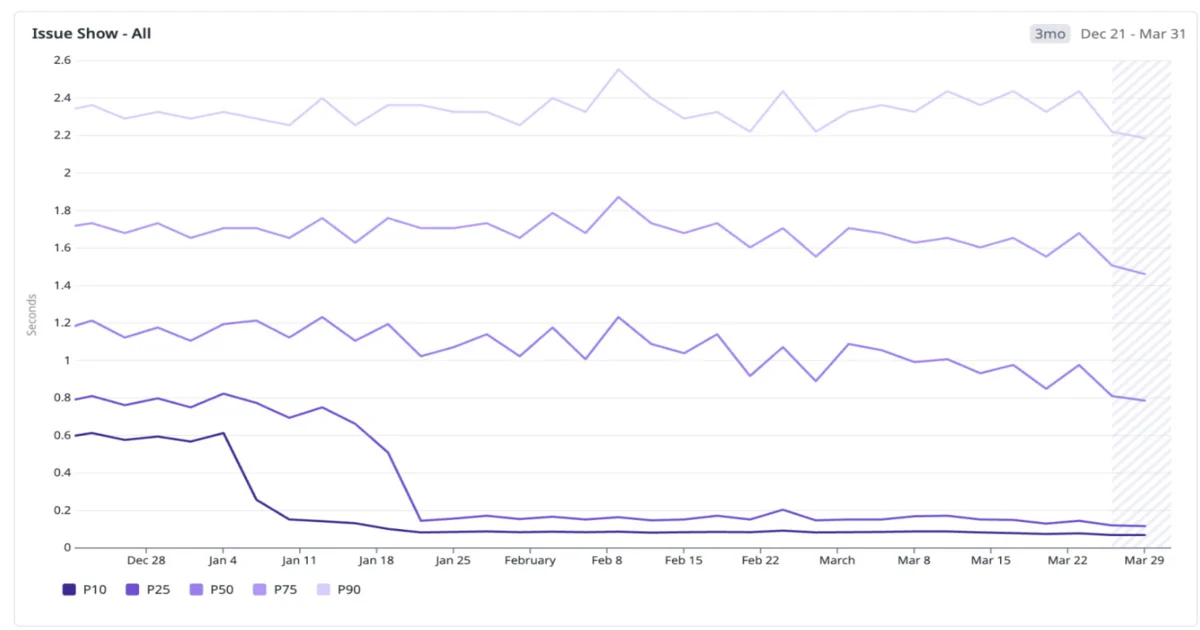
In the high-stakes world of software development, where developer productivity is measured in milliseconds, GitHub has taken a significant step toward redefining the user experience. The company recently unveiled a comprehensive architectural redesign of its "GitHub Issues" navigation system, shifting from a traditional server-dependent model to a sophisticated client-side architecture. By leveraging predictive prefetching, service workers, and multi-layered caching, GitHub has effectively moved the needle on performance, increasing "instant" navigation experiences from a mere 4% to a robust 22%.
This shift represents more than just a technical optimization; it signals a fundamental change in how large-scale web applications approach the "latency tax" associated with frequently repeated workflows.
The Core Challenge: The Latency Tax in Web Applications
For developers managing large-scale projects, GitHub Issues is the central nervous system of collaboration. However, the sheer volume of data and the frequency of movement between issue lists, individual tickets, and project boards previously created a significant bottleneck. In a traditional web architecture, every navigation event triggers a network request, a server-side fetch, and a full page or component re-initialization.
These repeated requests create cumulative delays. While a few hundred milliseconds might seem negligible in isolation, they aggregate into "context switching" friction. As Alexander Lelidis, a senior software engineer at GitHub, astutely noted, "Latency isn’t just a metric; it’s a context switch." When a developer’s flow is interrupted by a loading spinner or a delayed render, the mental overhead required to maintain focus increases. GitHub’s engineering team identified that the primary culprit was the dependency on backend services for data that, in many cases, had already been retrieved during the current session.
Chronology of the Redesign
The road to "instant" navigation was not a singular event but a methodical engineering journey.
Phase 1: Identifying the Bottleneck
The engineering team began by analyzing user behavior patterns. They discovered that power users—those who manage thousands of issues—frequently cycle through the same sets of data. The team realized that the existing architecture was treating every navigation request as "new," ignoring the high probability that the user had already interacted with the requested content.
Phase 2: Adopting a Local-First Philosophy
Moving away from the "server-first" paradigm, GitHub pivoted toward a local-first approach. The goal was to ensure that the browser could render the UI shell and available data immediately, while secondary processes managed the synchronization of newer data in the background.
Phase 3: Implementing Multi-Layered Caching
To achieve this, the team deployed a two-tiered storage strategy:
- In-Memory Caching: Used for extremely fast access during the active browser session, ensuring that frequently accessed data remains ready for near-instant retrieval.
- IndexedDB: A persistent storage layer that allows GitHub to cache larger datasets across sessions, significantly reducing load times even after a page refresh or browser restart.
Phase 4: Integration of Service Workers
The final structural shift involved the deployment of service workers. By acting as a programmable proxy between the browser and the network, these workers intercept navigation requests. If the requested data exists in the local cache, the service worker serves it immediately, bypassing the network entirely.
Supporting Data: Quantifying the Gains
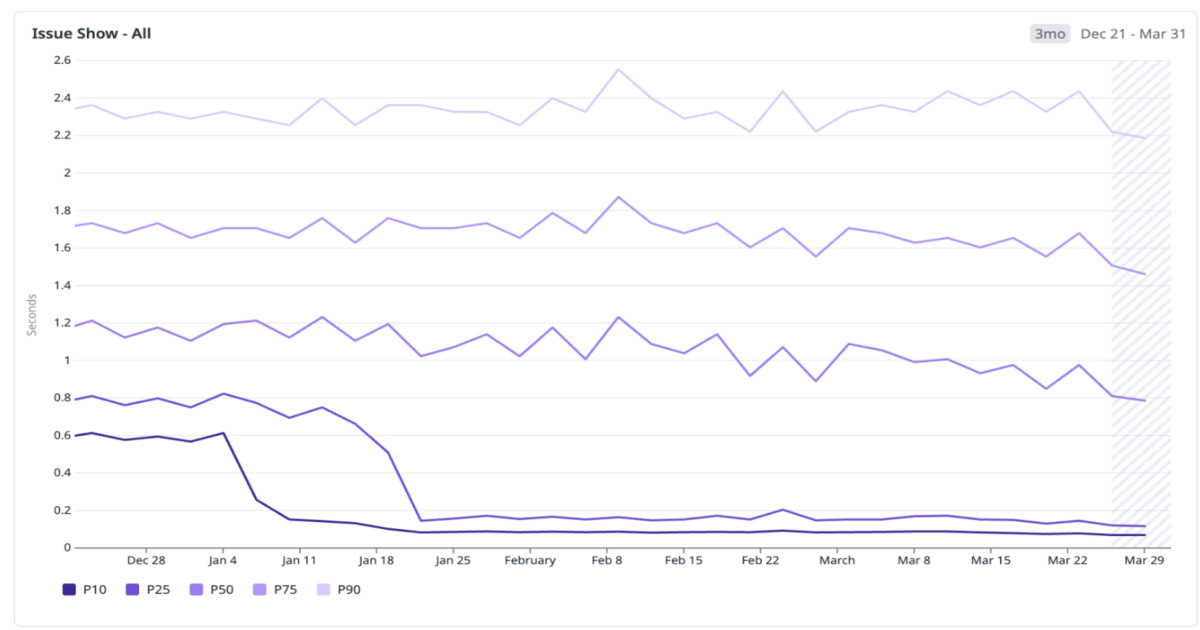
The success of this architectural shift is best illustrated by the distribution of latency improvements. GitHub did not merely optimize the average case; they aggressively attacked the tail-end latency (the slowest experiences), which historically plagued the user experience.
| Metric | Pre-Optimization (ms) | Post-Optimization (ms) |
|---|---|---|
| P10 (Fastest) | 600 | 70 |
| P25 | 800 | 120 |
| P50 (Median) | 1,200 | 700 |
| P75 | 1,800 | 1,400 |
| P90 (Slowest) | 2,400 | 2,100 |
As Oguz Guven, an industry observer, noted, the shift from optimizing for the P99 tail to improving overall distribution quality is a marker of "real engineering maturity." By focusing on the broader spectrum of user interactions, GitHub has ensured that the "instant" feel is not a lucky occurrence but a consistent standard across the user base.
The Mechanics of Stale-While-Revalidate and Preheating
At the heart of the new system is a "stale-while-revalidate" caching model. When a user navigates to a previously viewed issue, the system immediately renders the version stored in the browser’s local cache. Simultaneously, the application initiates a background fetch to check for updates from the server. If the server data differs from the cached data, the UI is updated gracefully. This prevents the user from staring at a blank screen while waiting for the server to confirm the status of a ticket.
To make this even more proactive, GitHub introduced "preheating." This mechanism uses machine learning or heuristic navigation patterns to predict which pages a user is likely to visit next. By proactively populating the cache with these predicted resources, the application ensures that the data is ready before the user even clicks the link.
Industry Perspectives: Is Prefetching the Panacea?
While the engineering community has lauded GitHub’s performance gains, the technical community has offered nuance regarding the limitations of these strategies. The team at BareStack, for instance, provided a critical observation: "Prefetching pays when the data graph is small and read-heavy like Issues. Most applications have a larger graph with read/write collisions, so prefetched views may re-fetch after landing."
The consensus among experts is that the "reusable pattern" is not the prefetching itself, but the combination of a "shell-first" rendering strategy and "cache-hit hydration." In this model, the application skeleton (the shell) is rendered instantly from local files, and the dynamic content (the data) is hydrated as soon as the cache-hit is confirmed. This decoupling of UI rendering from data fetching is becoming the gold standard for high-performance web applications.
Implications for the Future of Web Development
GitHub’s redesign serves as a blueprint for the next generation of web applications. Several key implications emerge:
/filters:no_upscale()/news/2026/07/github-issues-navigation/en/resources/1clientside-1783811916296.jpeg)
1. The Decline of the "Loading Spinner" Era
As browsers become more powerful and client-side storage mechanisms like IndexedDB become more robust, the traditional "request-wait-render" cycle is becoming obsolete. Applications that continue to force users to wait for server-side responses for common UI elements will increasingly be viewed as archaic.
2. The Rise of "Offline-First" Mentality
By treating the network as an enhancement rather than a dependency, GitHub has aligned its architecture with the "offline-first" movement. This makes the application more resilient to poor network conditions, a critical consideration for a global platform used in varying connectivity environments.
3. Engineering Maturity and Observability
GitHub’s decision to publish their P10 through P90 latency improvements highlights a shift in how engineering teams measure success. Moving away from focusing solely on the average speed to measuring the entire latency distribution allows teams to identify where their users are struggling most, leading to more equitable and consistent performance.
4. Complexity vs. Performance
The trade-off, however, is increased architectural complexity. Implementing service workers and managing cache invalidation (ensuring the user doesn’t see outdated data) requires a higher level of testing and maintenance. For many development teams, the cost of this complexity must be weighed against the potential gains in user retention and satisfaction.
Conclusion
The redesign of GitHub Issues is a masterclass in modern frontend architecture. By acknowledging that latency is a psychological barrier as much as a technical one, the team has successfully reduced the friction inherent in large-scale data navigation.
While the implementation of service workers and complex caching strategies is not a "one-size-fits-all" solution, the principles behind GitHub’s success—prioritizing the local user experience, embracing the shell-first rendering pattern, and focusing on the total distribution of performance metrics—are lessons that every architect of a large-scale web application should take to heart. As developers, we are moving toward a web that is increasingly instant, and in doing so, we are reclaiming the most valuable resource of all: our focus.


 Pevita Pearce
 Raul Delapena Setiawan