Lina Hope
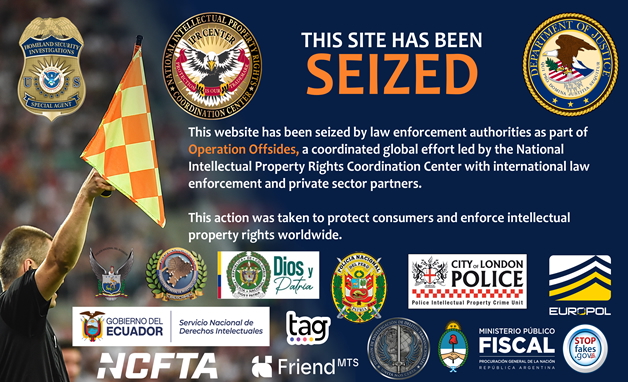
The global stage of the FIFA World Cup 2026 was intended to be a celebration of athletic prowess and international unity. However, behind the scenes of the world’s most-watched sporting event, a shadow economy of digital piracy flourished. In a decisive move to protect intellectual property and consumer safety, the U.S. Department of Justice (DOJ), alongside a coalition of international law enforcement agencies, has executed a massive enforcement operation, seizing over 1,000 websites and blocking nearly 2,000 domains dedicated to the illicit streaming of World Cup matches.
This aggressive crackdown, known as "Operation Offsides," represents one of the most significant coordinated efforts to date against digital sports piracy, highlighting the growing intersection between copyright infringement and organized cybercrime.
The Scope of the Seizure: A Multi-Front Battle
The sheer scale of the operation underscores the magnitude of the sports piracy industry. Law enforcement authorities, led by the National Intellectual Property Rights Coordination Center (IPR Center) and Homeland Security Investigations (HSI) Washington, identified the target domains through a complex intelligence-gathering process.
This was not a solo effort by U.S. authorities. The operation was bolstered by critical leads provided by FIFA, the Motion Picture Association’s Alliance for Creativity and Entertainment (ACE), and a suite of global media powerhouses, including beIN Media Group, NBCUniversal, the Ultimate Fighting Championship (UFC), and Warner Bros. Discovery. By the end of last month, investigators had successfully neutralized nearly 400 web domains, but that was merely the opening act. The final tally now exceeds 1,000 seized sites and 1,970 blocked domains, effectively severing the digital lifelines for millions of unauthorized viewers.
Chronology of Enforcement: From Early Warnings to Systematic Takedowns
The dismantling of these networks was the result of long-term planning that began well before the first ball was kicked in the 2026 tournament.
The Preparatory Phase (May 2026)
Months prior to the tournament, the FBI issued urgent warnings regarding the proliferation of "spoof" websites. These sites were meticulously designed to impersonate official FIFA portals, offering fraudulent ticket packages and hospitality deals. The primary goal of these sites was not just piracy, but the theft of sensitive financial information and personal credentials from unsuspecting fans.

Mid-Tournament Escalation (June 2026)
As the tournament gained momentum, the volume of illegal traffic spiked. In June, Mexican authorities moved to dismantle the "PirloTV" sports piracy ring. By seizing 44 key domains associated with the platform, officials effectively neutralized a network that boasted over 950 million visits annually—a staggering figure that highlights the reach of modern streaming piracy.
The Climax: Operation Offsides and Operation Red Card
Following the success in Mexico, the U.S. DOJ’s Criminal Division launched the full-scale Operation Offsides. Simultaneously, the "Operation Red Card" initiative took hold across South America. Working with the Justice Department’s International Computer Hacking and Intellectual Property (ICHIP) program, authorities blocked hundreds of sites across Argentina, Brazil, Colombia, the Dominican Republic, Ecuador, and Peru.
The operation reached a turning point on July 10, when Colombian authorities executed a series of raids that led to the arrest of four key members of the "Los Ciberinfiltrados" cybercriminal syndicate. This group had been operating since at least 2024, specialized in unauthorized access to telecommunications systems and the wholesale distribution of pirated content.
The Danger Beyond Copyright: Why Consumers Are at Risk
While the official narrative focuses on the protection of intellectual property, law enforcement officials have emphasized a more immediate danger to the public: cybersecurity.
Assistant Attorney General A. Tysen Duva articulated the dual purpose of the operation: "Operation Offsides is part of the Department’s ongoing effort to protect copyright while reducing the risk to American consumers from the malicious software embedded in many illicit streaming services."
The reality of these "free" streaming sites is often far more predatory than they appear. HSI Special Agent in Charge Eric Weindorf explained that these platforms act as gateways for cybercriminals. "These streamers not only violate copyright laws but also expose viewers to potential threats—including malware attacks and unsecure connections that can compromise personal and financial data."

When a user visits a site to watch a match for free, they are often prompted to download "updates," "video players," or "security certificates." These files frequently contain ransomware, credential-stealing trojans, or botnet-enrolling scripts. In many cases, the "free" stream is subsidized by aggressive ad-networks that push users toward phishing sites, turning a casual viewer into a victim of identity theft.
Official Responses and Strategic Partnerships
The success of these operations relies on a delicate balance between public sector authority and private sector intelligence.
IPR Center Director Ivan J. Arvelo noted that the collaboration was essential to the operation’s success. "The unauthorized broadcast of World Cup matches violates intellectual property rights and fuels criminal organizations. Through Operation Offsides and strong partnerships with law enforcement and the private sector, we identified and seized hundreds of domains, disrupting those who steal and distribute copyrighted content."
The Alliance for Creativity and Entertainment (ACE) has been a vocal proponent of these measures. By leveraging their global network of investigators, ACE provided the technical data necessary to map out the infrastructure of these piracy rings. These syndicates often use sophisticated content delivery networks (CDNs) to mask their location, making the cooperation of media giants and law enforcement agencies like the HSI and the IPR Center essential to mapping and disabling the servers in real-time.
Implications: The Future of Digital Sports Piracy
The fallout from Operation Offsides and Operation Red Card will be felt for years to come. By targeting the infrastructure—the domains, the hosting providers, and the individuals behind the syndicates—authorities have signaled that they are moving beyond simple "whack-a-mole" tactics.
1. The Legal Precedent
The arrests in Colombia and the seizure of nearly 2,000 domains set a clear precedent: participating in the distribution of copyrighted sports content is no longer viewed as a minor regulatory infraction, but as a core component of organized transnational crime. This shift in categorization allows for more severe sentencing and broader international cooperation under extradition treaties.
2. Economic Impact
Sports broadcasting rights are one of the most valuable assets in the modern entertainment industry. Billions of dollars are spent by broadcasters to secure exclusive rights. Piracy significantly erodes this value, potentially leading to increased costs for consumers who pay for legitimate services. By curbing piracy, the industry aims to stabilize the market and ensure that sports organizations can continue to fund tournaments at the scale seen in 2026.
3. The Shift in Cybersecurity Awareness
The FBI and HSI are now placing a heavier emphasis on educating the public. The narrative is no longer just about the ethics of "stealing" a broadcast; it is about protecting the consumer’s wallet and digital identity. As the public becomes more aware that "free" streams often come with hidden costs, the demand for these illegal services may decrease.
4. Technological Countermeasures
The fight is moving toward the infrastructure level. Expect to see increased pressure on domain registrars and hosting companies to perform more stringent "Know Your Customer" (KYC) protocols. As these illegal networks become more sophisticated, using encrypted protocols and decentralized networks to evade detection, the authorities are also investing in AI-driven monitoring tools that can identify and flag illicit traffic patterns before they reach the consumer.
Conclusion
The 2026 FIFA World Cup served as a high-stakes proving ground for digital law enforcement. While the tournament was a triumph on the pitch, the concurrent battle in the digital domain was equally historic. By seizing over 1,000 websites and dismantling sophisticated criminal syndicates, the U.S. Department of Justice and its global partners have delivered a stern warning: the digital playground is not a lawless territory.
As technology continues to evolve, the methods of piracy will undoubtedly adapt, but the commitment of global law enforcement to protect both intellectual property and the safety of the individual consumer has never been more robust. The digital "offside" flag has been raised, and for those who profit from illegal streaming, the playing field has officially been leveled.


 Sagoh
Sagoh
 Nana Wu