Jia Lissa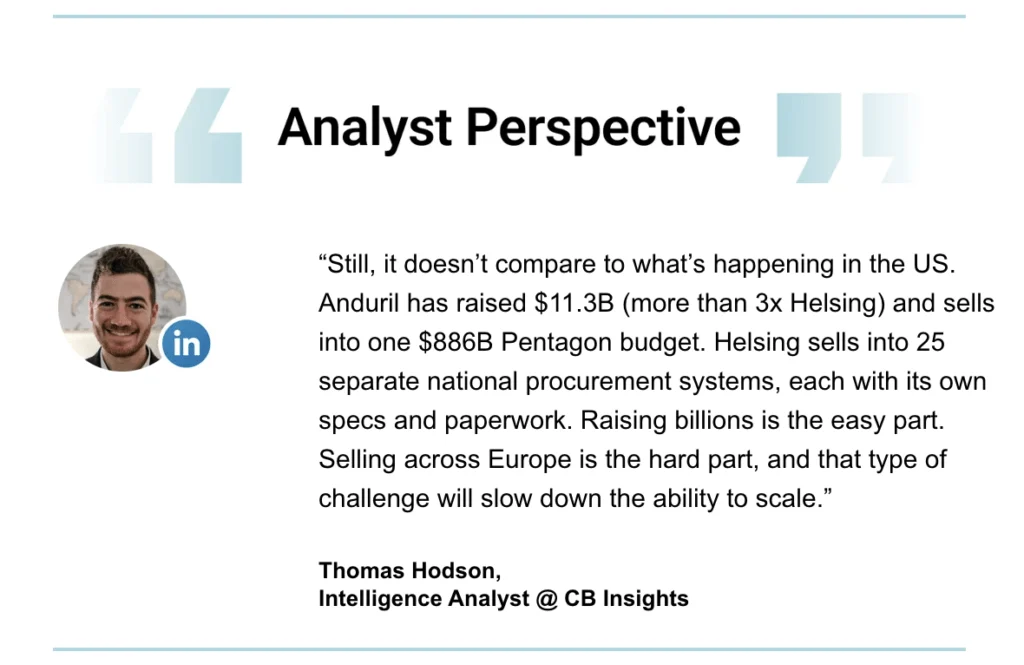
The landscape of European venture capital underwent a seismic shift this week as Munich-based defense tech firm Helsing secured a staggering $1.8 billion in Series E funding. The round, which catapults the company to an $18 billion valuation, represents the largest private defense-tech financing in European history. This landmark deal serves as more than just a financial milestone; it is the definitive proof point of a broader, systemic transformation in how the continent approaches national security, private capital, and the integration of artificial intelligence into sovereign defense systems.
While Helsing’s capital injection dominated headlines, it emerged against the backdrop of a Q2 2026 venture market defined by extreme concentration. As total funding figures paint a picture of a robust market, a closer look reveals a "two-tier" economy where a handful of AI titans command the lion’s share of liquidity, leaving the rest of the ecosystem to compete for scraps.
The Facts: A New High-Water Mark for European Defense
Helsing’s $1.8 billion raise brings the startup’s total lifetime funding to $3.3 billion, solidifying its position as the premier European player in the "software-defined defense" sector. Unlike traditional defense contractors that focus on heavy hardware manufacturing, Helsing specializes in AI-powered intelligence, battlefield situational awareness, and autonomous systems.
The core of Helsing’s value proposition—and the reason it managed to secure such immense capital—is its focus on the "software stack" of modern warfare. By integrating AI into existing hardware platforms, the company allows military forces to process vast amounts of sensor data in real-time, effectively acting as the "brain" for ships, aircraft, and armored vehicles.
For investors, the deal represents a bet on the inevitable modernization of the European military apparatus. With geopolitical tensions rising across the continent, governments are under immense pressure to move away from legacy bureaucratic procurement cycles and toward agile, tech-forward solutions.
Chronology: The Evolution of European Defense Sentiment
To understand why Helsing’s round is historic, one must look at the recent history of European institutional investment.
- 2020–2021: The "ESG Freeze." During this period, the European venture ecosystem was dominated by strict Environmental, Social, and Governance (ESG) mandates. Defense tech was frequently excluded from the mandates of major Limited Partners (LPs), and the industry suffered from a cultural stigma. Startups in the sector were viewed as "reputational liabilities," and venture capital firms largely shied away from any technology with potential dual-use applications in weapons systems.
- 2022–2023: The Strategic Pivot. The geopolitical landscape shifted violently. The return of large-scale territorial conflict in Europe forced a re-evaluation of defense as an essential, rather than optional, component of societal stability. The "reputational risk" of defense tech began to be outweighed by the existential need for sovereignty.
- 2024–2025: The Scaling Phase. Investment began to flow. In 2025 alone, European defense tech startups raised $3.2 billion—a 37% year-over-year increase and a 300% surge compared to five years prior. The number of unique investors entering the space tripled, signaling that the "defense-averse" stance of the previous decade had fully collapsed.
- 2026: The Mega-Round Era. The $1.8 billion Helsing round marks the maturation of the market. It is no longer about seed-stage experimentation; it is about scaling companies that can provide the backbone for national security infrastructure.
Supporting Data: A Tale of Two Markets
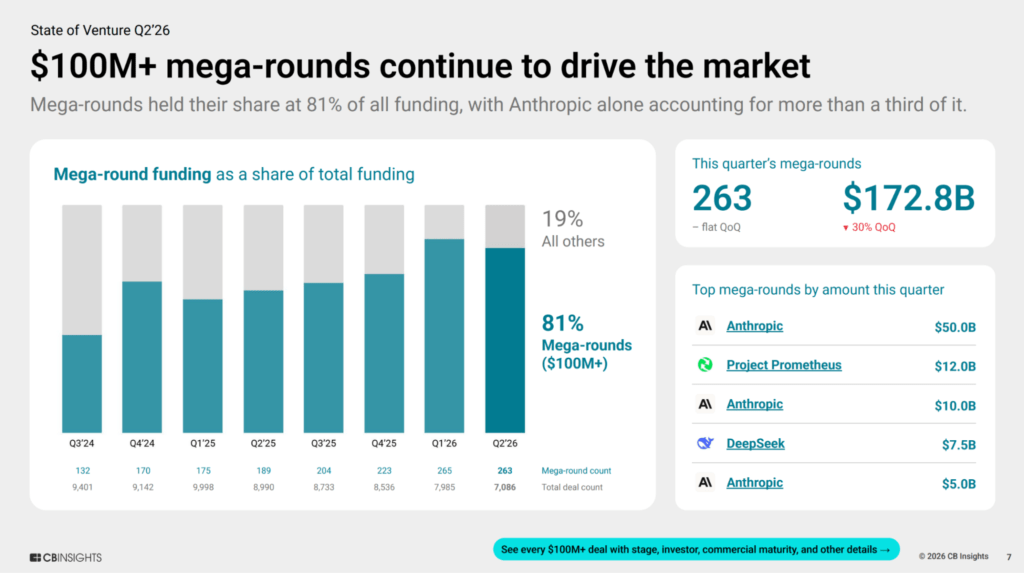
While the defense sector is experiencing a boom, the broader venture capital market in Q2 2026 presents a more complicated narrative. According to recent industry analysis, the quarter saw $212.9 billion in total funding—the second-highest figure on record. However, the optics of this "boom" are deceiving.
The Concentration Crisis
The data reveals a stark reality: 81% of all venture funding in Q2 was captured by "mega-rounds." Within this slice, the concentration is extreme. Anthropic, for instance, accounted for more than a third of all global mega-round dollars, securing $65 billion in a single period to reach a valuation of $965 billion.
When you remove the massive AI incumbents—Anthropic and OpenAI—from the equation, the reality for the remainder of the startup ecosystem is stark. Deal counts have plummeted to a decade-long low, and exit activity has declined for two consecutive quarters. This suggests that while capital is flooding into the "winners" of the AI race, the "middle class" of the startup world is facing a severe liquidity crunch.
Defense vs. Tech Generalism
Unlike the general AI market, where value is concentrated in a few hyperscalers, the defense tech sector is seeing a diversification of investment. The rise of companies like Helsing suggests that governments are looking for modular, interoperable, and scalable software solutions that can be applied across 25+ different procurement systems. This modularity is key: it is the difference between building a single "black box" that costs billions and building a software layer that makes existing, cheaper hardware infinitely more effective.
Official Responses and Strategic Shifts
The rise of Helsing and the broader defense-tech sector has prompted a reaction from policymakers and defense leaders. In recent briefings, EU officials have emphasized the "Strategic Autonomy" initiative, which aims to reduce reliance on non-European military technology.
"We are moving from an era of hardware-first procurement to one of software-enabled defense," noted a senior analyst monitoring the sector. "Helsing’s ability to navigate the fragmented procurement systems of different European nations—rather than waiting for a single, unified European defense budget—is what makes them a generational company."
By focusing on the "software-defined" aspect, Helsing avoids the trap of trying to replace entire military fleets. Instead, they provide the AI overlay that keeps these fleets relevant in a modern electronic warfare environment. This approach has resonated with both institutional investors and military procurement agencies that are tired of the 10-year lead times associated with traditional defense contracting.
Implications: The Future of Sovereign Tech
The implications of this week’s news are threefold:
1. The Death of the ESG-Defense Taboo
The success of European defense tech firms has effectively ended the era where "defense" was a dirty word in European boardrooms. The market has proven that defense tech is not only a viable asset class but an essential one. As European LPs update their investment charters, we should expect a continued surge in capital allocation toward dual-use technologies.
2. The Procurement Bottleneck
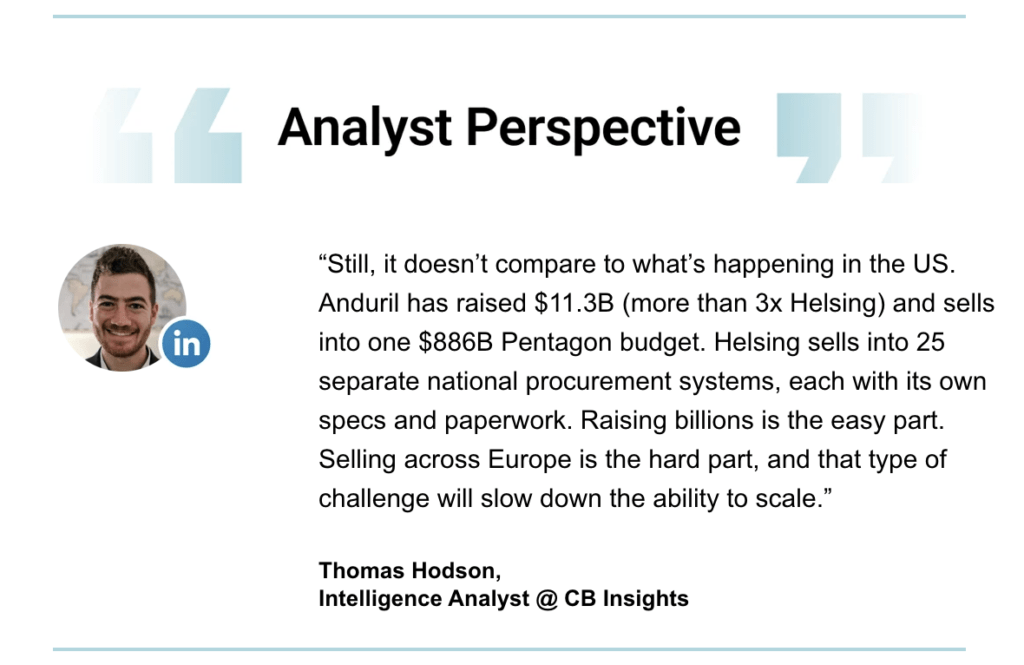
The biggest hurdle for companies like Helsing is not funding—it is the archaic nature of government procurement. Managing the integration of software across 25+ distinct, often siloed, national procurement systems is a massive operational challenge. The companies that succeed will be those that can act as "translators" between legacy hardware and modern AI software. Scaling across these systems is a far greater moat than the capital they have raised.
3. The "AI-First" Defense Paradigm
We are entering a period where the effectiveness of a nation’s military will be defined by its algorithm, not just its tonnage of steel. Helsing’s $18 billion valuation reflects the reality that in future conflicts, data superiority will be the primary determinant of victory. This shift will likely trigger a wave of M&A activity, as traditional "legacy" defense contractors look to acquire, rather than build, their own AI capabilities to stay relevant.
Conclusion: A New Standard
The $1.8 billion Helsing round is not just a triumph for a single company; it is a signal that Europe is finally reconciling its economic engine with its security requirements. While the broader VC market struggles with deal concentration and a lack of exits, the defense tech sector is providing a clear, mission-driven alternative.
For founders and investors, the lesson is clear: in an era of global volatility, the most valuable technology is that which provides security. As we move into the second half of 2026, the focus will shift from "who raised the most money" to "who can successfully integrate their software into the complex, fragmented reality of the battlefield." Helsing has set the pace; now, the rest of the industry must prove it can deliver.
For more in-depth data on the evolving European defense landscape, access the full market map of the Top 100 European AI Aerospace & Defense Startups via our research portal.


 Lina Hope
 Ammar Sabilarrohman