Lina Hope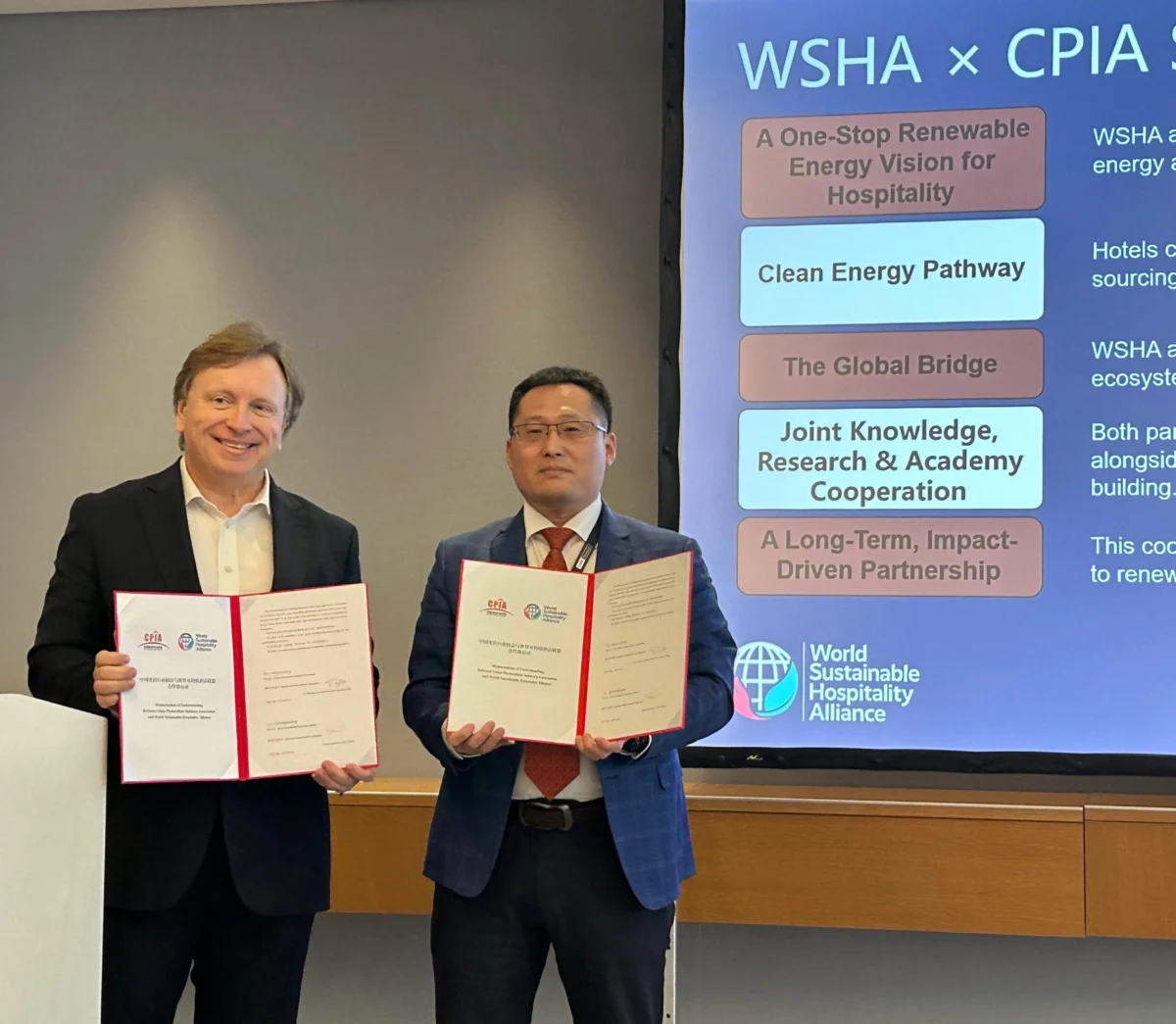
DÜSSELDORF, Germany – In a significant move toward the decarbonization of the global tourism sector, the World Sustainable Hospitality Alliance (the Alliance) and the China Photovoltaic Industry Association (CPIA) have officially announced a strategic partnership. This collaboration, unveiled during the China–EU Solar & Energy Storage Industries Dialogue 2025 in Düsseldorf, marks a pivotal alignment between the hospitality industry—one of the world’s most energy-intensive sectors—and the global leader in solar technology and manufacturing.
This partnership is designed to bridge the gap between clean-energy innovation and practical, scalable deployment within hotels, resorts, and hospitality infrastructure worldwide. By leveraging China’s expansive solar supply chain and technical expertise alongside the Alliance’s global network of major hotel brands, the initiative aims to accelerate the transition to renewable energy on a massive scale, moving the industry closer to its long-term vision of "Net Positive Hospitality."
The Strategic Core: Bridging Energy Demand with Innovation
The fundamental premise of this partnership is the integration of supply and demand. The hospitality sector faces mounting pressure from both regulatory bodies and environmentally conscious travelers to reduce its carbon footprint. However, the transition to renewable energy—specifically through solar power and battery storage—remains a complex logistical and financial hurdle for many hotel operators.
The CPIA, representing the interests of China’s massive solar industry, brings to the table unparalleled access to the latest advancements in photovoltaic (PV) modules, energy storage systems (ESS), and smart-grid integration. The World Sustainable Hospitality Alliance acts as the conduit, providing the framework to ensure these technologies are adapted to the specific operational needs of global hotel groups.
Key Objectives of the Partnership
While the formal agreement spans a broad scope, the core objectives are designed to transform the hospitality value chain:
- Standardization of Renewable Integration: Creating a "one-stop" pathway for hotels to assess, procure, and install solar energy solutions that meet international sustainability standards.
- Capacity Building and Education: Utilizing the World Academy for Sustainable Hospitality to train industry leaders and facility managers on the technical and financial aspects of renewable energy transition.
- Cross-Border Technology Transfer: Facilitating the deployment of advanced solar technologies from the Chinese manufacturing hub to emerging markets and global hospitality hot spots.
- Financial Frameworks: Developing scalable models for long-term procurement, such as Renewable Power Purchase Agreements (PPAs), to provide hotels with cost stability while lowering their carbon emissions.
- Global Project Collaboration: Establishing pilot projects that serve as templates for sustainable retrofitting and new-build construction across the sector.
Chronology of the Collaboration
The path to this partnership was not an overnight decision but the culmination of a broader shift in how global industries are addressing climate change.
- Mid-2024: Preliminary discussions between the Alliance and CPIA began, identifying a clear synergy between the energy requirements of the global hotel sector and the manufacturing capacity of the Chinese solar market.
- Late 2024: Working groups were established to identify the primary pain points for hotel groups, specifically focusing on the high capital expenditure (CAPEX) associated with solar installations and the lack of standardized procurement advice.
- Early 2025: The "China–EU Solar & Energy Storage Industries Dialogue" was identified as the ideal platform to formalize the agreement, signaling the international nature of the collaboration.
- February 2025 (The Announcement): During the Düsseldorf conference, the Alliance and CPIA officially signed the Memorandum of Understanding (MoU), setting the stage for immediate implementation of the partnership’s five-pillar strategy.
Supporting Data: The Scale of the Challenge and Opportunity
To understand the necessity of this partnership, one must look at the energy footprint of the global hospitality industry. Estimates suggest that the hotel sector accounts for approximately 1% of global greenhouse gas emissions. As international tourism continues to rebound and expand, this figure poses a significant barrier to the goals set by the Paris Agreement.
The Energy Equation
- Consumption Density: Hotels are characterized by 24/7 operations, requiring constant heating, cooling, lighting, and desalination (in coastal properties).
- Solar Potential: Millions of square meters of flat roof space on hotels and resorts worldwide remain underutilized. If properly equipped with high-efficiency PV cells, these properties could offset a significant portion of their daily electricity consumption.
- Technological Advancement: According to the CPIA, the efficiency of crystalline silicon solar cells has increased by over 20% in the last decade, while the cost of battery storage systems has plummeted, making decentralized energy systems more financially viable than ever before.
- Economic Drivers: Beyond environmental impact, energy costs are often the second-largest operating expense for a hotel, following labor. Transitioning to renewable energy provides a hedge against volatile fossil fuel prices, creating a compelling business case for sustainability.
Official Perspectives: A Unified Vision
The partnership has received strong support from leadership on both sides, emphasizing that this is a long-term, impact-driven framework.
Glenn Mandziuk, President and CEO of the World Sustainable Hospitality Alliance, commented:
"We are proud to announce a landmark partnership between the World Sustainable Hospitality Alliance and the China Photovoltaic Industry Association. This collaboration connects one of the world’s largest energy-consuming sectors with a leading global hub of solar innovation, turning the hospitality industry’s significant annual investment into a driver of renewable energy transition. Built on five pillars—from a one-stop clean-energy pathway to global project collaboration and shared expertise—this agreement establishes a long-term, impact-driven framework for decarbonizing our sector."
RU Jialin, Director of International Affairs of the China Photovoltaic Industry Association, stated:
"The CPIA is delighted to join hands with the World Sustainable Hospitality Alliance to advance the hotel sector’s transition to renewable electricity. With the rapid progress of solar and energy storage technologies, clean power is becoming more accessible, stable, and cost-effective for hotels worldwide. Through this partnership, we will promote practical clean-energy solutions and scalable project cooperation, helping hotels reduce energy costs while accelerating low-carbon transformation."
The Broader Implications: Shaping a Sustainable Future
The implications of this partnership extend far beyond the hospitality sector. It serves as a blueprint for how cross-industry collaborations can address the climate crisis.
1. Market Transformation
By creating a dedicated channel between solar manufacturers and hotel operators, the partnership removes many of the friction points that currently prevent small-to-medium-sized hotel chains from going green. It simplifies the supply chain, reduces technical ambiguity, and provides a clear ROI for stakeholders.
2. A Model for Global Cooperation
The partnership highlights the importance of China-EU cooperation in the energy sector. By aligning the technological prowess of the Chinese solar industry with the global footprint of European and international hotel brands, the alliance demonstrates that climate action is a collaborative, global effort that transcends geopolitical boundaries.
3. Impact on "Net Positive Hospitality"
The "Net Positive" ambition is a bold one—it requires the industry to give back more to the environment than it takes. To achieve this, reducing carbon emissions is the most critical first step. This partnership provides the physical infrastructure—the solar panels, the batteries, the smart-energy management systems—necessary to make this vision a reality.
4. Future-Proofing the Industry
As governments worldwide implement stricter building codes and carbon taxes, hotels that proactively adopt renewable energy will be at a competitive advantage. This partnership ensures that participating hotels are not just reacting to regulation, but are leading the industry toward a cleaner, more resilient, and more profitable future.
Conclusion
The collaboration between the World Sustainable Hospitality Alliance and the China Photovoltaic Industry Association is a milestone in the global effort to combat climate change. By merging the technical leadership of the solar industry with the massive scale and reach of the hospitality sector, the partnership provides a pragmatic, scalable, and highly effective pathway to decarbonization.
As the project enters its implementation phase, the hospitality industry will be watching closely. With the right support, the right technology, and a unified vision, the sector is well-positioned to transform its energy footprint, proving that luxury and service can exist in perfect harmony with the health of the planet.


 Asep Darmawan
 Layla Zulfa