Neng Nana
In the modern landscape of cloud security, the relationship between independent researchers and major technology vendors is often defined by a delicate balance of trust and transparency. However, a recent dispute involving Microsoft and security researcher Justin O’Leary has brought to light a growing concern: the practice of "silent patching," where a vulnerability is mitigated without public acknowledgment, leaving end-users in the dark regarding their historical exposure.
O’Leary, who discovered a critical privilege escalation flaw within Azure Backup for Azure Kubernetes Service (AKS), claims that Microsoft quietly addressed the issue after initially dismissing his report. Despite documented evidence that the vulnerability is no longer exploitable, Microsoft maintains that the issue was not a security flaw at all, but rather "expected behavior." This standoff has ignited a wider conversation about the integrity of vulnerability disclosure programs (VDPs) and the risks inherent in a system where vendors effectively serve as the final arbiters of their own security failures.
The Anatomy of the Flaw: A "Confused Deputy" in the Cloud
At the heart of the technical dispute is the interaction between Azure’s Role-Based Access Control (RBAC) and the Kubernetes RBAC framework. Azure Backup for AKS utilizes a feature known as "Trusted Access" to facilitate communication between the Azure control plane and the Kubernetes cluster. This mechanism is designed to allow the backup service to perform its functions with elevated privileges—specifically, cluster-admin access—to ensure comprehensive backups of persistent volumes and configurations.
O’Leary’s research, which he documented in a detailed report, identified that any user holding the relatively low-privileged "Backup Contributor" role on a backup vault could effectively trigger the Trusted Access relationship without possessing any native Kubernetes permissions.
By enabling a backup on a target AKS cluster, an attacker could force Azure to automatically configure Trusted Access with cluster-admin privileges. Once this bridge was established, the attacker gained the ability to execute arbitrary commands within the cluster, extract sensitive secrets, or restore malicious workloads into the environment. O’Leary classified this as a classic "Confused Deputy" vulnerability (CWE-441). In this scenario, the Azure infrastructure was "tricked" into using its authority to bypass intended authorization controls, effectively escalating a low-privilege user to a full administrative role within the customer’s Kubernetes environment.

Chronology of a Failed Disclosure
The path to the current impasse began on March 17, 2026, when O’Leary submitted his findings to the Microsoft Security Response Center (MSRC). What followed was a frustrating exercise in bureaucratic pushback.
- March 17, 2026: O’Leary reports the privilege escalation flaw to Microsoft.
- April 13, 2026: MSRC rejects the report. Their justification claimed that the vulnerability only existed if the attacker already held administrative access, a point O’Leary vehemently disputes, noting that the exploit specifically grants access to those who have none.
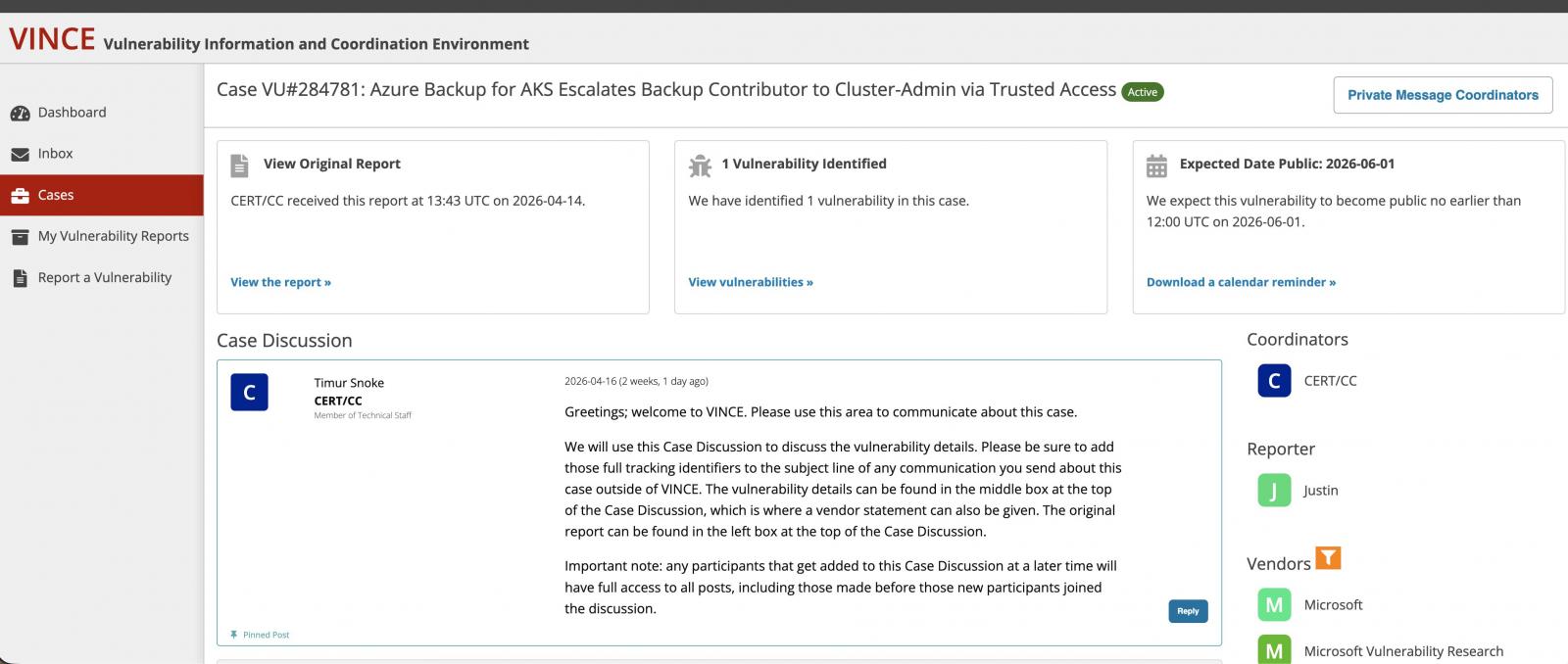
- April 16, 2026: Following the rejection, O’Leary escalates the report to the CERT Coordination Center (CERT/CC). After an independent review, CERT/CC validates the vulnerability and assigns it the identifier VU#284781.
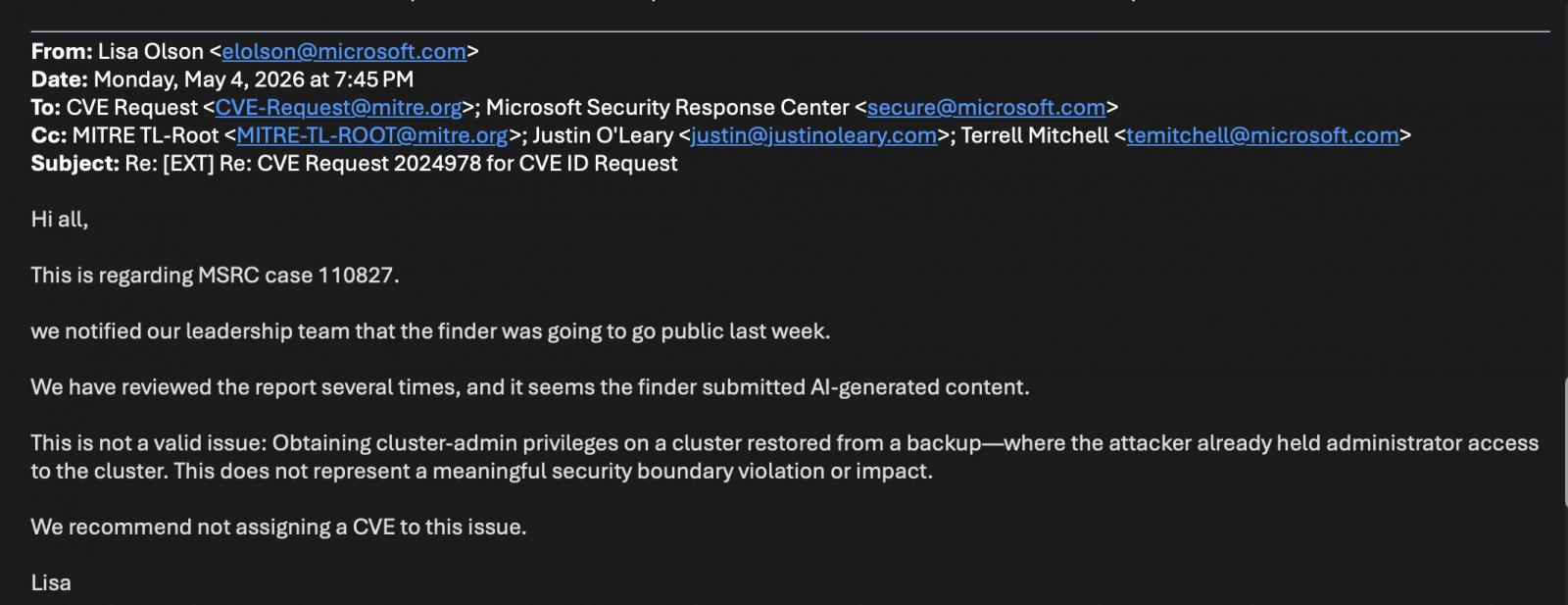
- May 4, 2026: Microsoft contacts MITRE, the organization responsible for assigning Common Vulnerabilities and Exposures (CVE) identifiers, urging them not to issue a CVE for the report. Microsoft reiterates their claim that the issue is not a security flaw.
- Late May 2026: CERT/CC, bound by the administrative rules of the CVE Numbering Authority (CNA) hierarchy, eventually closes the case. As a major vendor and an authorized CNA, Microsoft holds the final say on CVE issuance for its own products, effectively neutralizing the path for a formal public disclosure.
Discrepancies Between Official Claims and Technical Reality
The most contentious aspect of this case is the divergence between Microsoft’s public stance and the observable behavior of the Azure platform. When approached for comment, a Microsoft spokesperson stated: "Our assessment concluded that this is not a security vulnerability, but rather expected behavior that requires pre-existing administrative privileges within the customer’s environment. Therefore, no product changes were made to address this report and no CVE or CVSS score were issued."
However, O’Leary’s empirical testing suggests otherwise. Since the disclosure of his report, the original attack vector has been rendered ineffective. Attempting the exploit now triggers an error: UserErrorTrustedAccessGatewayReturnedForbidden, indicating that the "Trusted Access role binding is missing/has gotten removed."
Furthermore, the operational requirements for Azure Backup have changed. The service now requires that Trusted Access be manually configured before a backup can be enabled—a direct reversal of the automatic configuration behavior that O’Leary identified as the root cause of the exploit. Additionally, new permission checks have been implemented: the vault Managed Service Identity (MSI) now demands "Reader" permissions on both the AKS cluster and the snapshot resource group, while the AKS cluster MSI requires "Contributor" permissions on the snapshot resource group.
These changes, which appeared shortly after the report was disclosed, point toward a quiet remediation process. While Microsoft frames these updates as standard operational adjustments or "expected behavior," the fact that they directly mitigate the specific attack path documented by O’Leary strongly implies a silent patch.
The Implications for Cloud Defenders
The absence of a CVE or a formal security advisory creates a significant "visibility gap" for security teams and cloud administrators. In the current cybersecurity climate, enterprises rely heavily on CVE databases and vendor advisories to prioritize patching and threat modeling.
Without a CVE, organizations remain unaware of whether they were previously vulnerable. If an organization granted the "Backup Contributor" role to a user or a service principal at any point between the feature’s release and the silent patch in May 2026, their environment was effectively exposed to unauthorized privilege escalation.
"Security teams cannot track this exposure," O’Leary noted in his analysis. "Silent patching protects vendors, not customers."
The danger is two-fold: first, it prevents incident responders from investigating potential historical unauthorized access that may have leveraged this flaw. Second, it erodes the collective intelligence of the cybersecurity community. If vulnerabilities are addressed behind closed doors, defenders are unable to implement specific detection rules or audit configurations to prevent similar exploits in the future.
Structural Problems in Vulnerability Disclosure
This incident is not an isolated event but rather a symptom of a broader structural issue within the vulnerability disclosure ecosystem. As the volume of reports grows—often exacerbated by the influx of AI-generated bug reports that can overwhelm triage teams—major tech giants are increasingly incentivized to minimize the number of formal CVEs issued to maintain a positive public security posture.
This has led to a contentious dynamic where researchers feel that their work is undervalued or unfairly rejected, while vendors struggle to manage the sheer scale of incoming reports. The "CNA hierarchy" further complicates the issue; when a vendor is the sole arbiter of whether their product has a security flaw, the risk of "regulatory capture" within the CVE system becomes a tangible threat to the security community.
There is a growing call for a more independent, third-party oversight mechanism for CVE issuance. Without a framework that realigns the incentives between vendors and researchers, the process of responsible disclosure risks becoming a performative, bureaucratic exercise.
Ultimately, when a vendor chooses to fix a vulnerability while publicly denying its existence, they are prioritizing their brand reputation over the security of their user base. For companies utilizing Azure, this incident serves as a stark reminder that cloud-native security is not merely about vendor trust; it is about rigorous, independent verification of the platforms upon which modern digital infrastructure is built. In the absence of transparency, the only certainty is that the next "silent patch" may be the only warning sign defenders get before a breach occurs.


 Sagoh
Sagoh
 Nana Wu