Rifan Muazin
Introduction: The Crisis of "Passive Completion"
In the modern era of digital education, a troubling pattern has emerged. A student signs up for an online course, clicks through 40 static slides, passes a quiz with the help of a quick search engine query, and is rewarded with a digital certificate. While this satisfies the platform’s metrics for "completion," it raises a fundamental question: Did the student actually learn anything?
For too long, Learning Management Systems (LMS) have prioritized tracking clicks over measuring comprehension. They treat all learners as a monolith, serving the same content to the novice and the expert alike. However, the rise of open-source artificial intelligence is rapidly dismantling this one-size-fits-all model. We are entering an era where educational software can function not as a static repository, but as a dynamic, private tutor that adapts in real-time. By leveraging local, open-source models, developers can now build intelligent systems that identify knowledge gaps, curate personalized paths, and foster genuine mastery—all without the need for expensive API subscriptions.
The Evolution of Learning: Why Traditional Platforms Fall Short
To understand the necessity of an AI-powered LMS, one must first analyze the failures of legacy platforms like Moodle, Canvas, or Blackboard. While these systems are robust at administration, they are notoriously poor at pedagogy.
The Data Gap
Research from the Research Institute of America reveals a sobering statistic: learners retain only 8–10% of content delivered through traditional e-learning models. In contrast, personalized, active learning methods can boost retention rates to between 25% and 60%. The reason for this disparity is psychological. Traditional e-learning is passive; the student is a spectator. AI-powered learning is active; the student is a participant in a dialogue.
The Myth of Completion
Traditional LMS metrics focus on "vanity data"—time spent on page, modules clicked, and binary quiz results. These metrics fail to account for the "illusion of competence," where a learner remembers enough to pass a test but lacks the functional knowledge to apply the concept in a real-world scenario. By moving toward an AI-driven architecture, we can shift the focus from completion (did you finish?) to capability (can you do it?).
The Tech Stack: Building for Sovereignty and Scale
A significant barrier to entry for many developers has been the cost of AI infrastructure. However, the modern open-source ecosystem has democratized access. This project utilizes a "local-first" architecture, ensuring that no sensitive user data needs to leave the machine and no recurring cloud costs are incurred.
| Layer | Tool | Purpose |
|---|---|---|
| AI Model | Ollama + Mistral 7B | Executes high-performance LLM logic locally. |
| Backend | FastAPI (Python) | Manages asynchronous API routes and WebSocket communication. |
| Frontend | React | Delivers a responsive, intuitive interface. |
| Data Store | Python Dictionary | Efficient in-memory tracking of learner profiles. |
Why This Stack?
Ollama serves as the engine, allowing developers to pull models like Mistral 7B or Llama 3 without managing complex cloud environments. Mistral 7B is particularly suited for this task due to its ability to handle JSON-formatted outputs reliably, which is critical for programmatically generating quizzes and learning paths. FastAPI, meanwhile, is the backbone of the system. Its native support for WebSockets is essential for streaming AI responses, providing the user with a fluid, human-like interaction experience rather than a "loading" spinner.
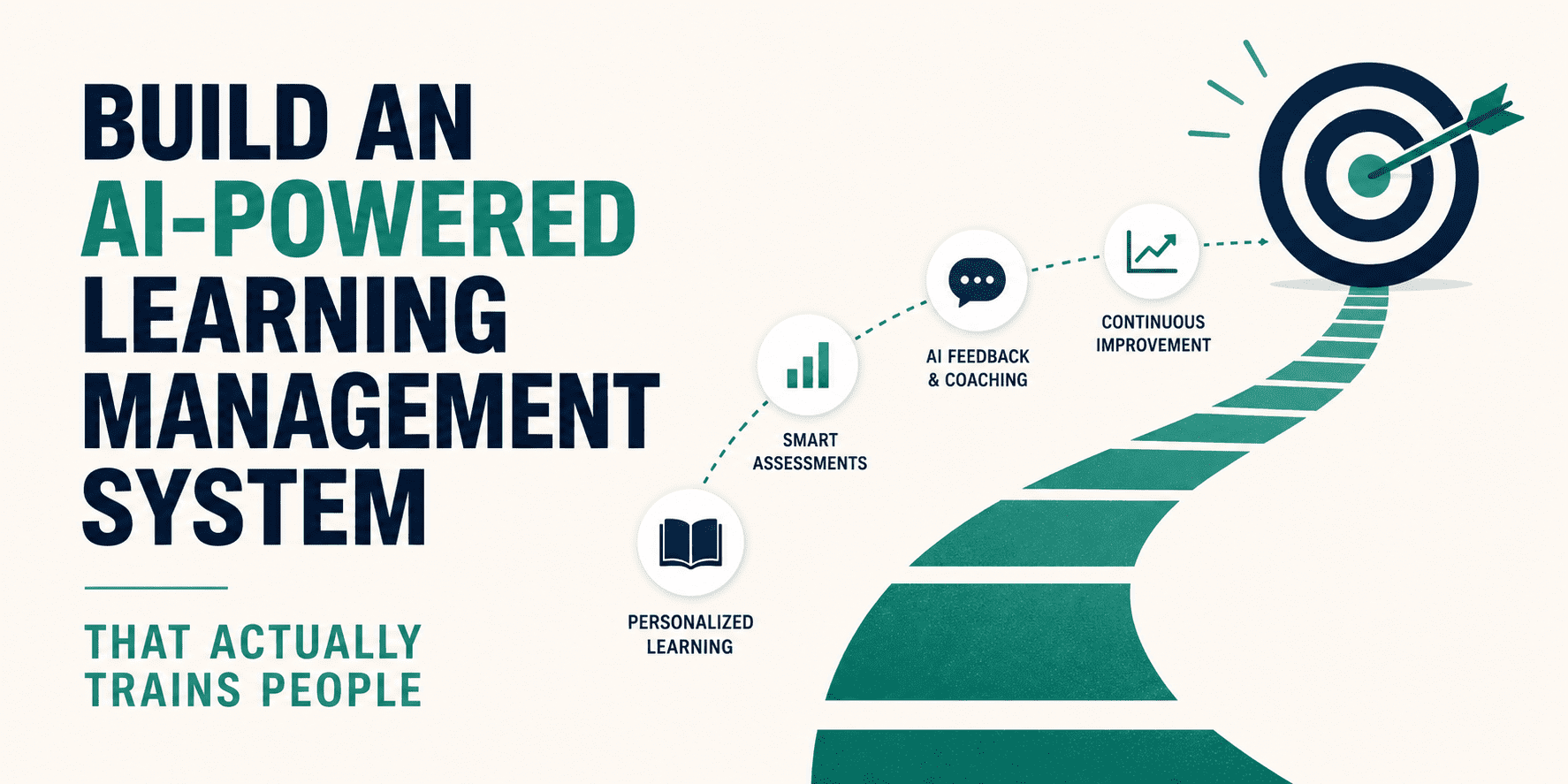
Step-by-Step Architecture: The Four Pillars of Intelligent Learning
1. Adaptive Learning Paths
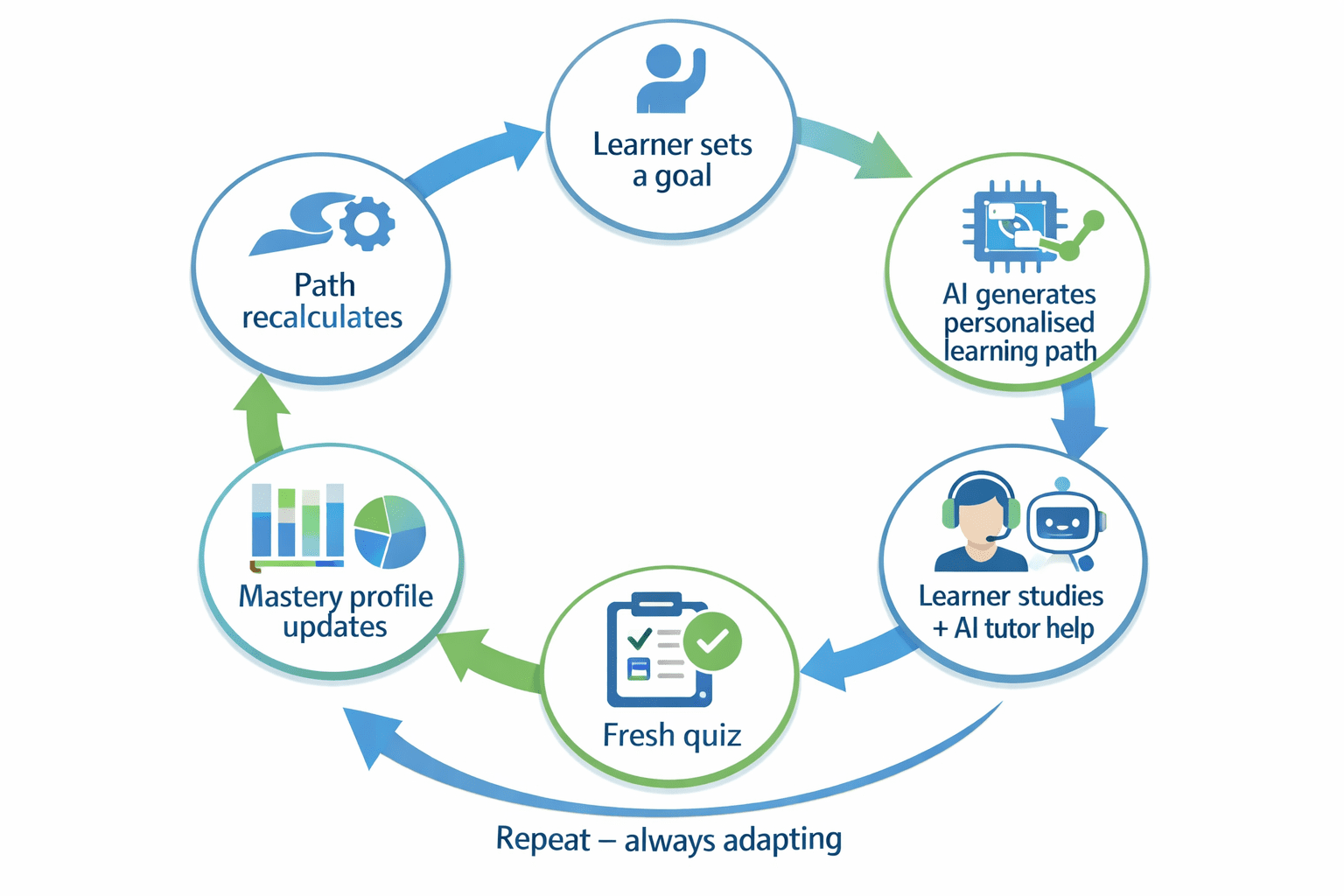
The most significant departure from traditional systems is the ability to generate a custom curriculum. In our system, the AI analyzes a learner’s mastery profile and their specific goals. By comparing the "Completed" modules against the required skills for a target objective, the system generates a unique learning sequence. This ensures that a senior developer looking to sharpen their Python skills isn’t forced to endure basic syntax lessons, while a beginner receives the foundational scaffolding they need.
2. AI-Generated Quizzes and Assessments
Static quiz banks are the enemy of true assessment. When quizzes are constant, they become a memorization exercise. Our system utilizes the LLM to generate dynamic, context-aware assessments based on the specific content of a module. Because the questions are generated in real-time, the "answer key" is non-existent. Furthermore, the inclusion of explanatory feedback—rooted in cognitive science—ensures that every quiz serves as a teaching moment rather than just a pass/fail checkpoint.
3. The Natural Language AI Tutor
Perhaps the most transformative feature is the 24/7 AI Tutor. By utilizing Retrieval-Augmented Generation (RAG), the tutor is grounded in the actual course material. If a student hits a roadblock, they don’t just get a general answer from a search engine; they get a response tailored to the context of the course. The use of a persistent WebSocket connection allows the tutor to explain concepts as if they were typing in real-time, significantly reducing the "cognitive load" and frustration that often leads to course abandonment.
4. Progress Tracking via Exponential Moving Average
Standard dashboards are often misleading. A student might fail a quiz once and pass it the next day, leading to a confusing metric. We implement an Exponential Moving Average (EMA) to track mastery. This gives more weight to recent performance, allowing the system to recognize when a student has genuinely grasped a concept, while preventing the dashboard from being too sensitive to a single lucky or unlucky guess.
Implications for the Future of Education
The implications of this shift are profound. As we move away from the "one-size-fits-all" model of education, we are seeing the birth of "Hyper-Personalized Learning."
Implications for Corporate Training
For businesses, the cost of ineffective training is high. Employees who complete mandatory compliance or technical training but fail to apply the knowledge represent a wasted investment. An AI-powered LMS ensures that training is not just "checked off" but is actually integrated into the employee’s professional skill set.
Implications for Educators
For educators, this technology acts as a force multiplier. Instead of spending hours grading quizzes or answering repetitive administrative questions, the teacher can focus on high-level mentorship, knowing that the AI is handling the "scaffolding" of the learning process.
Official Perspective: The Shift toward "Human-in-the-Loop"
While AI provides the structure, the role of the human remains central. As Shittu Olumide, the creator of this project, notes, the goal isn’t to replace the instructor but to remove the friction that prevents learners from achieving their potential. By automating the delivery and assessment, we reclaim the time needed for deep, human-to-human discussion.
The project, which is available as an open-source repository on GitHub, serves as a proof-of-concept for the industry. It proves that we do not need to rely on opaque, expensive, or proprietary systems to improve educational outcomes.
Conclusion: Tracking Learning, Not Clicks
The transition from traditional LMS platforms to AI-integrated ones is not merely a technological upgrade; it is a pedagogical necessity. By fostering a continuous, personalized feedback loop, we can address the core issues of retention and engagement that have plagued online education for two decades.
We are finally at a point where the software can support the learner, rather than forcing the learner to navigate the rigid architecture of the software. Whether you are a developer looking to contribute to the open-source community or an educator seeking to improve your classroom outcomes, the tools are now available. It is time to stop tracking clicks and start tracking the one thing that truly matters: the mastery of the human mind.
For those interested in exploring the codebase, the full project—including the backend architecture, React interface, and documentation—is available on GitHub. Join the movement to build more intelligent, adaptive, and human-centric educational tools.


 Nana
Nana
 Azzam Bilal Chamdy