Rifan Muazin
The global educational landscape has been thrust into a state of high alert following a series of aggressive cyberattacks against Instructure, the software powerhouse behind Canvas—the world’s most widely used Learning Management System (LMS). What began as a traditional data breach has escalated into a public extortion campaign, with threat actors utilizing cross-site scripting (XSS) vulnerabilities to deface institutional login portals and demand ransoms.
The incident, which has sent shockwaves through thousands of universities and K-12 school districts, highlights the systemic risks inherent in centralized educational infrastructure. With hackers claiming the theft of over 275 million records, the breach represents one of the most significant security failures in the history of educational technology.
The Anatomy of the Breach: Chronology of Events
The crisis unfolded in stages, beginning in late April and culminating in a brazen display of digital intimidation in early May.
Initial Discovery (April 29)
On April 29, Instructure’s internal security teams detected unauthorized access to their network. The company moved with relative speed, revoking the attacker’s access and launching an immediate investigation alongside third-party forensic experts. At this stage, the full scope of the incident remained undisclosed to the public.
Data Exfiltration and Leak Site Listing (Early May)
Within days of the initial discovery, the situation deteriorated. The notorious threat actor group known as "ShinyHunters" took credit for the intrusion. By early May, the group had listed Instructure on their data leak site, claiming to have exfiltrated a massive haul of data—approximately 3.6 terabytes of uncompressed information.
The Second Wave: Defacement and Extortion (May 7)
Perhaps the most alarming development occurred on May 7. Exploiting the same XSS vulnerabilities that facilitated the initial breach, ShinyHunters bypassed security protocols to inject malicious JavaScript into the Canvas login portals. This allowed them to modify the interface presented to students and faculty, effectively turning a legitimate educational portal into a tool for extortion. The hackers issued a clear ultimatum: Instructure and the affected educational institutions had until May 12 to enter negotiations or face further consequences.
Restoration and Mitigation (May 9)
Instructure responded by temporarily taking the Canvas platform offline. This period of downtime was critical for identifying the root cause and applying necessary security patches. By May 9, the platform was largely restored, though the "Free-for-Teacher" environment—a specific, limited version of the LMS—remained disabled as a precautionary measure while remediation efforts continued.
Technical Vulnerabilities: Exploiting the LMS
The success of the ShinyHunters operation rested on the exploitation of cross-site scripting (XSS) vulnerabilities, specifically targeting user-generated content features within the Canvas ecosystem.

Understanding XSS in the LMS Context
XSS occurs when an application includes untrusted data in a web page without proper validation or escaping. In the context of an LMS, where teachers and students frequently upload files, post comments, and embed external links, the attack surface is inherently large.
By injecting malicious scripts into these user-generated fields, the threat actors were able to execute code within the browsers of authorized users. This granted them access to authenticated administrator sessions. Once these sessions were compromised, the attackers possessed the privileges necessary to perform unauthorized actions, including the modification of login portals across multiple institutional subdomains.
The Role of the "Free-for-Teacher" Environment
Instructure confirmed that the most severe defacements were localized to the "Free-for-Teacher" environment. While this version is designed for individual educators to experiment with the platform, its integration with the broader Instructure infrastructure proved to be a critical weak point. The company has since tightened security controls around this environment to ensure that isolated instances cannot be used as a beachhead to compromise the larger enterprise network.
Supporting Data: The Scale of the Impact
The scale of the breach is staggering. According to claims made by ShinyHunters, the stolen database encompasses 8,809 distinct educational organizations, ranging from small local schools to major international research universities.
- Total Records Claimed: 275 million entries.
- Data Types Involved: While the login portal defacements did not result in immediate data compromise, the initial breach likely involved highly sensitive PII (Personally Identifiable Information). This includes:
- Full names and usernames.
- Email addresses.
- Course enrollment records and metadata.
- Internal communications and messaging logs.
For the students and staff affected, this data represents a significant risk for targeted phishing campaigns, identity theft, and social engineering attacks. Given the nature of the data, the risk is particularly high for minors whose digital identities are being established within these systems.
Official Responses and Institutional Accountability
Instructure has maintained a posture of transparency since the incident became public, providing regular updates through their official incident response page.
The Instructure Statement
In a formal acknowledgment of the situation, Instructure stated: "The unauthorized actor made changes to the pages that appeared when some students and teachers were logged in through Canvas." The company emphasized that the temporary shutdown of the platform was a calculated decision to "apply additional safeguards" and prevent further unauthorized manipulation.
Industry and Regulatory Reaction
The incident has triggered a broader conversation regarding the security obligations of EdTech providers. Educational institutions, which often lack the massive cybersecurity budgets of the private sector, are increasingly reliant on SaaS (Software as a Service) providers to protect their data.
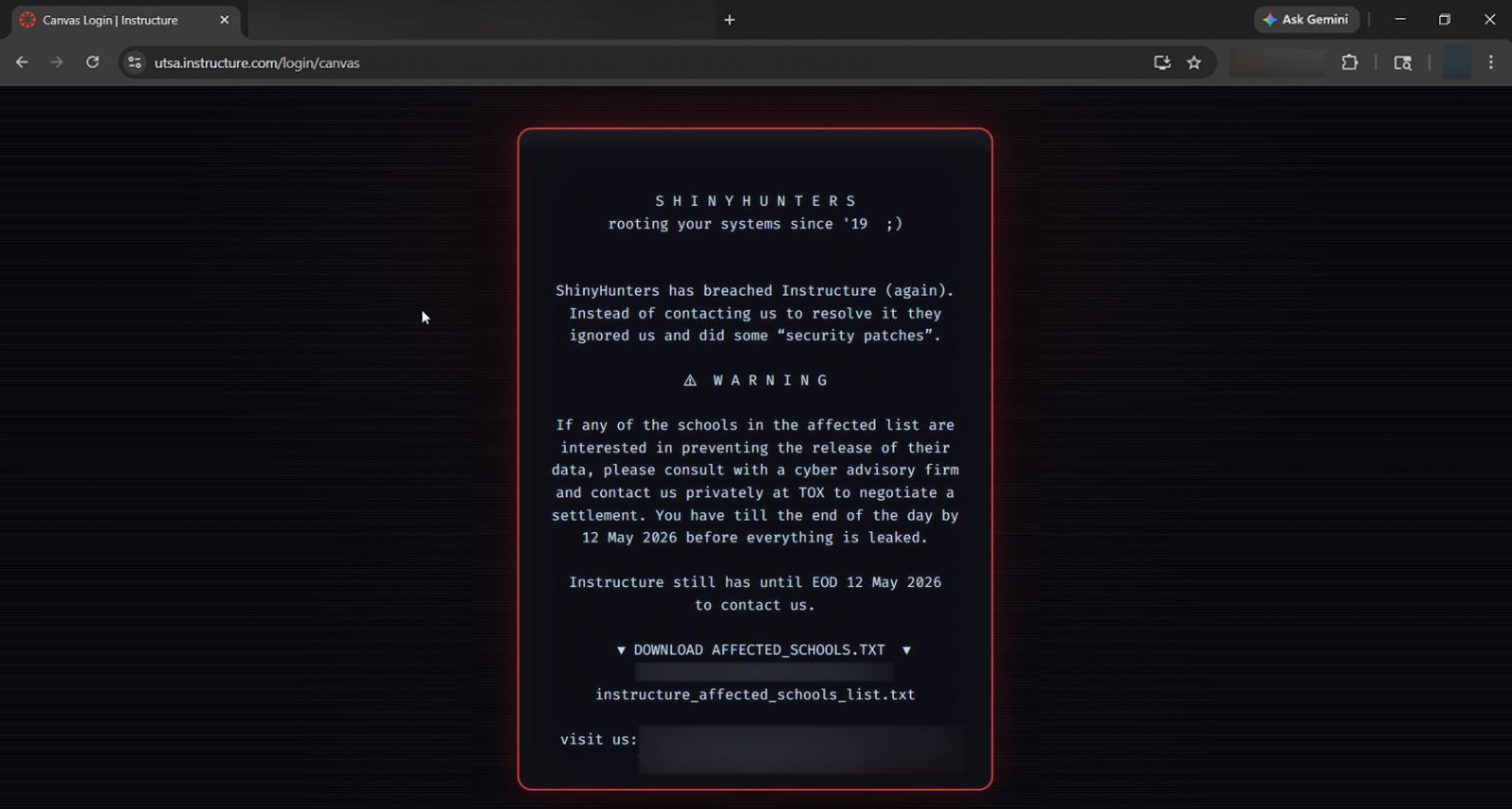
Privacy advocates have pointed out that while Instructure acted to restore service, the fact that the platform remained vulnerable to a repeat attack—using the exact same exploit path—raises questions about the company’s internal security auditing processes.
Implications: The Future of EdTech Security
The Instructure incident serves as a grim case study for the vulnerabilities inherent in modern digital learning environments.
The Rise of "Educational Extortion"
The move by ShinyHunters to use a platform’s own login portal to broadcast a ransom message is a sophisticated escalation. By turning the educational institution’s own brand against them—forcing students to see an extortion message while trying to access their coursework—the attackers maximize the pressure on the vendor to pay. This strategy transforms a standard data breach into a public relations crisis, forcing the target to choose between paying a ransom and suffering sustained reputational damage.
The Need for Proactive Security
The incident underscores the failure of traditional perimeter-based security. As the threat landscape evolves, vendors must adopt more robust, "defense-in-depth" strategies. This includes:
- Strict Content Security Policies (CSP): To mitigate the impact of XSS attacks by restricting the sources from which scripts can be executed.
- Autonomous Validation: The industry is moving toward tools that can automatically identify zero-day vulnerabilities and chain exploits before attackers can. As suggested by recent security summits, relying on manual patching cycles is no longer sufficient when AI-driven exploits can navigate complex network sandboxes.
- Third-Party Risk Management: Schools and universities must demand more rigorous security disclosures and independent audit reports from their EdTech vendors before integrating these platforms into their core curricula.
What Comes Next for Users?
For the millions of students and faculty members whose data was exposed, the path forward involves heightened vigilance. Educational institutions are encouraged to:
- Enforce Mandatory Password Resets: Ensure that all compromised accounts are secured with new, unique credentials.
- Enable Multi-Factor Authentication (MFA): While MFA may not stop every form of XSS-based session hijacking, it provides a crucial layer of defense for account access.
- Monitor for Phishing: With 275 million records in the hands of malicious actors, users should be warned to expect a surge in sophisticated phishing emails that leverage the specific course information or university data contained in the leaked files.
As the dust settles, the Instructure breach will likely remain a landmark event in the history of educational technology. It serves as a stark reminder that as schools move their classrooms to the cloud, the responsibility for protecting the next generation’s data must be treated with the same urgency as the delivery of the education itself. The era of "trust-based" digital adoption is over; in its place, a new, more rigorous era of verifiable security must emerge.


 Lina Hope
 Suro Senen