Lina Hope
The healthcare artificial intelligence landscape is shifting from simple clinical assistance to total operational control. Leading this charge is Commure, a company that has moved aggressively to position itself not merely as a tool for documentation, but as the comprehensive digital infrastructure for modern health systems. By consolidating ambient AI, autonomous medical coding, and referral management, Commure is signaling a transition toward a "holistic operating system" model for hospitals—a move that places them in direct competition with the largest legacy electronic health record (EHR) providers in the world.
The Core Expansion: From Scribes to Systems
The recent milestone of earning "Epic Toolbox" designation for its autonomous coding product is more than a technical achievement; it is a strategic bridgehead. Commure’s ambient AI scribe—which automates the tedious process of clinical documentation—has long been a staple of its value proposition. By integrating autonomous medical billing directly into the Epic environment, Commure is eliminating the "swivel-chair" workflow that has long plagued clinicians, who previously had to toggle between systems to document visits and then code them for insurance reimbursement.
This integration represents a critical shift: Commure is effectively embedding itself into the clinical workflow, becoming an indispensable layer of the hospital’s IT stack. As the company expands its footprint into European and UK markets, it is clear that the objective is global scalability. With the launch of "Orchestrator" for referral management and ongoing development of its "Air" AI-native EHR platform, Commure is aiming to capture the administrative work that occurs both before and after the patient enters the exam room.
Chronology of a Growth Engine
Commure’s ascent has been defined by a "buy-and-build" philosophy that prioritizes speed-to-market. The company has demonstrated a consistent ability to identify mature, revenue-generating startups and fold them into a unified ecosystem.
- Early Foundation: Commure established its reputation by focusing on clinical documentation, leveraging ambient AI to reduce physician burnout.
- The Acquisition Phase: With seven strategic acquisitions to date, the company has methodically plugged gaps in its portfolio. Key moves include taking the publicly traded Augmedix private in 2024 to bolster its ambient documentation capabilities and acquiring Rx.Health, which was rebranded as "Commure Engage" to handle patient outreach.
- The Series F Extension (May 2026): Securing $70 million in additional funding provided the "dry powder" necessary to accelerate its acquisition strategy.
- Global Expansion (September 2026): Commure initiated its European and UK rollout, signaling that its AI-driven efficiency tools were ready for international regulatory and clinical environments.
- Epic Integration (October 2026): The achievement of Epic Toolbox status for autonomous coding solidified its position as a primary partner for large-scale health systems.
The Strategy Behind the Shopping List
Commure’s growth is not accidental; it is driven by a data-centric mapping of the modern healthcare enterprise. By analyzing its existing 500+ health system clients, the company has identified "white spaces"—areas of the patient journey that remain manual, fragmented, or prone to error.
Analysts observing the company’s trajectory suggest that Commure is now looking for assets that can handle the complexity of prior authorization, post-acute care transitions, and clinical interoperability. The goal is to move beyond the point of care. If Commure owns the referral, the visit documentation, the coding, and the patient outreach, it becomes the "operating system" through which the hospital breathes.
Identifying the Gaps
The healthcare administrative burden is estimated to cost the US system hundreds of billions annually. Commure’s internal assessment suggests that current gaps in their suite include:
- Prior Authorization: Automating the friction-filled process of insurance approvals.
- Post-Acute Care: Ensuring seamless handoffs to nursing facilities or home health.
- Clinical Interoperability: Breaking down the silos between disparate data sets that prevent a 360-degree view of the patient.
- Advanced Revenue Cycle Management: Moving from reactive to proactive billing.
Supporting Data and Market Intelligence
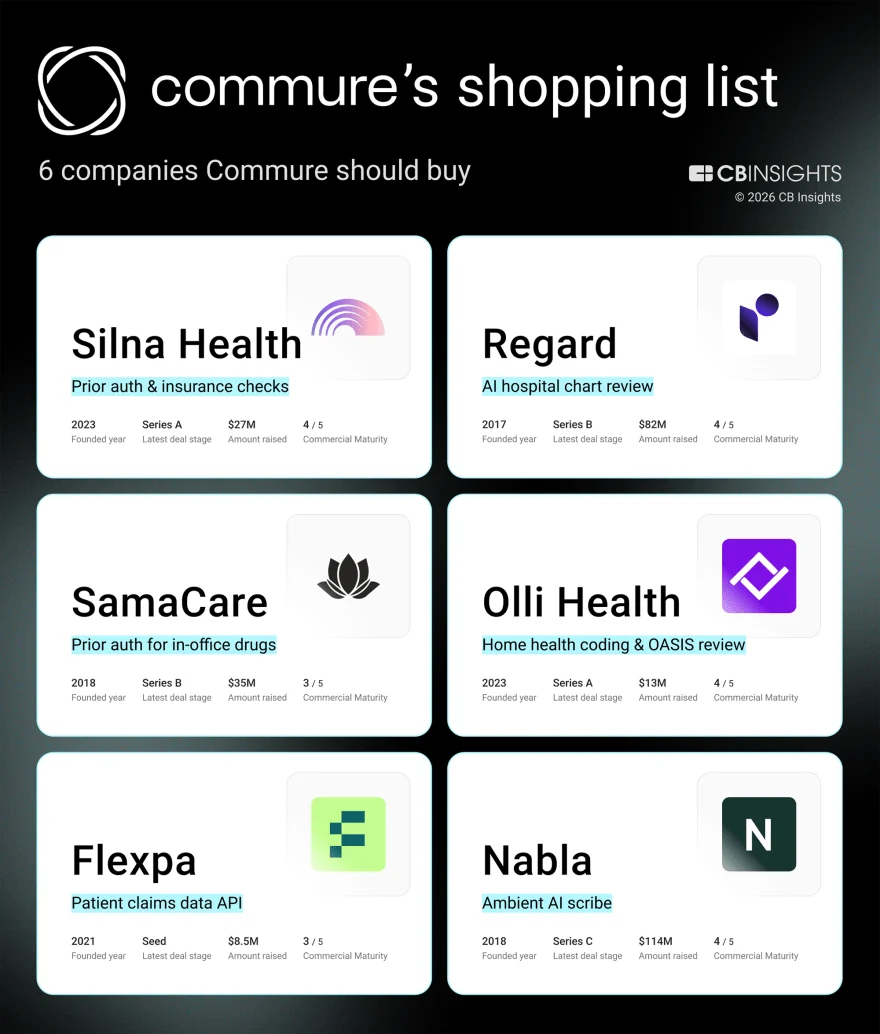
To determine the next logical steps for the company, researchers at CB Insights utilized the Management Control Platform (MCP) to cross-reference Commure’s existing business relationships, hiring patterns, and competitor activity. By filtering for private, VC-backed startups with less than $150 million in funding and high Mosaic scores—a proprietary metric that tracks health, momentum, and market quality—the strategy team has identified six potential acquisition targets.
These targets are not merely tech companies; they are specialized entities that have already cleared the hurdle of customer adoption. For instance, companies like Flexpa are currently showing significant activity in their funding windows, suggesting that the market is ripe for consolidation. Commure’s strategy relies on the fact that health systems are tired of "vendor fatigue." They would prefer to sign one contract with a comprehensive provider than manage dozens of point-solution vendors.
Implications for the Healthcare Sector
The implications of Commure’s expansion are profound for both the tech industry and the medical profession.
For Health Systems
For the hospital executive, Commure represents a potential solution to the "burnout crisis." By automating documentation and coding, the company is effectively giving time back to physicians. However, it also creates a form of "platform lock-in." As a health system relies more on Commure’s AI to manage its billing and patient workflows, the cost of switching away becomes prohibitive.
For Competitors
Legacy EHR giants and established revenue cycle management (RCM) firms like R1 and Waystar are being forced to respond. The "AI-native" approach is no longer a luxury; it is a necessity. Competitors that fail to integrate similar autonomous capabilities will find themselves at a disadvantage as hospitals move toward vendors that can demonstrate tangible, immediate ROI via reduced administrative overhead.
For the Future of Work
The rise of AI-native platforms like "Air" suggests a future where the EHR is no longer a static database but a dynamic, predictive agent. If Commure succeeds in its current expansion, the role of medical coders, administrative assistants, and even some clinical support staff will undergo a radical transformation. This shift promises a more efficient healthcare system but raises significant questions about data governance, the reliability of autonomous systems, and the preservation of the human element in clinical decision-making.
Conclusion: The Path Forward
Commure is currently in a "land-grab" phase. Having secured the capital and the technical credibility to influence the largest health systems in the US, the company is now testing the limits of how much of the hospital workflow can be automated. Whether they succeed will depend on their ability to maintain the accuracy of their AI as they scale, and their capacity to manage the complex, often messy, legacy infrastructure of the healthcare systems they seek to modernize.
As they move into 2027, all eyes will be on their next move. Will they continue their aggressive acquisition spree, or will they focus on internalizing the massive amount of data they are now processing? One thing is certain: the era of the manual healthcare workflow is nearing its end, and Commure is positioned to be the primary architect of what replaces it.


 Nana Muazin

 Neng Nana