Reynand Wu
In a significant architectural shift, Meta has announced the expansion of its "Private Processing" framework to its line of AI-integrated smart glasses. By leveraging Confidential Virtual Machines (CVMs) and hardware-level Trusted Execution Environments (TEEs), Meta is attempting to solve one of the most critical hurdles in the adoption of wearable artificial intelligence: the tension between persistent, highly personalized utility and the user’s fundamental right to privacy.
As AI assistants move from static chat boxes to ambient, "always-on" wearables, they require access to sensitive, long-term personal context—ranging from daily schedules and private conversations to visual observations of a user’s environment. Meta’s latest engineering effort seeks to ensure that while this data is processed, it remains cryptographically invisible even to Meta’s own engineers.
The Core Architecture: Moving the Boundary of Trust
The fundamental challenge of AI glasses lies in the limited onboard compute power of the hardware. While basic tasks like incoming notifications or simple voice commands can be handled locally, sophisticated features—such as real-time visual scene interpretation, complex contextual search, and "long-term memory" recall—demand massive compute resources. Historically, offloading this to the cloud meant handing over raw data to the provider.
Meta’s Private Processing architecture redefines this boundary by extending the "secure zone" from the physical glasses into the cloud. The system operates on several layers of security:
1. Confidential Virtual Machines (CVMs) and TEEs
At the heart of the system are CVMs, which utilize hardware-backed Trusted Execution Environments (TEEs). These environments ensure that the data processed by the AI models remains encrypted in memory, protecting it even from the underlying cloud host provider or unauthorized Meta staff. By utilizing memory encryption on both CPUs and GPUs, Meta aims to create a "black box" where AI workloads execute in total isolation.
2. Remote Attestation and Transparency
Before any sensitive data leaves the glasses, the device performs a remote attestation. The glasses verify a hardware-signed certificate provided by the cloud TEE, comparing the specific workload measurement against a publicly accessible, append-only transparency ledger. If the code running in the cloud does not match the verified, audited image, the connection is aborted. This "fail-closed" mechanism ensures that no data is transmitted to an unverified or tampered environment.
3. Anonymizing the Conduit
To further decouple user identity from data processing, Meta integrates third-party OHTTP relays (operated by partners like Cloudflare and Fastly) and anonymous credentials. This prevents the cloud infrastructure from easily linking a specific data packet to a specific user identity, adding an extra layer of obfuscation between the wearable and the server.
A Chronology of Privacy-Centric Engineering
Meta’s journey toward Private Processing has been a deliberate, multi-year evolution, reflecting a strategic response to both regulatory pressure and consumer apprehension regarding biometric data collection.
- Early 2025: Meta introduced the initial iteration of Private Processing, focusing primarily on WhatsApp and specific Meta AI tools. This pilot demonstrated the feasibility of using CVMs for text-based interactions, proving that the company could process user queries without maintaining persistent, readable logs of the content.
- Late 2026 (September/October): Following the success of the initial rollout, Meta officially announced the extension of this architecture to its wearable AI glasses. This move signaled a shift in strategy, transitioning from securing simple chat interactions to securing complex, multimodal, and agentic AI experiences.
- The Current Phase: Meta has pivoted to an "open-audit" strategy. By engaging with third-party security firms like the NCC Group and inviting the academic community to review their attestation mechanisms, the company is attempting to establish public trust through radical transparency—a marked departure from the "black box" approach common in Big Tech.
The "Always-On" Dilemma: Implications of Persistent Sensing
The introduction of this technology arrives at a time of intense societal debate. AI glasses are inherently different from smartphones; they are equipped with cameras, microphones, and sensors that capture the world from the user’s perspective.
The Privacy Trade-off
As one recent discussion on platforms like Reddit highlighted, a truly helpful assistant must be "always-on." To remind a user where they left their keys or summarize a meeting from two hours ago, the AI must constantly listen and observe. This creates a data set of immense sensitivity.
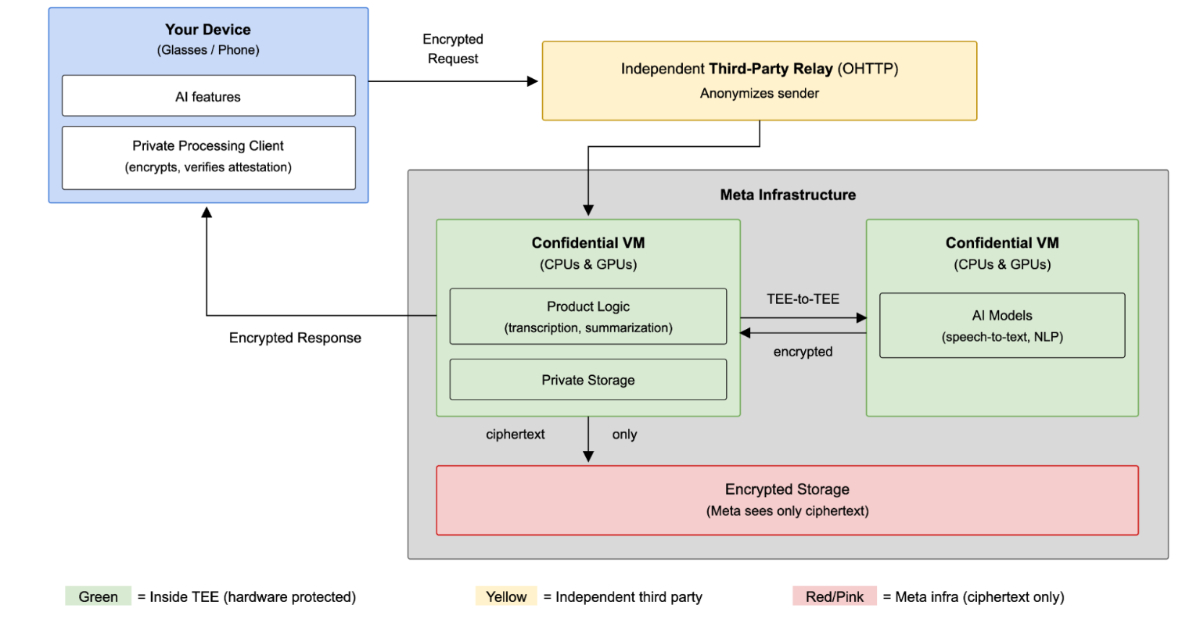
Critics argue that even with end-to-end encryption and TEEs, the existence of such a massive, searchable database of personal life poses a systemic risk. If the encryption is ever compromised—or if the "trusted" third party is coerced—the resulting data exposure would be catastrophic. Meta’s response to this has been to ensure that persistent state storage is also locked within the TEE, with data encrypted using user-provided keys, theoretically preventing even a rogue administrator from browsing a user’s historical context.
Operational Constraints
Because engineers cannot access the memory of these CVMs, Meta has had to develop new ways to monitor system health. Instead of traditional debugging, the company relies on aggregate operational signals: CPU utilization, network latency, and memory allocation metrics. This limitation is a deliberate design choice, prioritizing user privacy over the ease of maintenance for the engineering team.
Official Responses and The Path to Deployment
Despite the technical maturity of the framework, its implementation is currently in a "pre-deployment" phase.
The Regulatory and Public Relations Strategy
Meta has been transparent about the fact that Private Processing is not yet active on its current hardware. In statements provided to outlets such as WIRED, company representatives, including engineering director Pritam Shah, have noted that the platform is functional but remains in an engagement phase.
By announcing the architecture before full-scale deployment, Meta is executing a strategic move:
- Community Engagement: By sharing binaries, documentation, and tools with researchers, Meta is seeking to "crowdsource" the security vetting process, effectively paying the "reputation tax" upfront to avoid future scandals.
- Setting Industry Standards: By open-sourcing the principles of their transparency ledger and attestation flow, Meta is positioning itself as a leader in the "confidential computing" space, potentially influencing future regulatory requirements for all wearable AI manufacturers.
The Role of Independent Auditors
Meta’s partnership with the NCC Group serves as a vital bridge between the company’s internal engineering and public trust. Independent audits are no longer optional for companies handling biometric or persistent sensory data. By allowing external experts to verify the "fail-closed" guarantees of their TEEs, Meta is attempting to provide a level of assurance that cannot be provided by corporate marketing alone.
Future Outlook: Agentic AI and Beyond
The expansion of Private Processing into wearable tech is a precursor to the rise of "Agentic AI"—systems capable of performing complex, multi-step tasks on behalf of the user. For an agent to book a flight, negotiate a schedule, or provide real-time navigation while maintaining privacy, it must exist in a state of high-context awareness.
As the industry moves toward these agentic models, the distinction between a "local" and "cloud" experience will continue to blur. Meta’s bet is that by moving the confidential computing boundary, they can maintain the scalability of the cloud while upholding the privacy promises of a local device.
However, the true test will be the user experience. If the latency introduced by remote attestation and OHTTP relays makes the glasses feel sluggish, users may choose convenience over privacy. Conversely, if Meta can successfully maintain a seamless, high-speed experience while keeping the user’s personal context truly encrypted, they may set a new gold standard for the future of wearable computing.
For now, the project remains a fascinating, high-stakes experiment in technical governance. Whether the public is willing to trust a "secure" cloud with their most intimate daily moments is a question that goes beyond engineering—it is a question of social contract in the age of ambient intelligence. As Meta opens its doors to auditors and researchers, the world will be watching to see if the "Private Processing" label holds up under scrutiny, or if the challenges of persistent, always-on AI will prove too complex for even the most robust encryption to solve.


 Ammar Sabilarrohman
 Azzam Bilal Chamdy