Siti Muinah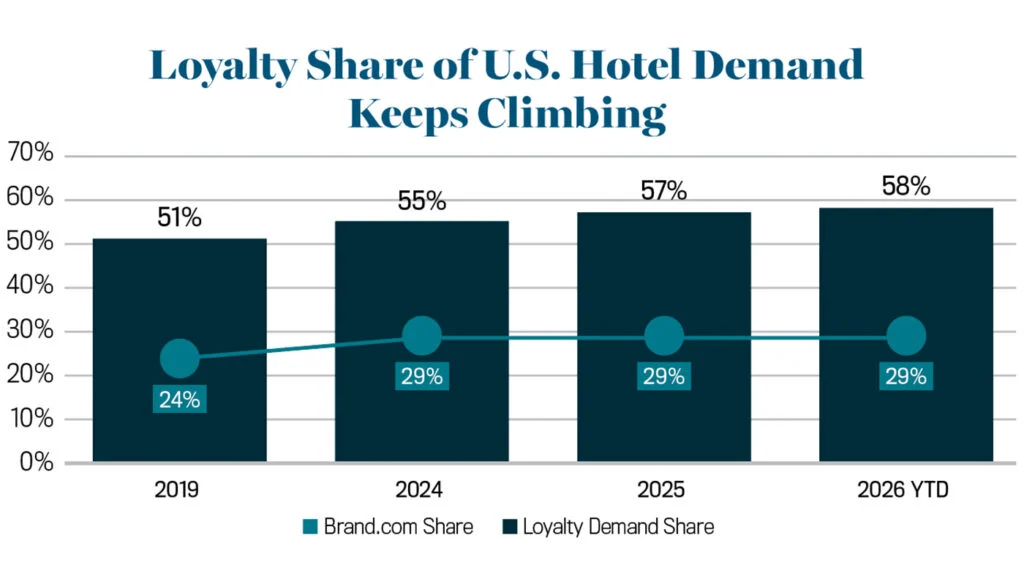
The landscape of U.S. hospitality is undergoing a quiet, structural transformation. For years, hoteliers have been told that the "direct-booking" war was the ultimate battle for profitability—a struggle to reclaim market share from the pervasive influence of Online Travel Agencies (OTAs). As we move through the second half of 2026, the data suggests that this war has not only shifted in favor of the brands, but has also fundamentally altered the way hotels drive demand.
According to the latest industry analytics from Kalibri, loyalty demand share—the percentage of total U.S. room nights booked by loyalty program members—reached a staggering 58 percent through the first half of 2026. This represents a monumental seven-point climb from the 51 percent recorded in 2019. The implications for hotel owners, general managers, and revenue strategists are profound: the era of reliance on third-party intermediaries is being supplanted by a robust, loyalty-driven direct ecosystem.
The Chronology of a Channel Shift
To understand where the industry stands today, one must look back at the tactical shifts of the last seven years. In 2019, the industry was already wrestling with the high cost of acquisition associated with OTAs. When the global travel landscape was upended in 2020, the subsequent recovery phase forced hotels to prioritize lower-cost, high-margin channels.
Between 2021 and 2023, major hotel brands doubled down on their "Book Direct" campaigns. These initiatives were not merely marketing slogans; they were deep-rooted technological investments in loyalty enrollment, website optimization, and member-exclusive benefits. By 2024, the strategy began to bear fruit, with Brand.com bookings stabilizing at a significant share of the total demand.
Now, in 2026, that work has transitioned from an investment phase to a permanent fixture of the demand mix. Brand.com bookings currently account for 29 percent of total demand—a significant jump from the 24 percent observed in 2019—and, more importantly, have held this level of dominance for three consecutive years. This suggests that the "direct channel" is no longer a fluctuating variable, but the foundational pillar upon which modern hotel revenue management is built.
Supporting Data: The Anatomy of Demand
The shift toward loyalty is not merely a preference for one channel over another; it is a calculated response to the economic reality of customer acquisition costs. When a guest books through an OTA, the hotelier must account for substantial commission fees—often ranging from 15 to 25 percent—which erode the net revenue of the room. Conversely, a booking through a Brand.com site, even when accounting for the overhead of maintaining a loyalty program, presents a significantly higher profit margin.

Current data highlights a divergence in booking performance across different segments:
- Loyalty Member Rates (LMR): Up 19 percent year-over-year as of early July. This represents the fastest-growing category in the entire industry.
- OTA and Government Demand: Seeing a modest 2 percent growth.
- Corporate Travel: Up 1 percent.
- Rack/BAR (Best Available Rate): Down 5 percent.
- Group Business: Down 2 percent.
The data paints a clear picture: while total U.S. room night demand has grown by only 2 percent year-to-date, the industry has managed to push Average Daily Rates (ADR) up by 6 percent. This ADR growth is being fueled by members who are booking through loyalty channels, proving that loyalty is not just a tool for volume, but a vehicle for price integrity.
Implications for Rate Integrity and Revenue Strategy
The 19 percent growth in Loyalty Member Rate (LMR) bookings is a critical development. Unlike generic "flash sales" or "promo codes" that can commoditize a hotel’s inventory and damage its brand positioning, LMRs are structured discounts earned through a relationship.
When a hotel lowers its price for a loyal member, it is an investment in a repeat customer, not a desperate grab for occupancy. This distinction is vital for maintaining rate integrity. As the industry moves through the remainder of 2026, properties that lean too heavily on OTAs remain vulnerable to market cooling. If an external channel suddenly shifts its algorithm or raises its commissions, those hotels lack the direct relationship with their guests to pivot effectively.
Furthermore, the plateau of Brand.com at 29 percent of total demand suggests that the "low-hanging fruit" of website-driven direct bookings has been harvested. To grow beyond this threshold, hotels must move from "acquisition" to "recognition."
The Human Element: Operationalizing Loyalty
Industry experts emphasize that a loyalty program is useless without the internal systems to back it up. There is a distinct, well-documented difference between a "scripted" guest experience and a "systematic" one.

A front desk agent reciting a welcome script is often hollow if the agent working the following shift has no record of the guest’s preferences. True loyalty is built when a guest’s history—whether it’s a preference for a high-floor corner room or a specific room temperature—follows them across every department. When a housekeeping team addresses a maintenance issue because they see a note from two visits ago, the hotel creates a "sticky" experience that no amount of marketing spend can replicate.
Empowerment is the second lever. When a front desk manager has the authority to resolve a friction point—such as waiving a parking fee or upgrading a room category—without needing to escalate to a corporate office, they create a memory. This human element is the ultimate loyalty driver.
Strategies for Independent Properties
For independent hotels and smaller boutique groups that lack the massive corporate infrastructure of global brands, the path to loyalty is still accessible. The reliance on big-brand points is no longer the only way to compete. Several innovative avenues have emerged:
- Consortia Networks: Platforms like Stash Rewards allow independent properties to offer a loyalty ecosystem that mimics the scale of larger brands, giving travelers the incentive to choose independent hotels without sacrificing the "points" benefit.
- Advanced PMS Integration: Modern property management systems, such as Mews, are increasingly focused on guest data portability, ensuring that profiles are rich with historical data that can be leveraged by any staff member.
- AI-Driven Perks: Companies like Laasie provide instant gratification for direct bookings. Instead of accumulating points that may never be redeemed, guests receive immediate, relevant perks, which incentivizes the booking at the moment of purchase.
Looking Ahead: The 2027 Planning Horizon
As we look toward the 2027 fiscal year, the warning for hoteliers is clear: the advantage currently enjoyed by loyalty-forward properties will only compound. If LMR bookings maintain their current trajectory, hotels that have failed to modernize their guest data systems or their direct-booking engines will find themselves at a structural disadvantage.
The market has spoken. The growth in 2026 is not coming from the "open market" or anonymous retail channels; it is coming from the cultivation of a known, valued customer base. The hotels that succeed in 2027 will be those that have stopped viewing "loyalty" as a marketing line item and started viewing it as an operational mandate. Recognition, personalization, and the authority to serve the guest must become as central to the business plan as the ADR forecast.
In conclusion, while the industry continues to navigate the complexities of a 2 percent demand growth environment, the winners are emerging with clarity. By prioritizing the direct, loyalty-based relationship, hoteliers are insulating themselves from the volatility of third-party channels and building a more sustainable, profitable future. The question for the next quarter is not how to get more bookings, but how to ensure that every booking is an invitation for the guest to return.


 Lina Irawan
 Azzam Bilal Chamdy