
 Lina Irawan
In an alarming shift in tactics, the advanced persistent threat (APT) group known as "Fire Ant" has pivoted away from its traditional focus on VMware hypervisors, opting instead to weaponize core networking hardware. Security researchers at incident response firm Sygnia have uncovered a campaign where the threat actors have successfully transformed Cisco IOS XR routers into clandestine spying platforms. This development represents a significant escalation in the group’s capabilities, allowing them to turn trusted transit devices into long-term, high-value collection points within critical infrastructure.
The Discovery: An Invisible Infrastructure
The discovery of Fire Ant’s new operational methodology began with a routine forensic examination of a Cisco IOS XR router. Investigators identified an active Generic Routing Encapsulation (GRE) tunnel interface that lacked any corresponding entry in the device’s running configuration or commit history.
This "ghost" interface was the first clue that the threat actors had gained deep, persistent access to the network’s foundational hardware. By bypassing standard management protocols and configuration logs, the attackers ensured that the tunnel remained invisible to network administrators, providing a stable, covert communication channel for data exfiltration and command-and-control (C2) operations.

The Anatomy of an Attack: Chronology and Methodology
The Fire Ant campaign is characterized by its meticulous nature and its reliance on "living-off-the-land" techniques, supplemented by custom, stealthy malware.
1. Initial Access and Escalation
Fire Ant does not rely on a single entry point. Instead, the group demonstrates a high level of proficiency in compromising a wide array of infrastructure, including TACACS authentication servers, Linux-based management hosts, and various network appliances. Once inside, the actors leverage valid administrative credentials to gain deep system access, allowing them to manipulate the core routing functions of the enterprise.
2. Persistence via Periodic Execution
Unlike standard backdoors that run continuously, Fire Ant’s implants are designed for maximum stealth. Researchers discovered that the malware employs a fake system service that executes only during alternating hours. This intermittent activity pattern is a deliberate attempt to evade behavioral detection systems that might trigger alerts based on consistent, long-running processes or sustained CPU usage.

3. Traffic Interception and Exfiltration
Once the router is compromised, the device ceases to be a mere traffic forwarder and becomes a strategic vantage point. The attackers deploy custom tools to perform deep packet inspection and capture traffic from multiple interfaces. These packet captures (PCAP files) are then uploaded to external FTP servers controlled by the threat actor. The sensitivity of this data cannot be overstated; it exposes internal network topologies, administrative credentials, authentication flows, and critical routing relationships.
4. The "Target Behind the Target"
Sygnia has coined the term "target behind the target" to describe the group’s strategic objective. By compromising a primary, trusted device, Fire Ant establishes a "covert bridge" into secondary, high-value environments. The GRE tunnel uncovered by researchers connected the compromised router to a legacy Linux server, which acted as a staging area. From this base, the actors probed critical infrastructure, targeting services commonly associated with SSH, SMB/RPC, and RDP, effectively pivoting through the network until they reached their ultimate objective.
Supporting Technical Analysis: The BridgeAgent Backdoor
A critical component of this campaign is the discovery of "BridgeAgent," a previously undocumented backdoor that mimics a legitimate Zabbix monitoring agent. This disguise is highly effective, as Zabbix is a ubiquitous tool in enterprise network management.
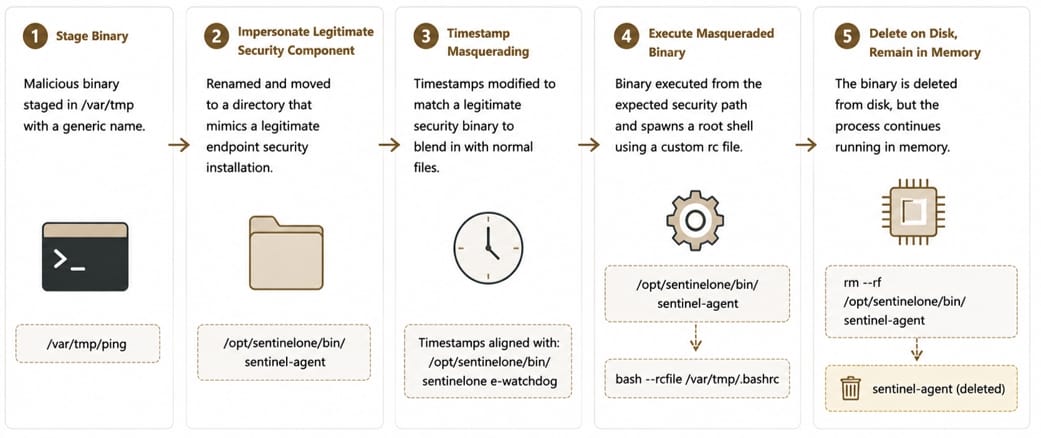
BridgeAgent persists as a root-level systemd service, providing the attackers with a persistent foothold on the host. It supports encrypted TLS reverse shells and allows for the remote execution of additional payloads. By hiding in plain sight—masquerading as a process that administrators expect to see on their servers—the attackers significantly reduce the likelihood of discovery during manual audits.
Evasion Techniques
Fire Ant’s commitment to stealth extends to the systematic tampering of evidence. The group goes to great lengths to:
- Suppress Syslog Messages: By selectively silencing logs, the attackers prevent administrators from seeing alerts related to the GRE tunnel or suspicious outbound Telnet connections.
- Log Tampering and Timestamp Manipulation: The group routinely alters file timestamps (
timestomping) to obscure the timeline of their activities, making it difficult for investigators to perform accurate incident reconstruction. - Interactive Shells without Logging: The malware provides the actors with an interactive command-line interface that operates entirely outside the scope of traditional audit logging, ensuring that the specific commands issued during an intrusion are never recorded.
Comparative Intelligence: Fire Ant vs. UNC3886
The tactics, techniques, and procedures (TTPs) observed in the Fire Ant campaign show a strong, undeniable overlap with UNC3886, a Chinese-linked espionage group previously documented by Google. However, Sygnia’s report notes critical nuances that suggest Fire Ant may be a distinct entity or a highly evolved branch of the same group. Differences in file paths, specific implementation details of the malware, and naming conventions suggest that while the "DNA" of the operation matches known Chinese APT activity, the specific tooling has been customized for this current campaign.
.jpg)
Implications for Critical Infrastructure
The implications of the Fire Ant campaign are severe. When the very devices designed to secure and route traffic are turned against the network, the traditional "perimeter" defense model is rendered largely ineffective.
The Erosion of Trust
The shift from compromising hypervisors to core networking hardware is a strategic move to undermine the foundation of network trust. If an administrator cannot trust the logs, the configuration files, or the integrity of the routing hardware, the entire network must be considered compromised.
Detection Challenges
The report highlights a sobering reality: traditional prevention measures are often insufficient. According to broader security research, once an attacker gains valid credentials, they are blocked in less than 40% of instances. Because Fire Ant uses legitimate administrative tools and disguises its malware as common system services, the threshold for detection is extremely high.
.jpg)
Recommendations for Defensive Hardening
In light of these findings, Sygnia and other security experts advise a multi-layered approach to defense:
- Log Integrity Validation: Organizations must treat logs as untrusted. Logs should be forwarded to a secure, write-only logging server in real-time. If logs on the host do not match the logs on the central server, an investigation must be triggered immediately.
- Configuration Auditing: Periodically compare the running configuration of routers against the "known-good" version in the source-of-truth repository. Any discrepancy—even if it appears minor—should be investigated for signs of unauthorized GRE tunnels or hidden interfaces.
- Behavioral Monitoring: Move beyond static signatures. Monitor for unexpected outbound connections, particularly those originating from management or routing devices. Use network-level monitoring to detect traffic patterns that deviate from the known baseline.
- Forensic Hygiene: Implement strict access control for management interfaces. Use multi-factor authentication (MFA) for all administrative access, and ensure that legacy protocols like Telnet are entirely disabled, as they are a primary vector for the lateral movement observed in this campaign.
- Leverage IoCs: Sygnia has provided an extensive list of Indicators of Compromise (IoCs) and YARA rules. Security teams are urged to incorporate these into their threat hunting programs to scan for historical evidence of the BridgeAgent or unauthorized GRE tunnels.
Conclusion
The "Fire Ant" campaign is a masterclass in modern, stealth-oriented espionage. By targeting the "plumbing" of the internet—the routers and switches that connect our digital world—the actors have demonstrated that they are capable of operating with near-total invisibility for extended periods. As the lines between legitimate administrative activity and malicious intent continue to blur, the burden of defense shifts toward deeper, more granular visibility and a healthy, persistent skepticism of the very infrastructure that keeps our networks running. Organizations must recognize that in the modern threat landscape, the most dangerous intruder is the one that has already become part of the system.

 Ali Ikhwan
 Sagoh
Sagoh