Lina Hope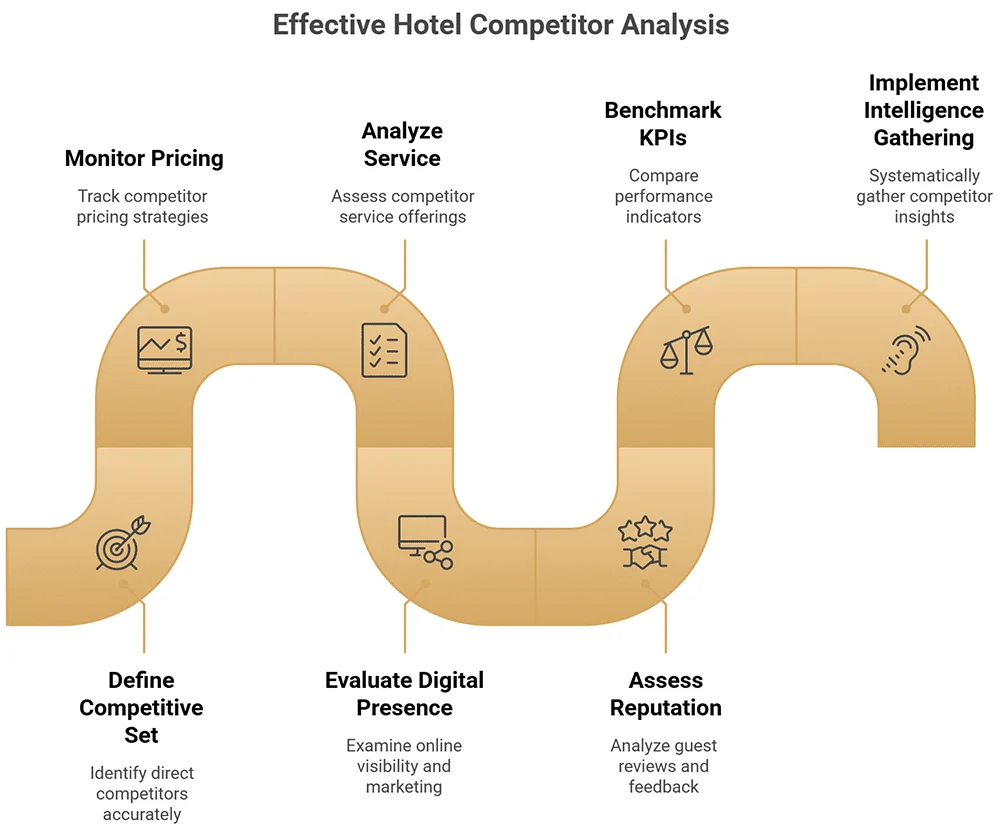
In the high-stakes world of hospitality, remaining stationary is equivalent to moving backward. For hoteliers, success is no longer defined solely by internal performance; it is fundamentally linked to how well a property performs against its immediate rivals. Hotel competitor analysis has evolved from a simple pricing check into a sophisticated, cross-disciplinary intelligence operation. By systematically evaluating the strengths, weaknesses, and market positioning of rival properties, hoteliers can unlock the strategic foresight required to optimize revenue, refine marketing efforts, and elevate the guest experience.
What is Hotel Competitor Analysis?
At its core, hotel competitor analysis is a structured, data-driven process of evaluating competing accommodation properties. It goes far beyond merely checking a rival’s room rates on an Online Travel Agency (OTA). It is an exhaustive assessment of a competitor’s pricing models, service standards, amenity packages, marketing strategies, and digital reputation.
This hospitality research discipline allows management teams to build a 360-degree view of their market position. By identifying what competitors are doing right—and where they are failing—hoteliers can pinpoint gaps in the local market. Whether it is a lack of high-speed Wi-Fi in the neighborhood or a failure of local rivals to capture the business-traveler segment, this analysis turns raw data into actionable market intelligence.
Why Competitor Analysis is the Bedrock of Modern Revenue Strategy
In an era where market conditions shift overnight, traditional revenue management is insufficient. Modern hoteliers must adopt a cross-disciplinary approach that aligns sales, marketing, and operations.
1. Strategic Decision-Making
Data provides the evidence needed to justify changes in room rates, package offerings, and capital investments. When you know exactly how your competitors respond to demand surges, you can adjust your own pricing strategy proactively rather than reactively.

2. Identifying Market Gaps
Through thorough analysis, hoteliers can identify "underserved" niches. If your primary competitor is struggling with poor guest sentiment regarding breakfast quality, your hotel can leverage that weakness by positioning your own culinary offerings as a core unique selling proposition (USP).
3. Rapid Adaptation
The emergence of new technologies—such as contactless check-in or AI-driven chatbots—can disrupt the market. Competitive intelligence allows you to spot these trends in real-time, ensuring you don’t fall behind the curve while your rivals modernize their guest journeys.
The 7 Pillars of Hotel Competitor Analysis
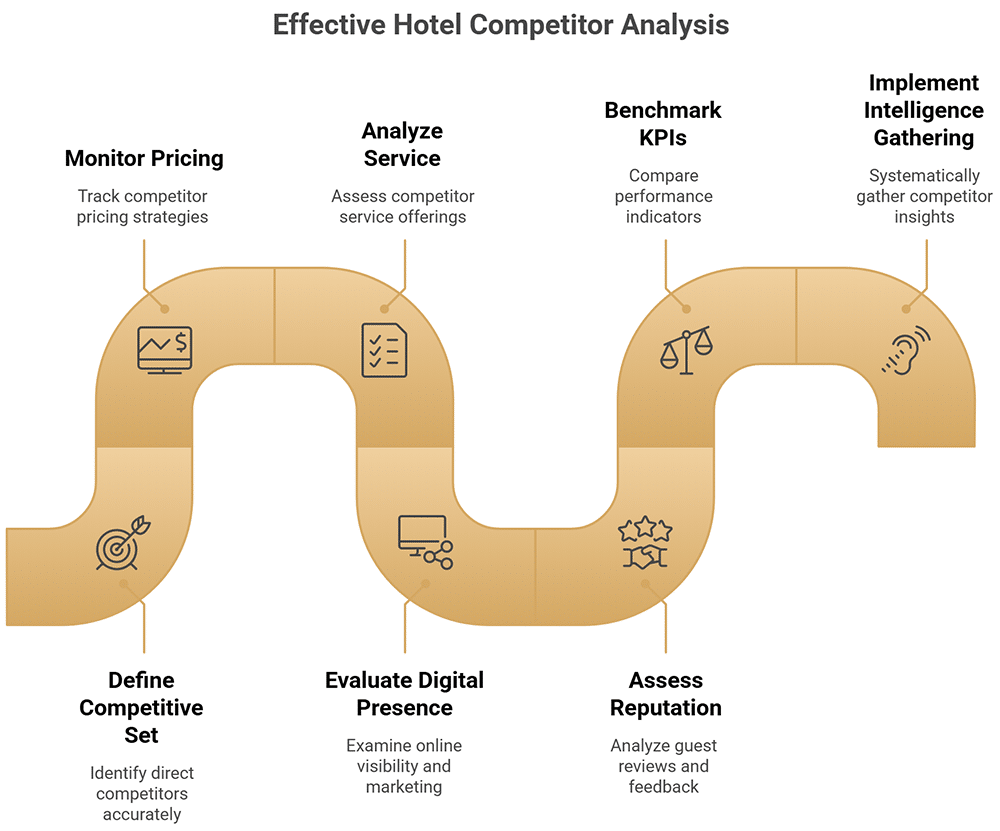
A comprehensive analysis must be broken down into actionable metrics. The following seven areas provide the framework for a high-performing competitive audit:
- Pricing Models & Rate Parity: Monitoring rates across all distribution channels to ensure you are capturing your fair share of demand.
- Service & Amenity Offerings: Evaluating the "in-room" and "on-property" experience, including wellness programs, family-friendly perks, and technology amenities.
- Digital Presence & SEO: Assessing how competitors rank on search engines for local keywords and evaluating the effectiveness of their social media and content marketing.
- Guest Sentiment & Reputation: Utilizing sentiment analysis to decode what guests are saying on TripAdvisor, Google, and Booking.com.
- KPI Benchmarking: Tracking core performance metrics such as RevPAR (Revenue Per Available Room), ADR (Average Daily Rate), and Occupancy.
- Distribution Channel Strategy: Identifying which platforms your competitors prioritize and how they manage their inventory across various OTAs.
- Staff & Operational Intelligence: Gathering frontline insights from staff interactions with guests who have recently stayed at competing properties.
The Evolution of the Competitive Set
The first step in any analysis is defining your "Comp Set." A common mistake is to pick the most prestigious, high-end hotel in the city simply because you aspire to be like them. However, if that property operates in a different price tier or targets a different demographic, the data will be skewed.
The Golden Rule: Your competitive set should consist of 5 to 10 properties that compete directly for the same guest, at the same price point, with similar service levels. Once defined, this set must be reviewed annually. If a competitor undergoes a major renovation or changes its brand positioning, your analysis must evolve accordingly.

How Artificial Intelligence is Changing the Game
The integration of Artificial Intelligence (AI) has shifted competitor analysis from a manual, time-consuming chore to an automated, high-speed advantage.
AI-Powered Rate Intelligence
Modern rate-shopping tools like Lighthouse or RateGain use machine learning to scan hundreds of distribution channels simultaneously. These systems can predict competitor pricing behavior during demand surges, allowing your revenue management system (RMS) to adjust rates before the market reaches capacity.
Sentiment Analysis via Natural Language Processing (NLP)
Instead of manually reading thousands of reviews, NLP algorithms can now scan review platforms and categorize feedback by "service dimensions." A manager can instantly see, for instance, that a competitor is receiving consistently poor marks for "check-in speed" or "noise levels." This allows for rapid, targeted improvements to your own service delivery.
Predictive Modeling
AI-driven systems now incorporate macroeconomic data, local event calendars, and flight search patterns to create predictive models. By analyzing these signals, hotels can forecast competitive pressure days or weeks in advance. As Stan van Roij of Infor Hospitality notes: "AI separates valuable data from irrelevant information, enabling more precise modeling of guest behavior and competitive positioning."
Common Pitfalls and How to Avoid Them
Even with the best tools, hoteliers often fall into traps that render their analysis ineffective.
- The "Copycat" Syndrome: Many hotels blindly mimic competitor pricing. This is dangerous because it ignores your unique cost structure and brand identity. Always ask: Is this tactic aligned with my hotel’s goals?
- Ignoring Qualitative Data: Focusing only on RevPAR and ADR provides a "what," but not a "why." Always pair quantitative KPIs with guest sentiment analysis to understand the human behavior driving the numbers.
- Overlooking Indirect Competitors: In the current market, your biggest threat might not be the hotel down the street, but a collection of high-end Airbnb rentals or a nearby serviced apartment complex. Ensure your analysis captures the broader "alternative accommodation" landscape.
The Global Outlook: A Softer Trading Environment
As we look toward the mid-2020s, the economic climate suggests a more normalized, slower growth trajectory. With forecasts for moderate RevPAR growth, the "easy wins" are disappearing. In a tighter market, the margin of error decreases significantly.
Urban centers and major travel hubs are showing resilience, bolstered by the return of business and group travel. However, for independent hotels, survival will depend on precision. A 1% improvement in online reputation or a sharper, more data-informed pricing strategy can be the difference between profit and loss.
Conclusion: Turning Data into Action
Hotel competitor analysis is not an end in itself; it is a means to achieve market leadership. By systematically gathering intelligence on pricing, service, and sentiment, you can pivot your business to meet the changing needs of your guests.
As the industry faces challenges ranging from labor shortages to evolving sustainability requirements, those who master the art of competitive intelligence will be the ones who maintain their edge. Whether you are using advanced AI tools or traditional benchmarking, the goal remains the same: understand your environment, know your worth, and execute your strategy with confidence.
Quick Reference: Checklist for Success
- Weekly: Monitor pricing parity and rate fluctuations.
- Monthly: Conduct a deep dive into guest sentiment and review scores.
- Quarterly: Audit your Competitive Set to ensure it still reflects current market realities.
- Annually: Evaluate your overall strategic positioning against long-term industry trends.
For further insights on maximizing revenue and optimizing your hotel’s operational efficiency, visit the Revfine knowledge platform—your dedicated resource for the latest in hospitality innovation.


 Ammar Sabilarrohman
 Rifan Muazin