Rifan Muazin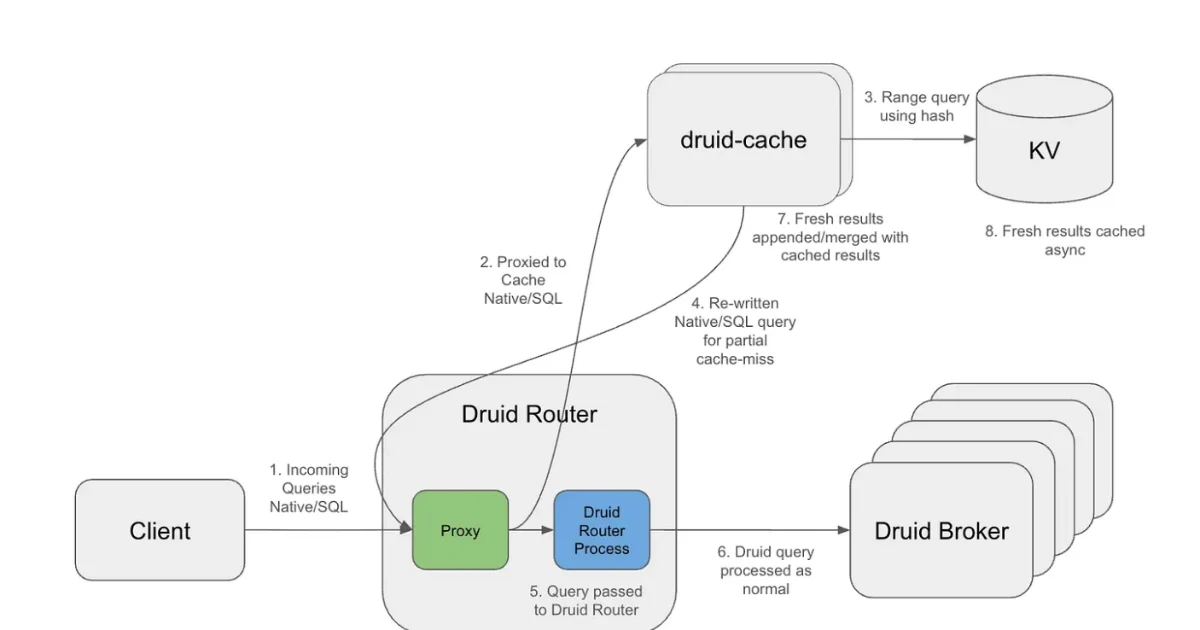
In the high-stakes world of streaming entertainment, data is the lifeblood of decision-making. At Netflix, where operational monitoring, user experimentation, and content performance tracking occur at a staggering scale, the ability to derive insights from data in real-time is not just a competitive advantage—it is an architectural necessity. Recently, the engineering team at Netflix unveiled a sophisticated solution to a pervasive bottleneck in their Apache Druid environment: the inefficiency of rolling window dashboard queries. By implementing a novel "interval-aware" caching strategy, Netflix has successfully reduced query load by 33% and achieved an 84% cache hit rate, fundamentally changing how the company handles massive-scale time-series analytics.
The Bottleneck of Rolling Window Dashboards
Apache Druid is a powerhouse designed for high-performance, real-time analytics. However, even the most robust systems encounter friction when tasked with the repetitive nature of modern dashboarding. Netflix’s internal dashboards, which monitor everything from server health to subscriber engagement metrics, rely heavily on "sliding" or "rolling" time windows.
A typical dashboard query might ask for the "error rate in the last three hours." As time progresses, the dashboard automatically refreshes, shifting that three-hour window forward by seconds or minutes. To a traditional database or standard caching layer, these shifting timestamps represent entirely unique, discrete queries. Even if 99% of the underlying data—the historical two hours and 59 minutes—remains identical to the previous request, the system is forced to re-scan, aggregate, and compute the entire dataset again.
At Netflix’s scale, where Druid processes upwards of 10 trillion rows, this "redundant computation" problem is not merely a minor inefficiency; it is a significant drain on CPU resources, memory, and network throughput. Every time a dashboard refreshes, the system wastes valuable cycles re-calculating results that have already been generated, creating a bottleneck that hinders performance and escalates operational costs.
Decoding the Strategy: How Interval-Aware Caching Works
To solve this, Netflix engineers introduced a layer of intelligence between the dashboarding tools and the Druid cluster. Instead of caching the final, monolithic query result—which is brittle and highly sensitive to time-boundary shifts—the new system decomposes queries into "time-aligned segments."
The Mechanics of Decomposition
The architecture functions as an external proxy that intercepts incoming queries. When a request arrives, the proxy separates the query’s structural definition (the metric being measured, the filters applied) from the time interval. It then maps the requested timeframe into fixed, granular "buckets."
By storing intermediate aggregates for these fixed intervals rather than the complete query output, the system creates a modular library of data. When a dashboard requests data for a rolling window:
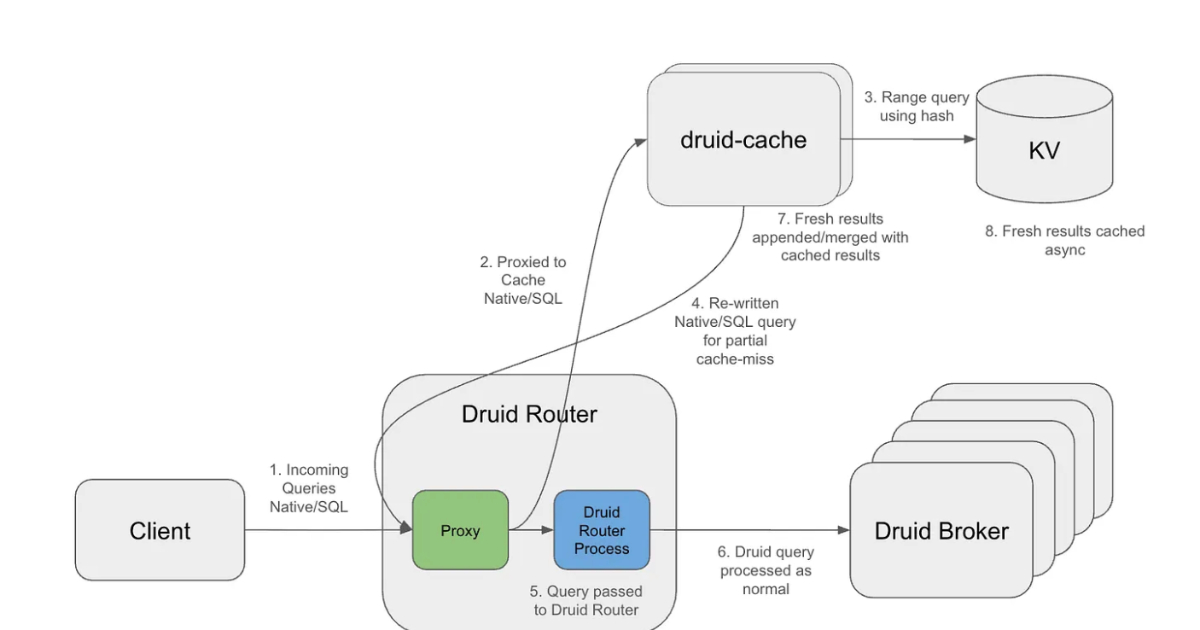
- Reuse: The system identifies which historical buckets have already been computed and cached.
- Compute: The system calculates only the "delta"—the most recent, un-cached time interval.
- Merge: The proxy merges the pre-computed historical segments with the newly computed recent data to present a seamless result to the user.
This approach transforms a heavy, redundant computation task into a lightweight "stitch and serve" operation.
Chronology of the Innovation
The shift toward interval-aware caching did not happen overnight. It was the result of a concerted effort to address the performance degradation that accompanied Netflix’s growth.
- Phase 1: Identification. Engineers identified that the P90 latency—the time it takes for 90% of queries to return—was being disproportionately impacted by the volume of near-identical rolling window queries.
- Phase 2: Architectural Prototyping. The team experimented with external caching proxies. They needed a solution that would be transparent to existing dashboarding tools while allowing for the granular storage of results.
- Phase 3: Implementation of Granular Bucketing. The transition to interval-based storage allowed for the use of exponential TTL (Time-to-Live) policies. Older data segments could be cached for longer periods, while newer segments—which are more volatile—were managed with shorter expiration cycles.
- Phase 4: Deployment and Refinement. Following successful internal testing, the system was rolled out as an experimental layer. The performance metrics were immediate, leading to the current optimization levels reported by the team.
Supporting Data and Performance Gains
The impact of this optimization on Netflix’s infrastructure has been profound. According to internal reports shared by Netflix engineers, the transition has yielded tangible, metrics-driven improvements:
- Query Load Reduction: The system now serves approximately 84% of all analytics results directly from the cache. This has resulted in a 33% reduction in the total number of queries hitting the primary Druid cluster.
- Latency Improvements: By offloading the heavy lifting, Netflix observed a 66% improvement in P90 query times, providing a significantly snappier experience for users monitoring live services.
- Efficiency Gains: In specific workloads, the system achieved a 14x reduction in total bytes returned. By avoiding the need to scan vast swathes of raw data for every dashboard refresh, the system drastically reduced the I/O pressure on the underlying Druid segments.
Evan King, Co-founder of Hello Interview, echoed the necessity of this work, noting on social media that traditional caches are fundamentally ill-equipped for time-series data because they fail to recognize that "most of the underlying data remains unchanged." Netflix’s solution turns this observation into a robust engineering paradigm.
Official Responses and Engineering Philosophy
Ben Sykes, a key engineer behind the initiative, emphasized the dual benefit of the system: it simultaneously eases the burden on the database while drastically improving the user experience. The engineering team’s philosophy is rooted in the idea of "not answering the same question twice."
This is not merely about saving electricity or reducing CPU usage; it is about architectural scalability. As Netflix continues to expand its content library and user base, the volume of telemetry data grows exponentially. Without strategies like interval-aware caching, the cost of scaling analytics would eventually become unsustainable. By decoupling the query structure from the time window, Netflix has created a flexible, modular architecture that can evolve alongside their data needs.
Implications for the Future of Analytics
The implications of Netflix’s work extend well beyond their own internal dashboards. The architecture provides a blueprint for any organization operating at a "big data" scale that relies on Apache Druid or similar OLAP (Online Analytical Processing) systems.
/filters:no_upscale()/news/2026/05/netflix-druid-interval-cache/en/resources/1Screenshot%202026-04-24%20at%209.46.21 PM-1777092444864.png)
1. The Shift to Proxy-Based Optimization
Netflix’s current implementation as an external proxy layer serves as a "bolt-on" solution. While this is effective, the company has signaled that this is not the final form of the project. The long-term vision involves tighter integration directly into the Apache Druid core. By baking interval-aware caching into the database’s query planner, the system could eliminate the overhead of the proxy entirely, allowing for even deeper optimizations in query execution.
2. Standardizing Templated SQL
One of the next major hurdles for the team is expanding support for templated SQL queries. Currently, many dashboarding tools generate complex, varying SQL expressions that can complicate the process of cache key generation. By standardizing these templates, Netflix aims to make the caching layer more ubiquitous across all internal reporting tools, further reducing the reliance on native Druid query expressions.
3. A New Standard for High-Velocity Data
The success of this strategy highlights a growing trend in software engineering: the movement away from "caching the result" toward "caching the process." In an era of real-time analytics, where data is constantly flowing and windows are constantly moving, the ability to break down complex queries into immutable, reusable parts is becoming a mandatory skill for platform engineers.
Conclusion
Netflix’s adoption of interval-aware caching is a masterclass in pragmatic engineering. By identifying a specific, high-frequency pain point and designing a targeted, modular solution, the team has managed to significantly boost the performance of a system processing over 10 trillion rows.
As the digital landscape demands faster and more accurate real-time insights, the techniques pioneered by the Netflix engineering team—specifically the decomposition of time-series queries—will likely become a standard pattern in the industry. For now, the experiment stands as a testament to the fact that even at the scale of a global streaming giant, the most significant performance gains are often found not by throwing more hardware at a problem, but by rethinking the way we structure our questions.


 Laily UPN
 Ammar Sabilarrohman